Fiery hearing shows stakes of Louisiana redistricting | Local Politics
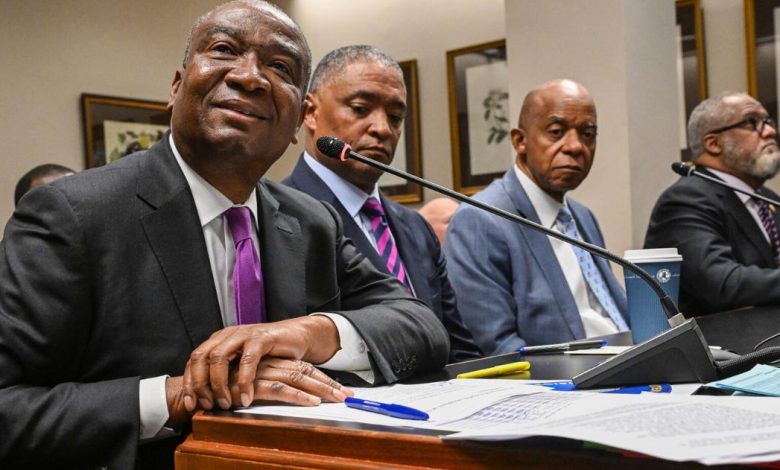
Over the course of more than 8 hours Friday, dozens of Louisiana residents demanded the state Legislature shut down a push to eliminate congressional districts held by African Americans.
The marathon hearing, which veered between solemn and fiery, showed the historic consequences of a redistricting battle inflamed by a recent U.S. Supreme Court ruling.
The high court substantially weakened the Voting Rights Act, telling lawmakers who draw voting maps they can’t take race into account when determining district lines. That opened the door to eliminate majority-Black congressional districts across the South.
Now, GOP lawmakers are poised to axe either one or both of Louisiana’s majority-Black congressional districts, which are represented by two Democrats. Louisiana has six U.S. House seats.
“This is not democracy. It is the deliberate dilution of Black political power,” said Keturah Butler-Reed, with the NAACP Youth and College Division. “The country is watching.”
Butler-Reed was just one of dozens of people, most of them Black, who traveled to the State Capitol to formally testify against the effort, chant in protest or watch the discussion.
Some who spoke to the Senate and Governmental Affairs Committee, which handles redistricting legislation, expressed indignation, frustration, anger and even fury, while others took a respectful tone.
Among the latter group were the only four Black congressmen who Louisiana has elected since Reconstruction: Current U.S. Reps. Troy Carter, D-New Orleans, and Cleo Fields, D-Baton Rouge, along with former Congressmen Cedric Richmond and William Jefferson, both of New Orleans.
The congressmen sat together and called on the Legislature to preserve two Black voting districts.
“A republic cannot survive if the people lose faith that their voices don’t matter,” Carter said. “We’re being tested, and the whole world is watching.”
Crowds gather outside the room chanting during a Senate & Governmental Affairs Committee meeting at the State Capitol on Friday, May 8, 2026. Staff photos by Javier Gallegos
Fields noted it took well over a century before Louisiana elected a Black person to Congress in the 1990s. He called Republican redistricting efforts “personal.”
State Sen. Gary Carter Jr., D-New Orleans, emphasized that point, saying, “Since the 1870s, these are the only four African-American congressmen from the state of Louisiana.”
He said the possibility of having one or even zero majority-Black districts in a state where one-third of the population is African-American was cause for anger and embarrassment.
“How can we not be outraged?” he said.
A short time later, that frustration surfaced again.
Hearing turns fiery
The first two hours of the hearing were relatively calm and orderly, but that changed briefly after two state senators clashed over accusations of racism inside the meeting room.
Sen. Jay Morris, a West Monroe Republican, is sponsoring legislation that will likely contain the new voting map. Carter pressed him on his motivation.
“You’re suggesting that I called you racist,” Carter, who is Black, told Morris, who is White. “What I’m suggesting is that we look at the body of your work this session. You are the only member of this body that has legislation that reduces significant African-American political power throughout the state of Louisiana.”
As Carter continued and became increasingly heated, Republican Sen. Caleb Kleinpeter, the committee chairman, attempted to pause the meeting, apparently further frustrating Carter.

Sen. Gary Carter Jr., D-New Orleans, is held back after he began shouting in opposition to Republican lawmakers who are poised to axe either one or both of Louisiana’s majority-Black congressional districts during a Senate & Governmental Affairs Committee meeting at the State Capitol on Friday, May 8, 2026. Staff photos by Javier Gallegos
“I don’t want a recess,” Carter exclaimed.
Kleinpeter cut off Carter’s microphone, but the New Orleans senator persisted: “He suggested he’s not racist. I said we take a look at his work.”
Morris moved to leave the committee room, which was filled with members of the public, some of whom apparently agreed with Carter and conveyed that fact to Morris. Morris responded as he was walking out, telling the people to “shut up.”
A brief verbal disagreement erupted inside the committee room.
Meanwhile, Carter’s comments also appeared to encourage observers who were listening and watching the meeting on video feeds outside of the committee room at the Capitol.
“Let him speak, let him speak, let him speak,” a crowd outside the door chanted, as some protestors attempted to barge in.
Security staff secured the room, and Kleinpeter called for order inside. After a few minutes, the uproar subsided and the committee reconvened.
‘Your grandchildren will see this’
The exchange between the senators was a kind of prelude to a cascade of at times fiery testimony from members of the public who decried GOP efforts to eliminate Black voting districts.
Leona Tate, a New Orleans civil rights activist who at age 6 helped desegregate schools in the South, was the first member of the general public to speak.
She called the Supreme Court’s recent decision “one of the most racist rulings in our nation’s history.”
Josiah Hardy, a 16-year-old who attends LSU Laboratory School, also spoke against the redistricting effort.
“As an African-American myself, I want to hold political offices in the future, but I cannot do so if my voice is diluted in a community that does not like me,” he said.
A number of people who testified called out legislators directly.
“I need every lawmaker in this chamber who supports these unfair maps to understand something clearly. History has its eyes on you. Your children will see this. Your grandchildren will see this,” said Diedra Meredith. “What is happening in Louisiana right now is not just politics, not just partisan decisions. It is the dismantling of Black voting power through racial gerrymandering.”

Protester Amanda Martello, facing the camera, chants “shut it down” along with dozens of other protesters who oppose redistricting that could axe majority-Black congressional districts outside of the Senate & Governmental Affairs Committee room during a meeting at the State Capitol on Friday, May 8, 2026. Staff photos by Javier Gallegos
Sarah Whittington, advocacy director of ACLU of Louisiana, told committee members if they adopt a map that reduces Black representation, “You will lose the moral authority to claim that you represent all Louisianans.”
Jordan Gonzales, of the Young Democrats of Louisiana, predicted Republicans will soon lose power after Democrats win at the ballot box in coming elections.
“I hope y’all do the right thing,” Gonzales said. “But if you don’t, good luck.”
Toward the end of the hearing, just a small handful of people spoke up in support of the redistricting effort, saying the Supreme Court was correct in deciding that race shouldn’t play a role in redistricting.
Christy Haik, a conservative activist, said she supported a proposed map that has no majority-Black districts.
“So many people here have expressed concern that moving away from race-based districting may diminish minority representation. But the Constitution requires equal treatment of voters,” she said. “This bill provides a constitutional map.”
Nationwide stakes
The public hearing is the first formal step in Louisiana’s effort to draw a new congressional map in the wake of last week’s U.S. Supreme Court ruling weakening the Voting Rights Act.
Louisiana lawmakers and legislatures in some other southern states immediately took action to redraw congressional maps, reducing the number of majority-Black districts that favor Democratic candidates and increasing the number of districts expected to elected Republicans.
The move has prompted public backlash by those who see the sudden redistricting efforts as an attack on Black voting rights and political representation.
President Donald Trump has pressured Republican-controlled states to draw new congressional maps that favor Republicans, helping the GOP retain power in Congress. A number of red states have done so, working quickly to adopt new maps in time for the November midterm elections.
Republican legislative leaders in Louisiana have said President Donald Trump has not contacted them about redistricting.
Credit: Source link