Global Big Pharma Merck’s stock price is soaring, revealing its strong presence in the U.S. stock ma..
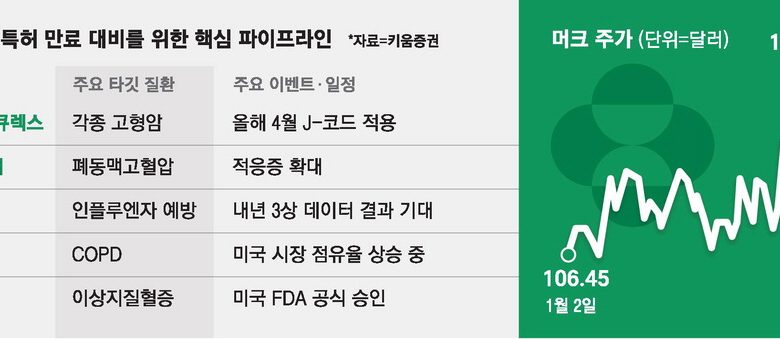
Global Big Pharma Merck’s stock price is soaring, revealing its strong presence in the U.S. stock market. This is because positive results have been made in the innovative new drug pipeline, attracting the attention of the market. Concerns that the blockbuster drug Keytruda patent will expire soon have been dispelled with new drugs, and global investors are also receiving favorable reviews.
Merck shares closed at $152.55 on the New York Stock Exchange on the 21st (local time), up $3.56 or 2.39% from the previous trading day. Merck set a new 52-week high, moving up to $154.49 during the day. The rise began when the personalized messenger ribonucleic acid (mRNA) cancer treatment Intismeran Autogen, which is being developed in collaboration with Moderna, had the world’s first significant effect in phase 3 clinical trials. In clinical trials of 1,137 high-risk melanoma patients, the survival period without recurrence of cancer or metastasis to other organs was significantly longer when administered in combination with Merck’s immuno-oncology drug Keytruda.
Inside and outside the market, mRNA cancer vaccines have opened a new horizon for next-generation precision chemotherapy. Global investment bank Morgan Stanley highly appreciated Merck’s growth potential, raising its investment opinion from Neutral to Overweight and raising its target price to $179 from $116 from the previous one.
Morgan Stanley analyst Terrence Flynn predicted in a report that “Merck’s next-generation new drug pipeline and capital allocation strategy will grow further, dispelling market concerns, even as the patent for Keytruda, a key anticancer drug, is nearing expiration.” In addition, Merck raised its price-to-earnings ratio (PER) target from 11 times to 17 times, saying that it is necessary to reevaluate the valuation (valued value) due to the commercialization of new drugs.
Merck has its roots in the world’s longest-running pharmaceutical and chemical company, which started in 1668 at a pharmacy in Darmstadt, Germany. After the establishment of the U.S. corporation in 1891, it was confiscated by the U.S. government during World War I and separated into a separate company, the U.S. Merck (MSD). Merck, which has continued research and development (R&D) since then, has made a new history in the pharmaceutical industry by launching the immuno-oncology drug Keytruda in 2014. Keytruda has established itself as the world’s top-selling drug, expanding its indication to dozens of carcinomas. Merck is also familiar to domestic investors by introducing human recombinant hyaluronidase (ALT-B4) technology from domestic biotechnology company Alteogen. It is strengthening its market dominance through formulation diversification, such as changing the existing intravenous (IV) formulation of Keytruda to a subcutaneous (SC) formulation.
However, there has been a limitation that the patent expiration of the existing blockbuster drug Keytruda will expire sequentially from 2028. As anticancer drugs account for more than half of Merck’s total sales, concerns have persisted over a huge sales gap due to biosimilar penetration when the patent expires. However, with the success of phase 3 clinical trials for mRNA cancer treatment, it is expected that Merck will highlight the strong defense and next-generation pipeline strategies that it is preparing to overcome.
Keytruda Curex (Keytruda SC) is by far the top defense card. It is expected to serve as a key shield for defending the challenges of biosimilars by quickly converting the existing IV formulation market to SC formulations even after the patent expires by maximizing convenience by reducing the patient’s administration time.
Lipendra (component name Enricitide), an oral PCSK9 inhibitor that was recently approved by the US Food and Drug Administration (FDA), is also considered another innovative new drug pipeline. Lipendra is a treatment for hypercholesterolemia and heterozygous familial hypercholesterolemia patients, and Merck has succeeded in formulating a pill that can be absorbed in the intestine by applying its own technology to maximize convenience. With the approval, Merck was evaluated as dominating the world’s first oral PCSK9 inhibitor market, beating its rival AstraZeneca.
[Reporter Hong Soon Bin]