Global stocks soar and oil prices drop as U.S., Iran reach tentative deal to end war
Listen to this article
Estimated 5 minutes
The audio version of this article is generated by AI-based technology. Mispronunciations can occur. We are working with our partners to continually review and improve the results.
Stock markets are rallying worldwide and oil prices are easing, after the United States and Iran reached a tentative deal to extend their ceasefire and reopen the Strait of Hormuz to get the global flow of crude going again.
The S&P 500 rose 1.7 per cent early Monday on hopes that this time, the announcement of an Iran-U.S. agreement will mean a long-term fix to a conflict that has sent prices up worldwide.
The Dow Jones Industrial Average was up 1.2 per cent as of 11:15 a.m. ET, and the Nasdaq composite was 2.7 per cent higher.
The TSX/S&P composite index, Canada’s main stock market index, rose about one per cent by midday.
Stocks got a lift after the price for a barrel of Brent crude oil (the international standard) fell 4.7 per cent to $83.25 US, back to where it was in early March.
While that’s still higher than its price of roughly $70 from before the war more than three months ago, it’s lower than the $100-plus it cost just a few weeks ago.
The hope is that lower oil prices will take pressure off households and businesses, which have had to pay higher prices for everything from food to fuel to fertilizer because of the supply crunch caused by the war with Iran.
Iran confirmed its agreement to a tentative deal but signalled that implementation would not start until a signing that Pakistan said would be held Friday in Switzerland. Broader negotiations on issues like Iran’s nuclear program are expected to continue over the next 60 days.
That leaves opportunity for hiccups that could derail the agreement. And even if the deal does reopen the Strait of Hormuz, it will take months for the energy industry to get back to full speed.
Energy experts said shipping and insurance companies will want to be confident the pact will hold, ensuring that oil and gas supplies will flow freely enough for the world’s needs to be met.

After more than six weeks of the de facto closure of the world’s most critical energy chokepoint, Iran said the Strait of Hormuz was “completely open” to ship traffic. But as Andrew Chang explains, a few key factors complicate how open the shipping route actually is, and how long the status quo might hold.
Images provided by The Canadian Press, Reuters and Getty Images
There have been a number of false starts to peace deals between the U.S. and Iran since the conflict began, according to Heather Exner-Pirot, energy director at the Ottawa-based Macdonald-Laurier Institute, who says any drop in oil markets could be short-lived if the deal breaks down.
“[It] is good news for sure, but this is definitely a conflict that’s been two steps forward, one step back,” Exner-Pirot told CBC News Network on Sunday.
“The cynics amongst us will be waiting for that one step back.”
Still, she said drivers could get a bit of a break soon, as prices at the pump could drop a little this week as long as the talks hold.
According to gas price tracking site GasBuddy.com, the average cost of a litre of gasoline across Canada is currently at $1.686 — that’s 2.1 cents less than last week’s average, but 32.4 cents higher compared to last year’s average.
For now, relief swept through financial markets worldwide.
On Wall Street, stocks of companies with big fuel bills were instant winners. United Airlines flew 5.2 per cent higher, American Airlines climbed 3.5 per cent and cruise operator Carnival rose 4.2 per cent.
Stocks of companies enmeshed in the artificial intelligence industry also jumped. These stocks have yo-yo’d sharply in recent weeks, going from roaring to records to suddenly turning lower. The big concern is whether such stocks shot too high, too fast because of AI mania, and their careening moves have sometimes reversed direction by the hour.
SpaceX, Elon Musk’s rocket company that also owns the AI company xAI, rose 7.9 per cent in its second day of trading on Wall Street. Its successful debut on the Nasdaq suggested plenty of demand still exists among investors for AI.
In the bond market, treasury yields eased on hopes that lower oil prices will remove pressure on central banks worldwide to raise interest rates. The yield on the 10-year treasury eased to 4.45 per cent from 4.48 per cent late Friday.
In stock markets abroad, indexes climbed in Asia and Europe.
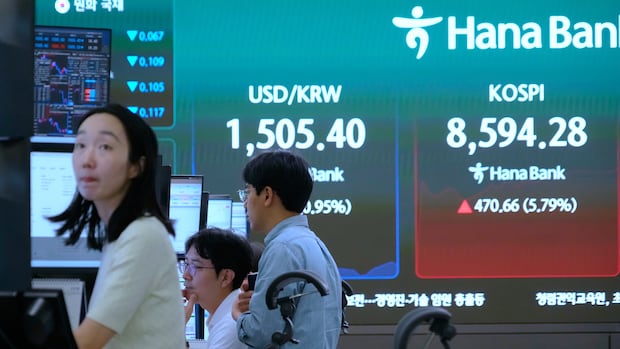
Japan’s Nikkei 225 jumped five per cent for one of the world’s biggest gains and finished at a record. South Korea’s Kospi surged even more, 5.2 per cent, thanks in part to continued rallies for AI winners like Samsung Electronics.
“This is great news,” said Takashi Hiroki, chief strategist at Monex. “Buying by foreign investors is leading the market with expectations of easing tensions around the situation in the Middle East. Then the decline in New York crude oil futures is supporting this positive market.”
London’s FTSE 100 was an outlier and slipped 0.4 per cent.