Gold Stocks Surge Sharply Across the Board as Market Rises Above the 4100 Point Mark

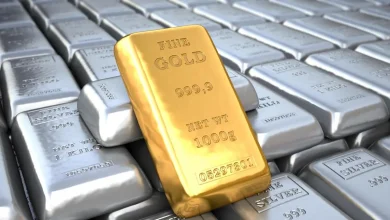
On August 5, spot gold surged sharply during the session, breaking through the $4100 per ounce mark, and gold-related sectors in both A-share and Hong Kong stock markets rose significantly.
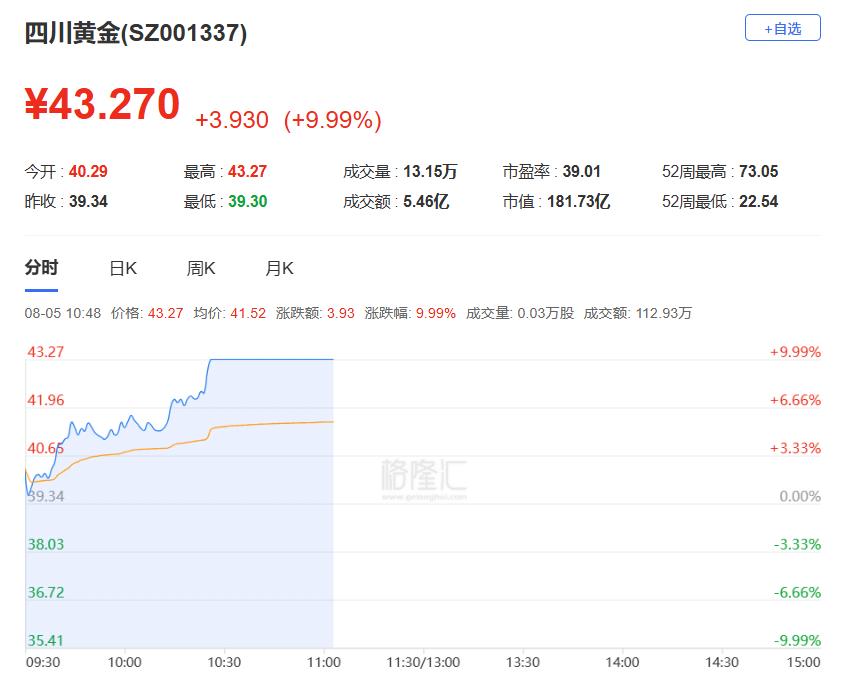
At the individual stock level, Sichuan Gold hit the daily 10% price limit, while Xiaocheng Technology, Zhuye Group, Shanjin International, Zhongjin Gold and other related stocks all saw strong upward movements.
Behind the sharp rise in gold prices lies a clear signal of easing tensions between the US and Iran.
The US side stated that an agreement to open the Strait of Hormuz may be reached with Iran as early as August 5.
The Strait of Hormuz is one of the world’s most important oil transportation corridors. In the past few months, the conflict between the US and Iran continued to escalate, and market concerns over disruptions to oil supplies kept growing.
Now that the situation has suddenly shifted to easing, it has directly triggered a sharp plunge in international oil prices, with Brent crude oil prices falling by more than 6% overnight.
Crude oil is the core vane of global inflation. The sharp drop in oil prices has significantly eased the upward pressure on energy inflation, prompting the market to lower the probability of subsequent interest rate hikes by the Federal Reserve.
After the situation eased, the probability of the Fed raising interest rates in September dropped from the previous 68% to 59%.
The cooling of interest rate hike expectations means that the opportunity cost of holding gold decreases, and the real yield of US Treasuries moves down accordingly.
It is under this chain of reactions that the valuation pressure on gold has been released, driving the gold price to move higher.
Looking at the situation on the Federal Reserve’s side, it also provides a favorable environment for the rise of gold prices.
The Federal Open Market Committee meeting at the end of July decided to keep interest rates unchanged at 3.5% to 3.75%, marking the fifth consecutive hold of policy rates this year.
However, the voting results of this meeting revealed internal rifts within the Fed: 9 voting members voted to keep interest rates unchanged, while 3 dissented and advocated for a 25 basis point rate hike, marking the first time since 2016 that three dissenting votes pointing in the same direction have appeared.
The three hawkish officials subsequently made a rare collective public statement to defend their stance in favor of rate hikes.
This divergence means that even if the Fed does not cut interest rates, further rate hikes will face growing internal resistance.
For gold, the marginal slowdown in the warming of rate hike expectations itself constitutes positive news.
Furthermore, although Fed Chairman Walsh delivered a neutral-to-hawkish tone, he also emphasized that the decline of inflation is a long-term process, and a single data point is not enough to confirm a downward trend.
In other words, the “ceiling” of tightening is becoming clearer, and the interest rate pressure on gold, as a non-interest-bearing asset, is weakening marginally.
Purchases by central banks also form a more solid medium and long-term support for gold.
The *Global Gold Demand Trends Report for Q2 2026* released by the World Gold Council on July 30 shows that global central banks’ net gold purchases in the second quarter reached 289 tons, a year-on-year surge of 62%.
The total global gold demand in the first half of the year reached 2522 tons, with a total value of about 380 billion US dollars, hitting an all-time high.
What is more noteworthy is a survey on global central bank gold reserves showing that 89% of the surveyed central banks expect global official gold reserves to rise further in the next 12 months.
On August 3, the Bank of Korea announced the restart of gold purchases, marking the first time the South Korean central bank has hoarded gold again in 13 years since it suspended such operations in February 2013.
In addition, the People’s Bank of China has also increased its gold holdings for 20 consecutive months.
At present, the stability of the US dollar credit anchor is weakening, driving the diversified reallocation of global reserve assets.
Against the backdrop of intensifying geopolitical risks and the continuous advancement of de-dollarization, the status of gold as the ultimate safe-haven asset is being reaffirmed by an increasing number of countries.
However, the rise of gold stocks is usually more elastic than the movement of gold prices themselves.
The cost of gold mining is relatively rigid, and most of the revenue increment brought by rising gold prices will be directly converted into profit increment. Therefore, the performance growth rate of gold mining enterprises usually significantly outpaces the increase rate of gold prices.
Coupled with the adjustments over the past nearly six months, the allocation cost-effectiveness of the gold sector has become relatively prominent.
However, short-term market fluctuations never follow a one-sided logic.
Even if the Strait of Hormuz is reopened, it will still take a considerable period of time for crude oil inventories to recover, and the tight supply of refined oil products such as diesel may continue to push up inflationary pressures.
The internal divergence within the Fed also means that there is still great uncertainty in the policy path, so short-term volatility will continue.
This article is from the WeChat official account “Gelonghui APP” (ID: hkguruclub), written by the editor of Gelonghui, and authorized for release by 36Kr.