Here’s how Europe can file for divorce from Donald Trump | Phillip Inman
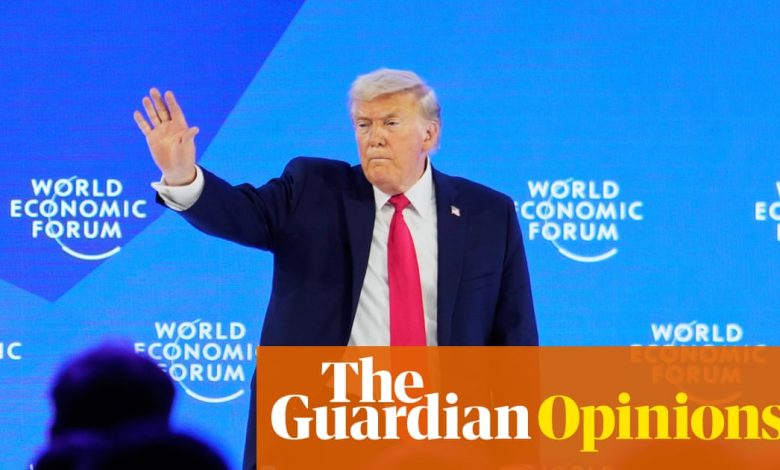
There is a way to file for divorce from Donald Trump and Europe needs to grab the opportunity.
To the public it will look as if nothing has changed. But behind the scenes the EU and the UK could close the joint bank account and cut up the credit cards, or at least set in motion a form of financial separation that limits the power of a controlling former partner.
It won’t be easy to walk away and it won’t be quick. But a degree of separation is necessary and, crucially, achievable.
As a tumultuous week in the Swiss Alps ends with a reprieve for Greenland and there is talk of a post-Davos peace deal for Ukraine, maybe some believe a mix of distraction and appeasement can placate the US president. Or that midterm elections in the US will lasso Trump and tame him permanently.
If only that were likely. What we know is that the breakdown of a post-second world war order is set in train – let’s face it, the signs have been flashing red since the 2008 financial crisis – and Washington’s next incumbent is likely to be just as belligerent when international rules constrain them.
There is some recognition in the shifting tectonic plates of international finance, which show a separation from the White House wrecking ball is on almost everyone’s mind.
The S&P 500 might say the opposite, sucking in, as it does, so much international money that its rise seems unstoppable. In other financial markets, the reverse is true.
For instance, China has spent the past year reducing its US government bond holdings. In other words, it has cut the amount it lends to the US government via the bond markets. Japanese pension funds have done the same.
In part their policy is driven by the fear of a stock market crash now that US share prices are at highs not seen since the dotcom bubble at the turn of the century. What is fantastic today could bring tears tomorrow, so those who lend must take a more cautious view and hedge against disaster.
China and Japan are also selling up because they have trouble at home, encouraging them to repatriate or redirect their foreign investments, but that is a different, if connected, story.
The ongoing leaching away of bond investors means the cost of US government borrowing has begun to rise, little by little. If Europe were to begin instituting a financial divorce, it too would start selling the US bonds it holds.
This week a fearless and spirited pension scheme – the main retirement fund for Danish academics – provided a glimpse of what could be the norm.
The AkademikerPension said it would sell all remaining US government bonds in its multibillion-pound fund by the end of the month. The investment director Anders Schelde made the announcement as Trump was still threatening to invade Greenland.
“The decision is rooted in the poor US government finances,” he said. “Thus, it is not directly related to the ongoing rift between the US and Europe, but of course that didn’t make it more difficult to take the decision.”
The holding is small, at $100m (£73m). Nevertheless, its impact as a beacon to others could be huge.
European regulators could help by making it easier for other pension funds to sell their US bond holdings. Some experts believe pension funds slavishly followed credit rating agency verdicts. And while most agencies downgraded the US last year, they still say it is a safe bet.
It should be remembered that credit ratings agencies were at the heart of the 2008 crash. They said the financial products containing US sub-prime mortgages were safe. They weren’t.
If pension funds can consider US debt to be more at risk, they can reduce their holdings. There is a cost, there always is, to a reduction rather than a Danish-style clear-out, which is that the bonds remaining in any portfolio are worth less. And the more pension funds sell, the lower the value goes.
But there is a gain, just as there is to the Danish, of a less risky portfolio once the number and value of US bonds is reduced.
Europeans could also lend to themselves, if Brussels created a market for bonds denominated in euros. This would create a rival market to US Treasury bonds, offering an alternative safe haven that would drain the US market even further.
As a proposal it dates back to a 2010 document from the Bruegel thinktank, which it recently updated. Since then the EU has corralled its disparate members to agree one-off eurobonds, most recently the borrowing that underpinned its post-Covid €385bn (£334bn) NextGenerationEU recovery scheme.
Like previous schemes it was a one-off. As Bruegel and more recently the Peterson Institute have argued, there needs to be a permanent market that could begin to rival the US and others. The opportunity is ripe. Funds across the world are looking for safe havens and Europe could be one of those places.
Brussels could start with a coalition of the willing rather than all 28 countries. It could reluctantly admit that much of the money would be generated by banks in London, which hosts bond markets that run deeper and wider than anything on the continent.
And why would that be a problem? Politicians in Berlin, Amsterdam, Dublin and maybe even Paris want the UK to be pulled closer to the EU. If there is more money to be made, then resistance on both sides of the Channel could ebb away.
And if there is a degree of insulation from Trump’s threats of financial punishment from Europeans creating their own debt market, in their own currency, then all the better.