India-US Trade Deal: Market Winners
Earlier in the week, the Dalal Street rejoiced at US President Donald Trump and subsequently Prime Minister Narendra Modi’s announcement of an India-US trade deal, with the Indian benchmarks, Nifty 50 and Sensex, rising sharply, and most textile stocks, in particular, ralling up to 20%. However, there was still a bit of underlying uncertainty as the agreement wasn’t completely made official.
That bit of uncertainty is now finally gone, with the White House confirming the deal on Saturday morning by releasing the fine print, which confirmed the US will indeed be lowering tariffs to 18% for key sectors in India, in exchange for receiving a $500 million export boost from New Delhi, among other benefits.
These finer details may have a significant impact on the stock market, with many sectors now finally finding some ground to breathe following an elongated period of trade uncertainty.
Reciprocal Tariff Slashed To 18%: Who Will Benefit?
The reduction of the reciprocal tariff to 18% could go a long way in aiding major export businesses in India and level the playing field for them when it comes to competing against other regions in the world.
The most apparent impact could be in the textile and apparel sector, with many of the players such as Indo Count, Kitex Garments, Pearl Global and Gokaldas Exports being heavily exposed to revenues from the US market.
The reduction of tariffs could also serve as a boost for the leather and footwear industry, with Mirza International and Mayur Uniquoters emerging as key beneficiaries.
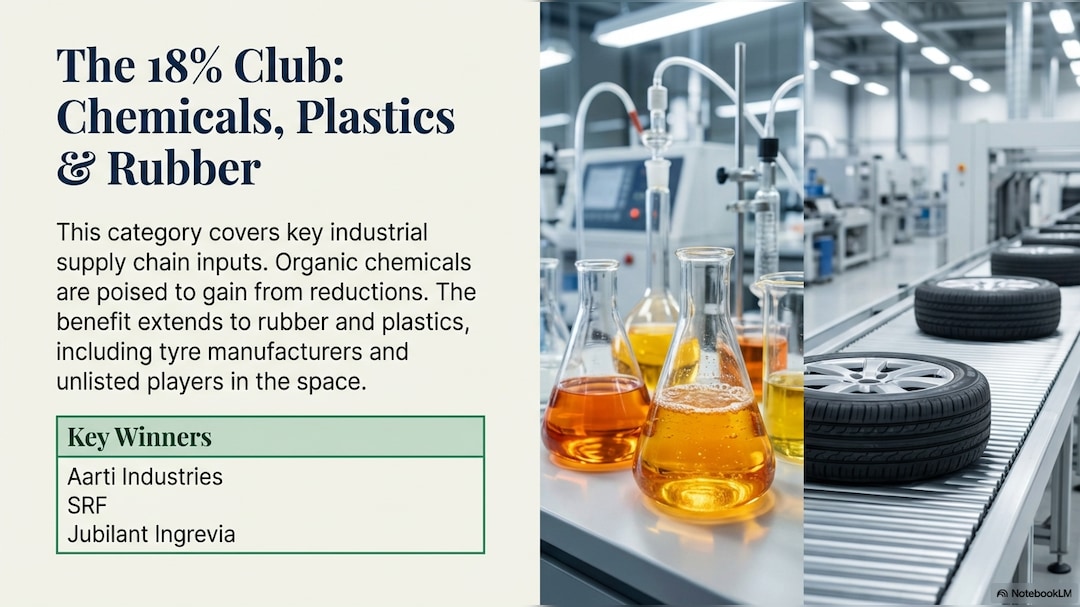
Plastic and rubber products, including tyre stocks and even largely unlisted players in this space, are poised to gain from the reductions as well. The same can be said for the organic chemicals industry, with Aarti Industries, SRF and Jubilant Ingrevia emerging as key beneficiaries.
A few other key sectors to be impacted include home decor and artisanal products, with Stanley Fashion and Shaily Engineering being the potential beneficiaries.
ALSO READ: Cheaper Scotch, Bourbon Soon: Premium Alcohol Prices Set to Drop 40% After US, EU Trade Deals
Zero Tariffs For These Sectors
While most sectors will attract a 18% reciprocal tariffs, there are certain exemptions that are put in place to protect India’s high value exports businesses.
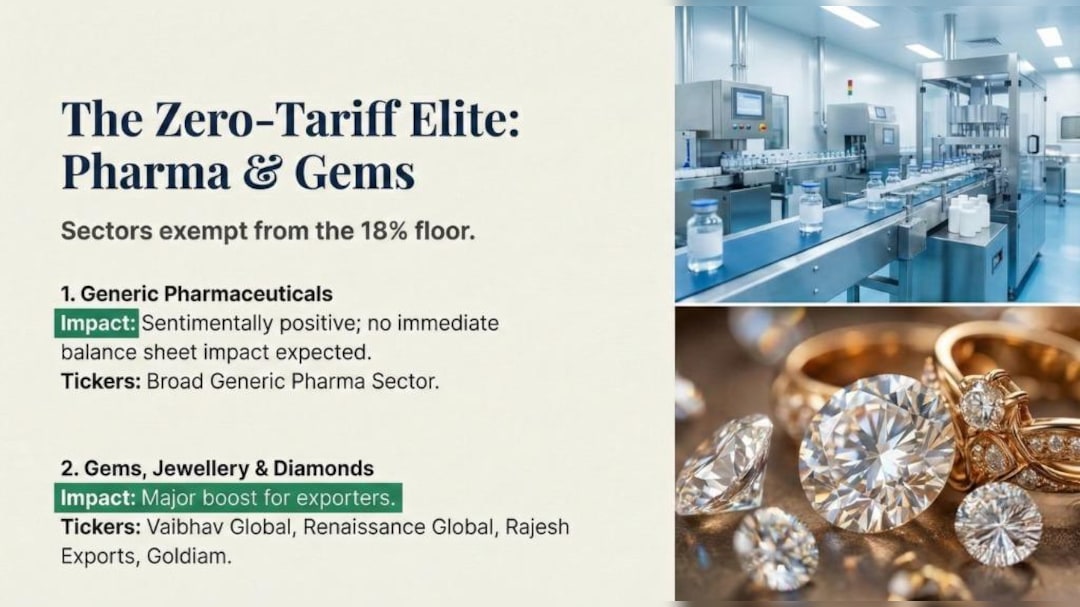
This list is led by the generic pharmaceutical space. Although the move won’t have any balance sheet impact, it is sentimentally quite positive for pharma stocks.
The same stands for gems and jewellery as well as diamonds, thus acting as a major boost for stocks such as Vaibhav Global, Renaissance Global, Rajesh Exports and Goldiam.
Another sector added to the tariff exemption is aircraft parts, which is a positive for Dynamatic Tech, HAL and MTAR Tech.
Tariff Rate Quota On Auto Parts
While the deal is expected to aid most businesses, tariffs have been kept at a base rate for auto components or parts, which doesn’t bode well for the sector’s key players.
These include Sona BLW and Motherson Sumi, among others. This has been listed as part of the Section 232 exemptions.
Tariff Reduction On US Products
Dried distillers’ grains (DDGs), red sorghum for animal feed, tree nuts, fresh and processed fruit, soybean oil, wine and spirits are some of the products which will invite significant tariff reduction on India’s part.
That means all these products are set to become much more affordable for an Indian consumer, including wine and spirits. This is a net negative for liquor companies that delve into either wines, such as Sula Vineyards or premium-level products.
What Will India Buy From USA?
India intends to purchase $500 billion of U.S. energy products, aircraft and aircraft parts, precious metals, technology products, and coking coal over the next 5 years.
India also plans to trade in technology products, including Graphics Processing Units (GPUs) and other goods used in data centres. This is positive for E2E Network, Netweb, Anant Raj, Aurion Pro Solutions and even Rashi Peripherals.
Meanwhile, there are safeguards in place to protect Indian dairy from foreign dairy products, which is a positive for Hatsun Agri, Dodla Dairy, Parag Milk Foods, as well as certain FMCG stocks.
What Are Brokerages Saying?
Antique has released a note to investors in which the brokerage firm has stated that India’s stoppage of the import of Russian oil has not been mentioned at all in the joint note shared by the two countries.
Antique believes the deal could be a bit open-ended, although if India does indeed stop Russian oil imports, it would be a net negative for oil marketing companies.
“Overall, I think it’s not a certainty that India will stop Russian oil. It’s open-ended. A total halt, if it happens, would be negative for the OMCs but more importantly would be significantly bullish for the international oil prices,” the note read.
A Story In Infographics: India-US Trade Deal Simplified — Behind Modi And Trump’s Mega Pact
Essential Business Intelligence,
Continuous LIVE TV,
Sharp Market Insights,
Practical Personal Finance Advice and
Latest Stories — On NDTV Profit.