Japan to Launch Crypto Asset ETFs as Early as Next Year, Russia to Impose Personal Income Tax on Crypto Transactions and Top10 News

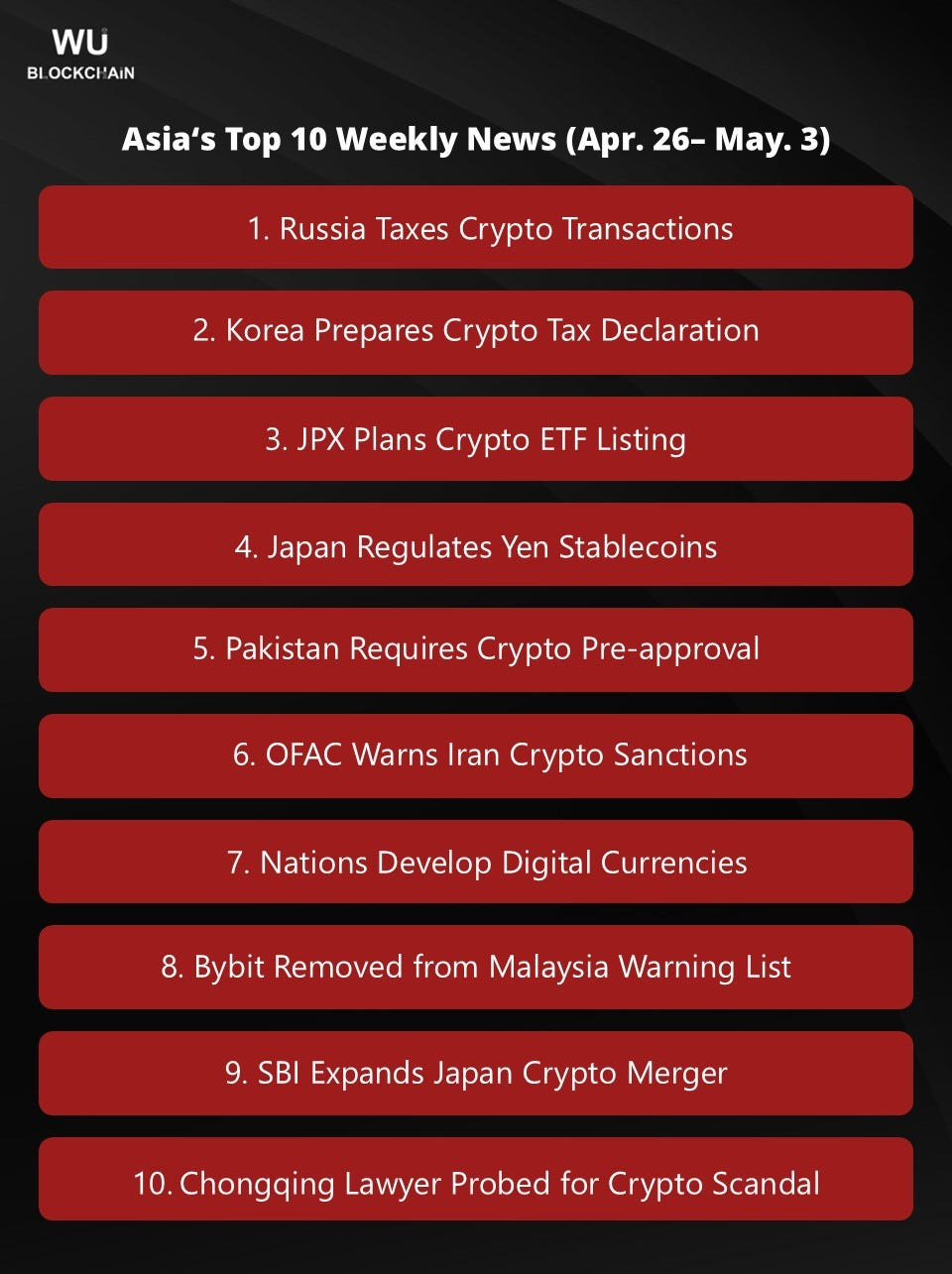
1. Russia’s Government Commission Approves Finance Ministry Proposal to Impose Personal Income Tax on Crypto Transactions link
The Russian Government’s Legislative Activities Commission has approved a Ministry of Finance proposal to impose personal income tax (PIT) on earnings from digital currency transactions, including crypto exchange trades. The draft stipulates that costs be calculated using the FIFO (First-In, First-Out) method and prohibits carrying forward crypto trading losses to offset future tax periods. It also proposes VAT exemptions for services provided by digital depositories and crypto exchangers, as well as certain foreign digital rights transactions without physical delivery.
2. South Korea’s National Tax Service Prepares for Virtual Asset Tax Filing, Set to Launch First Comprehensive Income Tax Declaration in 2028 link
South Korea’s National Tax Service has officially begun preparations for taxing virtual assets, with implementation set to start next January. In accordance with legal requirements, the authority is securing data from virtual asset exchanges and building an integrated analysis system to ensure the smooth launch of the first comprehensive income tax filing for virtual assets in May 2028. Under the current Income Tax Act, gains from the transfer and lending of virtual assets will be classified as “other income” starting January 1 next year. A 22% tax rate including local income tax will apply to annual gains exceeding 2.5 million Korean won.
3. JPX Plans to Advance Crypto Asset ETF Listings, Potentially Launching as Early as Next Year link
Japan Exchange Group (JPX) CEO Hiromi Yamaji stated that following the amendment of crypto asset-related laws and clarification of tax treatment, JPX will prepare for the listing of crypto asset ETFs. The launch could come as early as 2027, or be delayed to 2028 depending on legislative progress.
4. Japan Clarifies Regulatory Framework for Yen Stablecoins; JPYC Classified Under Fund Transfer Business Regulations link
Japan’s Financial Services Agency (FSA) officially designated JPYC, Japan’s first yen stablecoin issuer, as a fund transfer service provider for the first time in its April publication Access FSA. FSA officials noted that economically, JPYC serves the same fund transfer function as payment services such as PayPay and Rakuten Pay. Users purchase JPYC with Japanese yen, and the stablecoin can later be redeemed for yen by final holders. Under current Japanese law, exchange transactions are primarily handled by banks and fund transfer service providers. JPYC is required to maintain full user asset protection of no less than 100% under the applicable regulatory framework.
5. Pakistan’s Regulator Mandates Prior Approval for All Virtual Asset Operations link
Pakistan’s Virtual Assets Regulatory Authority (PVARA) has issued a regulatory advisory stating that, under the Virtual Assets Act 2026, providing virtual asset-related services in Pakistan — including stablecoins, cross-border payments, and tokenization — requires prior regulatory approval.
The announcement emphasizes that publicly announcing partnerships or pilot projects without prior consultation may expose entities to compliance and FATF risks, and such initiatives may not proceed legally. Stakeholders are urged to apply for authorization in advance through official regulatory channels.

Sponsored by FinTax
6. US OFAC Warns of Sanctions Over Digital Asset Payments as “Tolls” to Iran link
The U.S. Department of the Treasury’s Office of Foreign Assets Control (OFAC) issued a warning to the shipping industry that paying tolls to the Iranian regime for safe passage through the Strait of Hormuz will incur sanctions risks. The notice explicitly noted that Iran may demand such payments in forms including digital assets and fiat currencies. The U.S. Treasury stated it will take direct sanctions against entities supporting Iran’s military and urged maritime service providers to enhance targeted due diligence.
7. Over 130 Countries Are Developing Digital Currencies, Potentially Undermining the US Dollar’s Role in Cross-Border Payments link
More than 130 countries are currently developing their own digital currencies, which can be used for cross-border payments in the future and may affect the stability of the US dollar as the world’s major reserve currency. The article focuses on how central bank digital currencies (CBDCs) and new digital fiat currencies are transforming cross-border settlement. Data from the Atlantic Council CBDC Tracker shows that 137 countries and monetary unions are currently exploring CBDCs, covering 98% of the global GDP, among which 72 are in advanced stages including development, pilot or official launch.
8. Bybit Removed from Malaysia Securities Commission Investor Alert List and Invests in Licensed Local Platform Hata link
Bybit CEO Ben Zhou posted on X that Bybit has been removed from the investor alert list of Malaysia’s Securities Commission (SC). Previously, Bybit conducted constructive communications with local regulators and aligned with local regulatory requirements. In addition, Bybit recently led the investment in Hata, a Malaysian dual-licensed crypto platform. Ben stated that regulated local infrastructure is crucial for the long-term development of the industry and user trust, and Malaysia remains an important market for crypto adoption in the region.
9. SBI Accelerates Consolidation of Japanese Crypto Exchanges, Set to Acquire bitbank Following BITPoint Merger link
SBI is holding discussions with cryptocurrency exchange Bitbank over capital and business cooperation. The deal aims to make Bitbank a consolidated subsidiary of SBI, and the company plans to acquire its shares upon completion of due diligence and internal procedures.
10. Peng Jing, Director of Chongqing Jingsheng Law Firm, Taken Into Custody, Allegedly Involved in Stablecoin Bribery and Money Laundering Case Linked to Hu Henghua and Luo Lin link
Peng Jing, founding partner and director of Chongqing Jingsheng Law Firm, has recently been taken in by relevant authorities. Previously, Hu Henghua, Mayor of Chongqing, was reported to be under investigation on March 20, 2026. Subsequently, Luo Lin, Member of the Standing Committee of the Chongqing Municipal Party Committee and Secretary of the Liangjiang New Area Party Working Committee, was announced to have fallen from power on April 17. According to sources in Chongqing’s political and business circles, the downfalls of Hu Henghua and Luo Lin both involve bribery and money laundering through stablecoins, and Peng Jing is alleged to be a key figure suspected of facilitating money laundering under the guise of collecting “legal fees.” Sources reveal that in the case involving Hu Henghua, Lin Kechuang, the son-in-law of Lin Xiucheng, allegedly paid Hu 30.8 million USDT (approximately 210 million RMB), of which 10 million USDT was a handling fee for currency conversion. After seizing Hu’s cold wallet, authorities further discovered the flow of funds from six other cold wallets held by Lin Kechuang, with one transaction of 15.5 million USDT allegedly transferred to Luo Lin. Luo Lin was taken in on April 14, and the cold wallet he had concealed with a third party has since been recovered.
Follow us
Twitter: https://twitter.com/WuBlockchain
Telegram: https://t.me/wublockchainenglish