London’s Silver Is Running Out of Room
(www.investorideas.com
Newswire) Silver Price Analysis article from Przemyslaw K. Radomski.
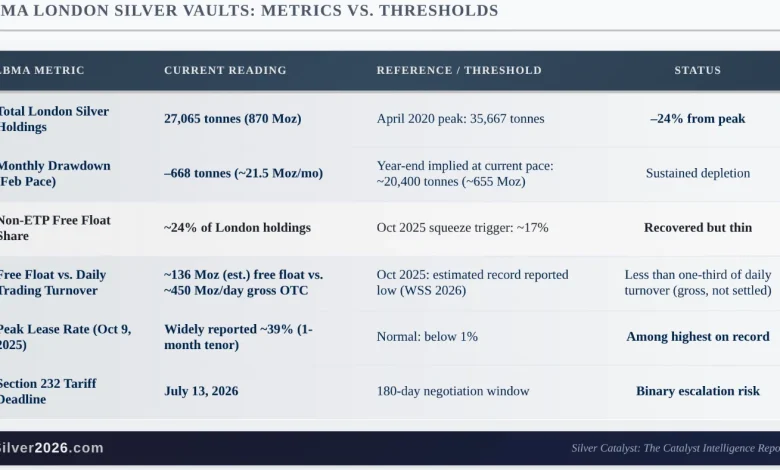
27,065 tonnes in London’s vaults sounds like a large number. The
World Silver Survey 2026 just confirmed it is not.
In October 2025, silver lease rates (the cost of borrowing physical
silver for short periods) spiked to levels widely reported at around
39%, among the highest on record. The normal rate is below 1%. A
market that, by all appearances, had felt well supplied for years
had suddenly become one where metal appeared impossible to source.
The squeeze lasted weeks, drove silver to the January 2026 all-time
high of $121.67, and then eased as metal flowed back into London
from New York.
The World Silver Survey 2026, released on April 15, provides the
most authoritative account of what actually happened and why it
matters that the conditions which caused it have not fundamentally
changed.
I covered the stagflation data in the first article from this issue, and the COMEX delivery clock in the second. This article covers a third force: the physical silver market in
London, and why the most authoritative annual data source in the
silver market describes the current environment as “the era of
virtually unlimited silver liquidity is gone.”
There are eight Deep Dives in this week’s premium Silver Catalyst issue, and in this article, I’ll focus on one of them.
COMEX Sets the Price. London Moves the Metal.
To understand why London vault levels matter to silver investors, it
helps to understand what London actually is in this market.
COMEX in New York is the primary futures exchange: where price
discovery happens, where traders go long and short, where the paper
price is set. The LBMA in London is the primary physical OTC market:
where large-scale silver is actually transferred between banks,
refiners, ETPs, industrial users, and sovereign entities. The two
markets are linked but separate. COMEX plays a central role in price
discovery, while London is the primary hub for physical OTC
transactions.
When London’s available physical inventory tightens, the ability of
market participants to source metal on short notice diminishes.
Lease rates spike. The gap between the paper price and the cost of
actually obtaining physical silver widens. That is not a theoretical
dynamic; it is what happened in October 2025, and the World Silver
Survey 2026 now gives us the full picture of how thin the market had
become before it did.
What the World Silver Survey 2026 Confirms
The WSS 2026 documents that by end-September 2025, the silver
genuinely available for day-to-day OTC operations and leasing in
London (the “free float”: not allocated to ETPs, not backing
structured products) had fallen to an estimated ~136 Moz (a record reported low per the WSS 2026) (4,234 tonnes).
That number needs context to land properly. Daily OTC trading
turnover in the London market averaged approximately 450 Moz per day in 2025, according to LBMA data cited in the World Silver
Survey 2026. This reflects gross trading activity, not physical
settlement volumes. The free float was less than one-third of a
single average day’s trading turnover, though this compares a stock
against a flow — the point is that the available buffer was
very small relative to normal market activity.
The squeeze that followed was triggered by a surge in Indian demand
in October. The WSS 2026 describes it precisely: “The squeeze that
ensued became self-fulfilling, as shorts had to cover and were
forced to pay unprecedented rates for near-term liquidity. A market
that a year earlier felt well supplied had become one where metal
appeared impossible to source.”
What caused the free float to shrink so dramatically before October?
Three forces converging simultaneously:
First, global deficits. Five consecutive years of demand exceeding
supply drew down above-ground stocks steadily. The WSS 2026 confirms
the 2025 deficit at 40.3 Moz, the fifth consecutive shortfall.
Second, tariff-driven arbitrage. Concerns about potential US tariffs
on silver saw approximately 225 Moz flow from London into CME vaults
between December 2024 and early October 2025. London’s pool shrank
as New York’s swelled.
Third, ETP growth. Strong inflows into silver ETPs meant that an
ever-larger share of London’s headline inventory was allocated and
inaccessible. By end-September 2025, physically backed products
accounted for 83% of London inventories, leaving only 17% genuinely
available for market operations.
Where Things Stand Now
The acute October stress has passed. Metal flowed back into London;
lease rates have fallen from their 39% peak to approximately
2–3% by mid-Q1 2026, and lower since. The WSS 2026 notes the
market “feels similar to historical norms” at the time of writing.
The February 2026 LBMA vault data, the most current snapshot
available, shows total London holdings of 27,065 tonnes (870 Moz), down from 894.4 Moz at end-2025. The non-ETP share has recovered
to approximately 24% of London holdings, well above the 17% that
triggered October’s squeeze.
Sources: LBMA — London Vault Data, through February 2026 | Silver Institute / Metals Focus — World Silver Survey
2026 | Investing.com — Silver lease rates October 9, 2025 (widely
reported ~39%) | White & Case — Section 232 deadline analysis
The WSS 2026’s own assessment is worth quoting directly in its
substance: the market has clearly entered an era of reduced stocks.
Tightness will not be constant, but liquidity will generally be
thinner, lease rates more volatile, and price moves likely to be
larger than investors have grown used to.
The crucial point is that the structural conditions that made
October possible (persistent deficits drawing down global stocks,
ETP growth locking up an ever-larger share of London’s inventory,
and a tariff threat that could re-trigger New York arbitrage at any
moment) have not been resolved.
The July 13 Risk
One forward-looking factor that the newsletter covers in this issue
deserves mention here: the Section 232 bilateral agreement deadline
falls on July 13, 2026, the 180-day window from the January 14
critical minerals proclamation. If negotiations are deemed
insufficient, new tariffs on silver imports become the default
outcome.
The WSS 2026 confirms that tariff fears drove the Q4 2024 to October
2025 London-to-New York arbitrage that depleted London’s free float
to record lows. London is already 24% below its 2020 peak. A second
arbitrage-driven drain arriving at this lower starting level would
encounter a much thinner buffer than October 2025 did.
This connects directly to Catalyst #58: London Bullion Market Stress Indicators from “Silver Rising”, which identified the combination of
declining London inventory, rising ETP allocation, and external
shock risk as the mechanism for acute physical market stress.
October 2025 was the first activation. The WSS 2026 confirms that
the underlying conditions remain structurally present.
The Outlook
Silver trades near $78.10 as of April 23, approximately 36% below
the January 29 all-time high of $121.67. The Hormuz blockade remains
in force; Iran has stated it will not reopen the strait while the US
Navy continues intercepting vessels, though ceasefire talks are
ongoing.
The physical market in London is not in acute stress today. The WSS
2026 confirms conditions have normalised since October. But
normalised does not mean resolved. The projected sixth consecutive
annual deficit of 46.3 Moz for 2026 continues drawing down the
global inventory buffer. The free float share, at 24%, is above the
October trigger level, though the trigger level itself is not a
fixed number. It depends on demand. A reactivation of the
tariff-driven arbitrage, or another surge in Indian physical demand,
or both, could compress it faster than the market currently prices.
The full Silver Catalyst Issue #13 covers seven more Deep Dives beyond this one: the
stagflation thesis confirmed in March CPI at 3.3%, the Hormuz
blockade and the new mining cost floor it creates, the COMEX
inventory situation with May delivery First Notice Day approaching,
the 64% semiconductor revenue surge and its industrial silver
implications, the Section 301 trade investigation and tariff risk to
Mexico’s 185–200 Moz annual supply, the Samsung solid-state
battery commercial deployment timeline, and the Warsh Fed
confirmation delay and the fiscal dominance argument for why this
inflation is structurally difficult to contain. For anyone
tracking silver’s performance throughout 2026 as these dynamics develop, I encourage you to get “Silver Rising” with complimentary 2-week access to the
Silver Catalyst newsletter.
Thank you.
The Silver Engineer
Investorideas.com
is the go-to platform for big investing ideas. From breaking stock
news to top-rated investing podcasts, we cover it all.
Mining stocks -Learn more about our news, PR and social media,
podcast and content services at Investorideas.com