Only 1 % Of Physical Stores Accept Crypto, ECB Survey Shows
20h05 ▪
6
min read ▪ by
Crypto aims to become a means of payment like any other. In the eurozone, it is still far from it. In a large survey conducted by the European Central Bank (ECB), it is noted that, even in the case of sector development followed by the entry into force of the MiCA regulation, crypto payments remain marginal at the merchant level. Consumers are still attached to traditional payment channels while businesses show reluctance to take the plunge. This gap persists between the ambitions of the crypto industry and actual usage. Will European regulation be enough to shift the lines?
In Brief
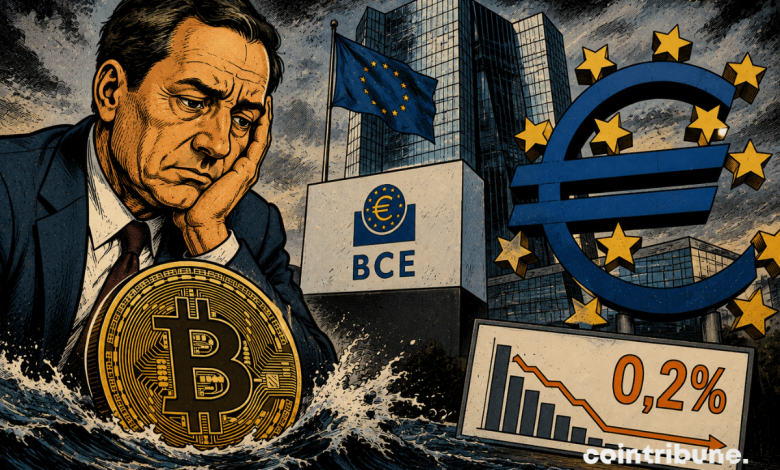
- A study by the European Central Bank conducted with 8,205 companies reveals that acceptance of cryptocurrencies remains extremely marginal in Europe, standing at only 0.2% for online commerce and 1% in physical stores.
- Cash and bank cards maintain overwhelming dominance in the market, supported by the ECB’s explicit intention to preserve access to cash despite the rise of digital and mobile payments.
- This merchant lag persists despite the recognized economic advantages of blockchain and the entry into force of the MiCA regulatory framework, which offers unprecedented legal certainty to industry players.
- Without the deployment of simple integration tools by payment processors, crypto-assets risk remaining confined in Europe to a role of store of value or speculative investment.
The hegemony of cash and traditional means versus the marginality of cryptos
In all eurozone countries, a survey was conducted with 8,205 companies. The results published by the European Central Bank allow for an unyielding assessment of the importance of digital currencies in daily commercial payments. It emerges that only 0.2% of the companies surveyed accept cryptos or stablecoins as a means of payment for online purchases. This number increases slightly in physical points of sale but remains limited to a modest 1%.
By comparison, traditional payment channels maintain overwhelming dominance. Cash remains the most widely accepted solution, present in 92% of physical stores, closely followed by bank cards at 88%. Meanwhile, mobile payment solutions are experiencing impressive growth, rising from 36% in 2024 to 68% in 2026.
This statistical snapshot highlights the resilience of traditional payment methods, especially in a context of growing automation of points of sale. The ECB has wanted to mark its institutional reservation for the preservation of cash in the face of the rapid expansion of self-service payment points and digital commerce.
The monetary institution indeed emphasized: “it is vital to ensure that growing payment automation neither inadvertently hampers nor weakens cash as a viable payment option, to ensure widespread acceptance of cash.” This reminder shows the authorities’ vigilance to preserve cash accessibility, relegating alternative currencies to the periphery of everyday commercial exchanges. The key data from this study thus re-establish the real hierarchy of payment uses within the commercial fabric of the eurozone :
- Online cryptos : 0.2% acceptance by eurozone companies ;
- Physical cryptos : 1% adoption in points of sale ;
- Cash : 92% acceptance in physical commerce, maintaining its dominant position ;
- Bank cards : 88% acceptance by physical merchants ;
- Mobile payments : a clear surge, climbing from 36% in 2024 to 68% in 2026.
The inertia of European payment processors despite the regulatory springboard of MiCA
Beyond consumers’ clear preference for cash, the adoption delay also comes from the weakness of the financial intermediary infrastructure. Even if a majority of financial institutions see the direct economic interest of cryptos, especially to remove intermediaries and strongly reduce transaction fees, on-chain analysis reveals that European payment processors struggle to implement these advantages in commercial life. This lack of initiative is surprising, especially since the full application of the MiCA regulatory framework was precisely intended to remove the legal uncertainty that had so far blocked investments and the launch of adapted payment solutions.
This situation seems even more strange as ecosystem experts point out that European rules now offer all necessary guarantees to encourage institutional innovation. Speaking about this evolution, Mark Aruliah, Head of EMEA Policy and Regulatory Affairs at Elliptic, recalled that with the MiCA framework now in place, payment processors can confidently develop compliant crypto payment solutions adapted to the European market.
Perspectives of a European market caught between strict compliance and usage revolution
Despite this green light regarding the rules, a large gap remains between the existence of a secured legal framework and the availability of simple tools for merchants. This prevents Europe from competing with the adoption level seen in some emerging markets.
Thus, this gap between the continent’s regulatory maturity and actual merchant usage fundamentally raises questions about the future role of cryptos within the European financial landscape. If the theoretical promise of faster and cheaper transactions remains intact, the absence of smooth acceptance tools perfectly integrated with existing terminals continues to constrain the market.
The continuation of this transition will depend on the ability of technological players to transform the compliance base offered by MiCA into ergonomic mass-market products. Without this accessibility effort, cryptos risk persistently retaining their status as reserve or speculative assets in Europe, leaving mobile payments and public currencies with the monopoly on daily transactions.
Maximize your Cointribune experience with our “Read to Earn” program! For every article you read, earn points and access exclusive rewards. Sign up now and start earning benefits.

Diplômé de Sciences Po Toulouse et titulaire d’une certification consultant blockchain délivrée par Alyra, j’ai rejoint l’aventure Cointribune en 2019.
Convaincu du potentiel de la blockchain pour transformer de nombreux secteurs de l’économie, j’ai pris l’engagement de sensibiliser et d’informer le grand public sur cet écosystème en constante évolution. Mon objectif est de permettre à chacun de mieux comprendre la blockchain et de saisir les opportunités qu’elle offre. Je m’efforce chaque jour de fournir une analyse objective de l’actualité, de décrypter les tendances du marché, de relayer les dernières innovations technologiques et de mettre en perspective les enjeux économiques et sociétaux de cette révolution en marche.
DISCLAIMER
The views, thoughts, and opinions expressed in this article belong solely to the author, and should not be taken as investment advice. Do your own research before taking any investment decisions.