Power Metallic CEO sees low costs despite lower first tonnage at Lion in Quebec
Power Metallic Mines (TSXV: PNPN; US-OTC: PNPNF) CEO Terry Lynch says the first resource at its Lion polymetallic deposit in Quebec came in lighter than expected, but development costs should be low. The stock fell.
The initial estimate contains 4.15 million indicated tonnes grading 1.68% copper, 2.61 grams palladium per tonne, 0.85 gram platinum, 0.49 gram gold, 12.21 grams silver and 0.1% nickel, the company said on Tuesday. Contained metal is 153.1 million lb. copper, 348,000 oz. palladium, 114,000 oz. platinum, 64,000 oz. gold, 1.63 million oz. silver and 9 million lb. nickel.
The resource also held 601,000 inferred tonnes grading 1.84% copper, 2.86 grams palladium, 0.59 gram platinum, 0.41 gram gold, 12.47 grams silver and 0.13% nickel, containing 24.4 million lb. copper, 55,000 oz. palladium, 11,000 oz. platinum, 8,000 oz. gold, 241,000 oz. silver and 1.7 million lb. nickel.
Lynch said the tonnage shortfall against earlier expectations partly reflected tighter infill drilling and a more detailed understanding of Lion’s geometry. Some mineralization the company expected to fall inside the resource didn’t survive the final modelling because of changes in thickness, density and the way the deposit was blocked out.
“The expectations were the tonnage would be higher, and so when that didn’t hit, certain traders sold their positions,” Lynch said during a conference call with investors. “We’re moving from the arm waving of Terry to the reality of data.”
Shares in Power Metallic fell 14% on Tuesday in Toronto to $1.31 apiece, valuing the company at $341 million. They’ve traded in a 52-week range of 76¢ to $1.73.
Analyst
Red Cloud Securities analyst Ron Stewart characterized the resource announcement as “neutral to slightly negative,” saying Lion came in lighter than expected even though its grade was strong. Red Cloud calculated the combined Lion and Nisk resource at about 9.5 million tonnes, including 6.8 million indicated and 2.6 million inferred tonnes, grading an average 3.25% copper equivalent for 677 million lb. contained copper equivalent.
A preliminary economic assessment targeted for the first half of 2027 is expected to examine an initial open pit at Lion followed by underground mining and the potential addition of feed from the nearby Nisk deposit.
Lynch said high grades, shallow mineralization and strong recoveries could keep development capital relatively low, less than $200 million (US$145 million) to put into production.
“That’s what I’ve seen from one of the analysts and that’s sort of the number we’ve worked at internally as well,” Lynch said on the call. “Shoot, would we like to have had more tonnage? Yes. Will we get there? I believe so.”
‘More modest’
Red Cloud’s Stewart said the two deposits could nevertheless support a modest-sized profitable operation because of their grades, metallurgy, geometry and infrastructure. Using its own metals assumptions, Red Cloud estimates the rock at Lion has an average gross metal value of US$416 per tonne, compared with US$244 per tonne at Nisk. It maintained a buy rating and $2.50 target on Power Metallic.
Red Cloud is compensated by Power Metallic to provide liquidity support and may trade the company’s shares as principal. It also performed investment banking services for Power Metallic during the past year, according to the research note’s disclosures.
Lynch said the lighter-than-expected tonnage helped explain selling in Power Metallic shares after the resource was released.
High recovery
About 2.78 million indicated tonnes of Lion are modelled for open-pit extraction at 1.47% copper, while another 1.36 million indicated tonnes underground grade 2.1% copper. Resource consultant SGS used cut-offs of 0.35% copper equivalent for open-pit material and 0.9% copper equivalent underground.
Metallurgy remains one of Lion’s stronger features. SGS locked-cycle testing recovered 98.9% of the copper from a blended composite into concentrate grading 25.8% copper. Palladium recovery was 93.9% and platinum recovery 96.8%.
Power Metallic has also held preliminary discussions with U.S. government agencies, including the Export-Import Bank, over potential support for Nisk-Lion, Lynch said. He said platinum and palladium may attract particular U.S. interest because supplies are concentrated in South Africa and Russia.
The company is working on an internal timeline that could see production start around 2032, although that remains well ahead of any formal development study.
“I think internally, in 2032 or something like that would be when we could get producing this thing,” Lynch said. “It’s a long ways out.”
Power Metallic is preparing to develop Lion itself rather than seek a buyer, although Lynch said the company would consider an exceptional takeover proposal.
“We’re not looking to sell,” Lynch said. “We’re very much approaching this as this is our project. We’re going to build it.”
Small plant
The company is also examining toll treatment and contract mining as it works towards the PEA. Management said the bigger constraint on reaching production may be completing environmental submissions on schedule rather than constructing what it expects to be a relatively compact processing plant.
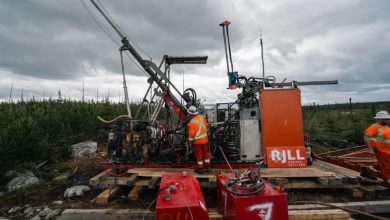
Lion has been modelled from surface to more than 600 metres vertical depth, but drilling completed since the April 19 resource cutoff isn’t included. Lynch said three holes have since tested the system to almost 900 metres, with assays expected by the end of September.
The company has previously reported high-grade drilling at Lion, including its best copper hit in March. The company holds 80% of Nisk, while Critical Elements Lithium (TSXV: CRE; US-OTC: CRECF) owns 20%.
Power Metallic also expects to update its Nasdaq application after filing the technical report supporting the resource, with Lynch saying the company hopes to secure an American depositary receipt listing in October or November.