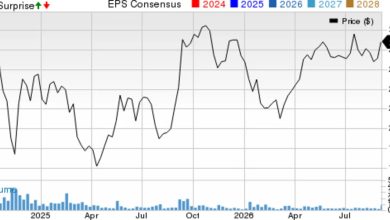
Q2 2026 earnings: GE Aerospace keeps the beat despite a few missed notes

Free to nonsubscribers
By Chris Sloan
July 16, 2026, © Leeham News: Even in the face of the conflict in Iran, GE Aerospace delivered an upside surprise: raising its full-year guidance based on strong commercial execution, rocketing aftermarket demand, higher engine deliveries, and improving MRO shop capacity.
The company also reported progress on the durability front, as it achieved extended engine time-on-wing while reducing turnaround times, underscoring continued improvement in CFM LEAP fleet reliability as it works through a backlog exceeding $210 billion. Profit margins took a hit, decreasing 130 basis points to 21.7% attributed to higher installed engine deliveries, investments (such as production ramps on the GE9X for the forthcoming 777-9), and inflation. The engine maker said this was expected, laying out plans to address the drop.
Chief executive Larry Culp described the period as “another quarter of significant growth, driven by robust commercial services” during the company’s second-quarter earnings call. He pointed to first-half engine deliveries that increased 31%, including a 41% jump in LEAP deliveries, while highlighting Copa Airlines’ selection of up to 120 LEAP-1B engines for up to 60 additional Boeing 737 MAXs. He also touted certification of the 1B durability kit, including the upgraded high-pressure turbine blade, which is expected to deliver roughly double the time on wing when it enters service early next year. Turnaround times for LEAP shop visits have fallen to about 100 days, down more than two weeks from a year ago, while the number of LEAP-powered aircraft grounded because of engine availability has fallen to nearly none. This is a significant advantage over the competing Pratt & Whitney geared turbofan (GTF) engines.
Rahul Ghai, GE Aerospace’s chief financial officer, told analysts that demand remains robust and production continues to improve. The company raised its outlook for LEAP deliveries to high-teens growth this year, up from the previous forecast of 15%, while widebody engine deliveries increased 30% in the quarter, led by significantly higher GEnX shipments, supporting the ramp-up of Boeing 787 deliveries. GE Aerospace slipped in that it received a $100 million tariff refund during the quarter but characterized the payment as “not extremely material” to the company’s overall financial performance.

Image from: GE Aerospace
Iran conflict tests demand resilience
The on-again, off-again war in Iran injected uncertainty into the air travel outlook during the second quarter, but GE Aerospace saw little evidence that the disruption changed airline strategies or weakened demand for engine services. Culp told analysts first-half departures were “roughly flat,” yet the company “did not observe any changes in customer behavior.” GE still expects departures to return to modest growth in the second half, while its commercial services backlog of roughly $170 billion provides a substantial cushion for aftermarket growth in 2026 and beyond.
That resilience was also evident at IATA’s Annual General Meeting in Rio de Janeiro. Culp recalled the prevailing view among airline leaders: “Let’s all remember that, as we saw in the pandemic, demand will return.” He added that carriers are increasingly focused on being ready for “the other side of the uncertainty,” rather than pulling back in the face of short-term volatility. GE Aerospace is taking the same approach. The company continues to invest, procure material, and push ahead with its Flight Deck business strategy, betting that robust demand and a deep backlog will outweigh near-term geopolitical shocks. Culp noted that demand has proved “far more resilient than maybe many of us would have expected,” giving GE greater confidence in the second half.
Years of services growth runway
Commercial services continued to be the beating heart of GE Aerospace earnings in the second quarter, but management’s rosy gaze extended well beyond this year’s results. With a commercial services backlog of roughly $170 billion and an installed fleet that continues to mature, executives see a long runway for profitable aftermarket growth stretching into the years ahead.
First half commercial services revenue increased 32% as work scopes became more intensive across both narrowbody and widebody engines. Culp argued the company has clear visibility into future demand as engines transition from early inspections into higher value overhauls and shop visits. “We do not have a demand problem,” he said, noting that much of the growth is tied to the natural aging of the installed base. About 70% of the GE90 fleet, for example, has yet to undergo its second shop visit—periods during which maintenance requirements, revenue, and profit drop—putting more dollars into company coffers.
Much of that demand is already baked into today’s installed base rather than dependent on future deliveries, Ghai said. Most engines entering service now will not require a shop visit before 2030, meaning the company’s aftermarket outlook is driven primarily by engines already flying. At the same time, GE expects its external services channel to grow from the mid-teens of its LEAP services portfolio today to about 30% by 2030, expanding capacity as maintenance demand accelerates.
The company is also working to lower the cost of every shop visit, a pain point with its customers. Ghai said GE expects to leverage fixed cost investments as maintenance volumes grow while expanding repair capability, which is increasing at more than a 20% compound annual rate this year. More repairs reduce turnaround times and shop visit costs, while a larger external services network further improves the business mix through the end of the decade.
LEAP will become an increasingly important contributor to the aftermarket as the installed fleet matures. “We know with LEAP becoming a larger part of the installed base, eclipsing the CFM56,” Culp said. Ghai added that LEAP services margins are improving and are expected to reach parity with the broader Commercial Engines & Services portfolio by 2028, gradually reducing the margin pressure associated with the engine’s rapid growth and ongoing operational challenges.

Image from: GE Aerospace
The CFM56 keeps delivering
More than four decades after its launch in the early 1980s, the legacy CFM56 remains one of GE Aerospace’s most valuable assets. Although CFM International delivered the last commercial CFM56-7B engines in June 2019, nearly 28,000 CFM56 engines remain in service today, making it the world’s largest commercial engine fleet and what many consider the most reliable, robust, and durable airliner engine ever built. Demand shows little sign of slowing. Culp noted that the number of parked CFM56-powered aircraft has declined since March, while the company’s maintenance network is “oversubscribed” as airlines compete for shop capacity. Ghai said GE now expects CFM56 shop visits to finish at the upper end of its annual guidance of 2,300-2,400 visits.
Perhaps the biggest surprise is how much maintenance demand still lies ahead. About 30% of the global CFM56 fleet has yet to undergo its first shop visit, Culp observed, while roughly two-thirds have not reached their second overhaul. “We think about CFM56 as the older platform it is,” he said, “but as we work through the next several years, I think we’ll see those engines come back.”
For GE, the opportunity is less about expanding work scopes than about executing more of the work already in front of it. Ghai said improved material availability has enabled the company to complete heavier maintenance events that previously stalled waiting for parts, lifting revenue per shop visit through better volume, pricing, and execution. With retirements remaining low and more engines requiring life-limited part upgrades, he expects CFM56 work scopes to remain stable through at least 2028 or 2029.
Balancing pricing and pushback
As maintenance demand continues to outstrip available capacity, GE Aerospace is carefully balancing higher MRO pricing with the financial pressures facing airline customers.
“We clearly recognize that, but I think at the same time, the airlines have also recognized a lot of price,” Ghai told analysts, noting that carriers have largely maintained their profitability despite higher maintenance costs. He argued that GE’s pricing reflects the value it is adding through investments in repair capability, technology, and MRO capacity while helping offset the inflationary pressures affecting the business.
That approach is expected to continue into 2026. Ghai said the company’s spare parts pricing strategy will remain consistent with this year’s strategy as it continues to invest across its services network and expand capabilities for airline customers.
Looking further ahead, GE expects additional pricing gains as LEAP and GEnX move beyond their initial launch-phase pricing and higher-value shop visits begin flowing through the MRO network. Ghai said those larger dollar shop visits should start contributing to revenue around 2028 or 2029, supporting LEAP’s progression toward CFM56-level profitability by 2030.
Durability improvements LEAP ahead
The latest generation of commercial engines has delivered the fuel savings airlines demanded but not the durability and time on wing of previous generations. While airlines continue to embrace LEAP for its economics, its durability remains an issue. “They love the fuel efficiency and what they see in LEAP. I think the order book is a proof point in that regard,” Culp told analysts. But he acknowledged the job is far from finished. “Whether it be cost of ownership, whether it be time on wing, we’ve heard those concerns loud and clear.” GE is now focused on accelerating durability kit retrofits for both the LEAP-1A and LEAP-1B “so that the issues that you’ve referenced become a thing of the past as soon as possible.”
The company says customer sentiment is improving. Discussions at the IATA AGM and recent customer surveys suggest airlines recognize the progress GE is making through faster shop turnaround times, expanded spare engine availability, and improved fleet support, Culp said: “Not in any way declaring victory here. We understand where our customers are in this regard… the tone today is much better, I would submit, than it was a year ago.” But he acknowledged that “unfinished business” remains.
More than 40% of LEAP-1A engines (powering the Airbus A320neo family) are now equipped with the durability kit, which Culp said has performed well in service. “We’ve talked about this being the unlock for a doubling of the time on wing,” he said, bringing LEAP into line with the CFM56. Certification of the LEAP-1B durability kit clears the way for industrialization through the second half of the year, ahead of full production and aftermarket cutover in 2027.
Until then, GE continues relying on operational improvements to keep aircraft flying. Culp said the number of aircraft on the ground due to LEAP availability has fallen to nearly zero through a combination of additional spare engines, faster shop turnaround times, and closer airline support. The retrofit campaign itself will unfold over several years as engines enter scheduled shop visits, with most of the global LEAP fleet not expected to receive the upgrades until the early 2030s.
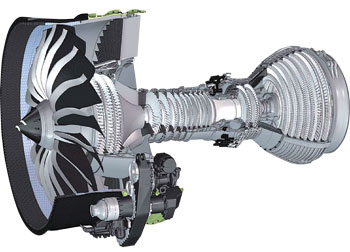
The LEAP entered service nearly a decade ago on the A320neo and on the first flight of the 737 MAX.
Supply chain pain
While GE Aerospace continued to ramp up production in the second quarter, executives made it clear that the industry’s biggest challenge remains getting enough parts into the system, particularly for the aftermarket. “As much as we’re pleased with the delivery increases, our spare parts delinquencies are up, unfortunately,” Culp acknowledged. The issue carries added weight because spare parts account for about 40% of GE Aerospace’s revenue, Ghai noted. Spare parts orders rose 34% during the first half, yet delinquencies increased 20%, highlighting the gap between robust demand and the industry’s ability to keep pace.
Even so, management believes the foundation is getting stronger. Culp pointed to nine consecutive quarters of double-digit output increases among GE’s most critical suppliers, crediting deeper technical collaboration and joint problem-solving for easing production bottlenecks and unlocking additional capacity throughout the supply chain. The company insists that demand is not the limiting factor. “It’s much more a supply-side challenge than it is a demand,” Culp said, adding that GE’s priority is to build “a bigger, better second half” and carry that momentum into 2027. But he was quick to temper expectations: “There are no victory laps here in Evendale today. As we get ready for next year, that is very much the mindset.”
Flight Deck and AI attack bottlenecks
GE Aerospace says the answer to many of its supply chain constraints lies not only with suppliers but also in changing how the company operates, including by using artificial intelligence.
During a May visit to GE’s largest MRO in Brazil, Culp pointed to one example. By applying the company’s Flight Deck operating system, the team reduced CFM56 final assembly lead time by nearly 50%. Those improvements helped cut overall shop visit turnaround times by about a week since the end of 2025 while supporting record internal shop visit output during the second quarter and a 32% increase in first-half commercial services revenue.
Artificial intelligence is also becoming part of the solution. Culp described AI as “a force multiplier for Flight Deck,” citing a recent effort across GE’s Turbine Module and Airfoils business. After simplifying demand planning with Flight Deck and automating the process with AI, the company halved the number of supplier demand signals while reducing processing time by nearly 90% across 190 parts. The streamlined process has allowed suppliers to focus on the highest priority material, contributing to another quarter of double-digit sequential and year-over-year growth in supplier output. “Hopefully, we’re a better partner. We’re a better customer,” Culp said, adding that closer collaboration is helping unlock capacity across the supply chain.
GE is also expanding its maintenance footprint to prepare for the next wave of LEAP overhauls. The company expects the installed LEAP fleet to more than double by 2030 and last week, together with MTU Aero Engines, opened a new maintenance facility in Fort Worth, Texas. The site has already inducted its first LEAP engine, adding another piece of capacity as the aftermarket enters its next phase of growth.

Image from: GE Aerospace
GE9X: Paying today for tomorrow
The GE9X is expected to become one of GE Aerospace’s most profitable engine programs. For now, it’s one of the company’s biggest margin headwinds. As with every new engine program, the first units are the most expensive to build. It began shipping production GE9X engines last year and will deliver more this year as Boeing slowly ramps the 777X program. Those early production costs are expected to push program losses higher through about 2028, before manufacturing efficiencies begin to take hold and margins improve.
The wait has been almost as long as the engine itself. Boeing’s 777X, now about seven years behind schedule, is in the back half of the FAA’s Type Inspection Authorization certification program. The airframer continues to target the first delivery of the 777-9 to Lufthansa in early 2027. When that happens, GE will have the field to itself. The GE9X is the exclusive powerplant for the 777X family, giving the company sole access to what should become decades of lucrative aftermarket work. Boeing has accumulated more than 600 orders and commitments for the aircraft, making today’s investment a down payment on tomorrow’s services business.
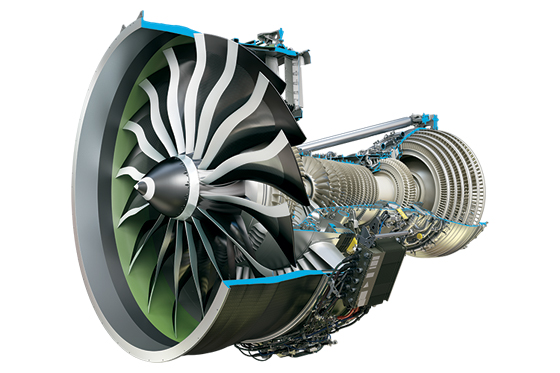
Cutaway view of the GE9X – The world’s largest and most powerful commercial turbofan, capable of delivering over 134,000 lbs of thrust. Designed for the Boeing 777X—the world’s largest twin-engine jet. Courtesy: GE Aerospace
Farnborough teaser
GE Aerospace used the earnings call to offer a glimpse of what may be in store at next week’s Farnborough International Airshow, highlighting progress in hybrid-electric propulsion alongside its long-running RISE technology development program. Culp said the company recently completed a ground test of its megawatt-class hybrid electric demonstrator under NASA’s Electrified Powertrain Flight Demonstration program. The milestone brought together advanced engines, electric power systems, and controls in a single integrated test, furthering GE’s work on one of the key technology pillars supporting RISE.
The investment reflects the company’s broader technology strategy. GE is spending about $3 billion annually on research and development and more than $1 billion a year on capital expenditures as it pursues improvements in durability, fuel efficiency, and turnaround times while developing the next generation of propulsion technologies.
Asked for a preview of what might be unveiled at the Farnborough air show, Culp shot back with a laugh, “A teaser is a teaser.” He did acknowledge that while the open fan architecture remains central to RISE, hybrid electric propulsion is another of its foundational technologies. He added that electrification is expected to play a growing role across both commercial and defense applications, with “more to come over the weekend and early next week.”
Strong first half drives higher guidance
The propulsion maker posted another solid quarter, with Commercial Engines & Services (CES) continuing to drive the business, prompting management to raise its full-year outlook. Total company revenue increased 21% year-over-year to $13.3 billion, while operating profit rose 18% to $2.7 billion. For the first six months of the year, revenue climbed 23% to $25.7 billion, and operating profit increased 18% to $5.3 billion. Operating margin was 21.7%, down 130 basis points from a year ago, as higher installed-engine deliveries, continued investment, and inflation more than offset the benefits of stronger services volume and pricing. CES remained the company’s largest contributor. Second-quarter revenue increased 27% to $9.7 billion, fueled by higher shop visit activity, robust spare-parts demand, and increased engine deliveries. CES operating profit rose 20% to $2.7 billion, while the segment operating margin was 27.3%.
Following the stronger first-half performance, GE Aerospace increased its 2026 guidance. The company now expects operating profit of $10.55 billion-$10.75 billion, compared with its previous outlook of $9.85 billion-$10.25 billion. CES is now projected to deliver about 20% revenue growth for the year and an operating profit of $10.25 billion-$10.35 billion, up from its prior forecast of $9.6 billion-$9.9 billion.

Image from: GE Aerospace
Wall Street’s first take
Wall Street’s first take on GE Aerospace’s second quarter was overwhelmingly positive, with analysts pointing to another earnings beat, stronger-than-expected execution, and a higher full-year outlook. Jefferies called the quarter a “beat” with a larger-than-expected guidance increase, saying the company’s growth continues to justify its valuation. RBC Capital Markets highlighted strong second-quarter growth that exceeded already-elevated expectations, while Bernstein described the results as a strong beat accompanied by another increase in full-year guidance.
J.P. Morgan poured a little cold water on the results, writing that the increases in results and guidance “weren’t so massive that they reset the board,” although they likely leave room for additional upside. The firm also suggested investors may have been looking for a stronger second-half CES outlook, but added that GE Aerospace’s guidance remains consistent with its typically conservative approach.
Related