Ready to Buy Bonds? Here’s How to Choose from These 3 Bond Funds.

Bonds don’t usually offer the same levels of long-term growth as the best stocks, but bonds are supposed to be relatively “safe” fixed-income investments. As you get closer to retirement, conventional wisdom says that most people should have a larger portion of their portfolio invested in bonds.
Unfortunately, right now is a complicated time to buy bonds. There’s a lot of uncertainty among bond investors about stubborn inflation, high energy prices, and global turmoil from the Iran conflict, all of which could lead to interest rate hikes from the Fed. Some bond investors also share the concerns that JPMorgan Chase (JPM +0.31%) CEO Jamie Dimon expressed recently in an interview, where he said that high levels of U.S. government debt could drive long-term U.S. Treasury bond yields higher (and bond prices lower). If interest rates go higher in the future, that could make bonds, especially longer-term bonds, a risky bet today.
Image source: Getty Images.
How should people navigate the bond market? Let’s look at three popular bond exchange-traded funds (ETFs) that make it easy to buy bonds for different goals and time horizons. The T. Rowe Price Ultra Short-Term Bond ETF (TBUX +0.43%) holds mostly short-term corporate bonds. The Vanguard Total Bond Market ETF (BND +0.25%) holds a diversified mix of short-term to longer-term bonds, with a large percentage of Treasuries and some corporate bonds. And the iShares 20+ Year Treasury Bond ETF (TLT +0.58%) owns nothing but Treasury bonds with 20-year durations or longer.
During the past three years, the T. Rowe Price Ultra Short-Term Bond ETF has outperformed the other two funds. In fact, the iShares long-term bond fund has lost about 5% of its value during that time.
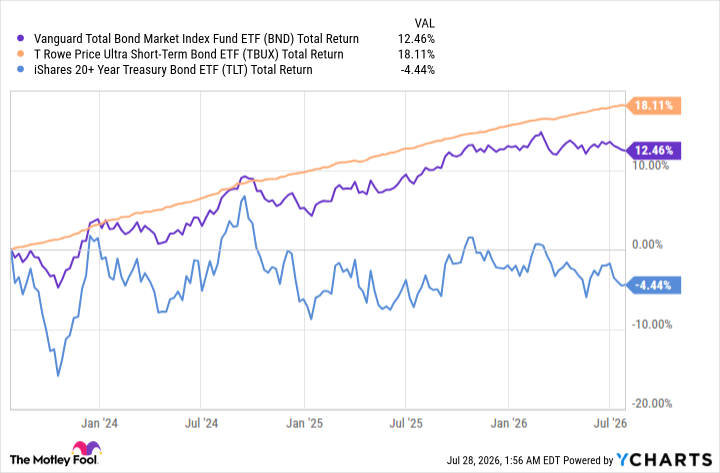
BND Total Return Level data by YCharts
Let’s see which of these three bond ETFs could make the most sense for your investment goals.
iShares 20+ Year Treasury Bond ETF (TLT): 46 bonds, 24 years of 3.68% annualized returns
The iShares 20+ Year Treasury Bond ETF holds a total of 46 bonds, all U.S. Treasuries, with a weighted average maturity of 26.07 years. As of July 24, it is earning a 30-day yield of 5.10%. The fund was created in July 2002, and for the past 24 years it has earned average annual returns of 3.68%.

iShares Trust – iShares 20+ Year Treasury Bond ETF
Today’s Change
(0.58%) $0.49
Current Price
$84.24
Key Data Points
AUM
$43B
Dividend Yield
4.63%
Expense Ratio
0.15%
Buying long-term Treasury bonds paying about a 5% yield might sound “safe,” but it’s not always the best choice. Because the iShares 20+ Year Treasury Bond ETF is a longer-duration bond fund, it is vulnerable to long-duration interest rate risk. If interest rates go up in the future, this ETF could lose value for investors. Just like it has for the past several years, with negative annualized total returns of -1.65% for the past three years, -6.66% for the past five years and -1.93% for the past 10 years.
T. Rowe Price Ultra Short-Term Bond ETF (TBUX): 618 holdings, nearly 5 years of 4.11% annualized returns
The T. Rowe Price Ultra Short-Term Bond ETF takes a completely different approach to investing in bonds. Instead of only Treasuries, the T. Rowe Price fund takes a multisector strategy and owns mostly corporate debt and some international bonds. The fund has about 618 holdings, and only 5% of the fund’s assets are in U.S. Treasury bonds. The rest are mostly corporate bonds and notes (49.6% of the fund), asset-backed securities (22.1%), and mortgage-backed securities (10.5%).
And instead of being limited to durations of 20 years or longer, this ultra-short duration bond fund only owns bonds that are much closer to maturity, with a weighted average maturity of 1.79 years. The T. Rowe Price Ultra Short-Term Bond ETF has existed for almost five years. Since its September 2021 inception date, the fund has delivered average annual returns (by net asset value) of 4.11%, and a total return of 4.63% in the past year.

T. Rowe Price Exchange-Traded Funds – T. Rowe Price Ultra Short-Term Bond ETF
Today’s Change
(0.43%) $0.21
Current Price
$49.73
Key Data Points
AUM
$1.3B
Dividend Yield
4.81%
Expense Ratio
0.17%
This T. Rowe Price fund has outperformed the other two bond ETFs for the past few years, but it also charges slightly higher fees, with a 0.17% expense ratio. The iShares long-term Treasury bond ETF charges an expense ratio of 0.15%, while the Vanguard Total Bond Market ETF charges 0.03%.
Vanguard Total Bond Market ETF (BND): 11,476 bonds, 19 years of 3.08% annualized returns
What if you want to find a middle ground between longer-duration bonds and ultra-short-term bonds? The Vanguard Total Bond Market ETF can do that. In the past 19 years since its inception in April 2007, this bond ETF has delivered average annual returns (by net asset value) of 3.08%. More recently, it’s delivered average annual returns (by net asset value) of 4.15% in the past three years, and 3.7% in the past year.

Vanguard Total Bond Market ETF
Today’s Change
(0.25%) $0.18
Current Price
$72.64
Key Data Points
AUM
$398B
Dividend Yield
4.00%
Expense Ratio
0.03%
This bond ETF is massively diversified, with 11,476 bonds in its portfolio, with an average effective maturity of 8.2 years. About 79.6% of this fund’s bonds have maturities of less than 10 years, and about 45% of the fund matures in less than five years. That could offer decent protection against longer-term interest rate risk.
The Vanguard Total Bond Market ETF also offers exposure to a broad mix of bond sectors. About 49.2% of the fund’s holdings are in U.S. Treasury or agency bonds, with 19.3% allocated to government mortgage-backed securities. Other leading issuer types include corporate bonds such as industrials (14.75% of the fund) and finance (8.09%).
Which bond ETF should you buy? It depends on your time horizon and risk tolerance. But the Vanguard Total Bond Market ETF is a solid choice for most bond investors. It’s ultra-low cost and highly diversified. If you want to keep your bond investments simple, BND is tough to beat.