Senate backs Iran war powers resolution as GOP pressure grows on Trump
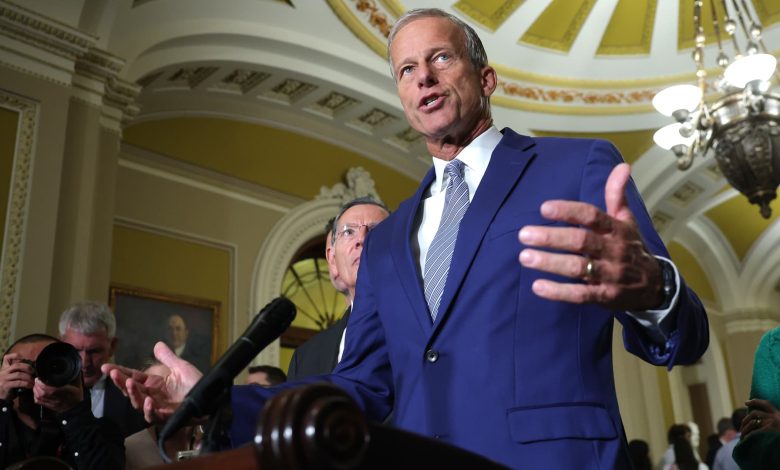
Senate Majority Leader John Thune, R-S.D., arrives at the Capitol in Washington, Tuesday, June 23, 2026, as he prepares for a meeting with President Donald Trump.
J. Scott Applewhite | AP
The Senate voted Tuesday to adopt an Iran war powers resolution directing President Donald Trump to remove U.S. forces from hostilities with Iran, delivering a symbolic bipartisan rebuke of the president’s handling of the conflict.
The 50-48 vote came amid growing resistance in Congress to Trump’s Iran policy.
Republican Sens. Bill Cassidy of Louisiana, Susan Collins of Maine, Rand Paul of Kentucky and Lisa Murkowski of Alaska joined most Democrats in voting for the resolution. Sen. John Fetterman, D-Pa., joined most Republicans in opposition.
Two Republicans, Sens. Mitch McConnell of Kentucky and Dave McCormick of Pennsylvania, did not vote. McConnell has been ill, and McCormick traveled with Trump for a rally in Pennsylvania.
The measure — a concurrent resolution — will not be sent to Trump’s desk and won’t become law, meaning it will not force an immediate change in U.S. policy. However the symbolic vote is an escalation in Congress’s effort to reassert its role over both the military and diplomatic tracks of Trump’s Iran policy.
Lawmakers in both parties have pushed for limits on further U.S. military action against Iran, while also demanding more information about the administration’s memorandum of understanding with Tehran.
Democrats have repeatedly forced votes in recent months to limit Trump’s war powers in Iran, an effort that has gradually drawn increasing Republican support. Tuesday’s vote was the 10th Senate vote on an Iran war powers measure since the beginning of the year.
The House approved the same resolution earlier this month, with four Republicans joining Democrats. Trump lashed out at those GOP lawmakers after the vote, calling them “GRANDSTANDERS” and saying their action was “unpatriotic.”
Tuesday’s vote came shortly after Senate Majority Leader John Thune, R-S.D., said he expects Congress would likely vote on any broader Iran deal that emerges from the Trump administration’s 60-day negotiating window, though he said he does not yet know what form that vote would take.
“If there is some deal that is struck, I would expect at some point Congress would have some sort of vote on it,” Thune told reporters. “Whether that’s a resolution of disapproval or something, I don’t know the answer to that,” he added.
Asked what role Congress should play in approving whatever comes out of the talks, Thune said many senators are still “anxious to hear more” from officials involved in the negotiations.
Several GOP senators have praised Trump’s effort to end the conflict and reopen the Strait of Hormuz, but they have also raised concerns about possible sanctions relief, frozen Iranian assets, a proposed reconstruction fund and whether Tehran will accept enforceable limits on its nuclear program.
Last week Thune told reporters that nuclear components of the deal could trigger congressional notification requirements. But he voted against the war powers resolution.
The U.S. and Iran met last weekend in Switzerland along with representatives from Pakistan and Qatar to discuss terms for a final deal and an end to fighting in Lebanon involving Israel.