ASML Holding N.V. ASML is increasingly benefiting from the growing adoption of AI, rapid advances in leading-edge Logic and Memory technologies and the need for sophisticated semiconductor manufacturing processes. The company is one of the biggest beneficiaries of the increasing technology complexity of the semiconductor ecosystem, which is driving demand for its lithography equipment.
AI Boom Fuels Advanced Logic & Memory Demand
Rapid expansion of AI infrastructure is one of ASML’s most powerful growth catalysts. Training and inference workloads require increasingly powerful and energy-efficient processors, which are accelerating the transition toward smaller process nodes and more advanced memory technologies.
The ongoing investments and continued progress in AI technologies are further boosting demand for both advanced Logic and Memory chips. Semiconductor manufacturers are accelerating capacity expansion plans, resulting in stronger commitments across ASML’s product portfolio.
Growing demand for high-bandwidth memory alongside tighter supplies of conventional DRAM is encouraging memory manufacturers to build additional capacity. At the same time, migration toward advanced DRAM nodes requires greater lithography intensity, benefiting both extreme ultraviolet (EUV) and deep ultraviolet (DUV) immersion demand.
Near-term trends remain equally encouraging. ASML now expects to ship approximately 65 Low-NA EUV systems in 2026, supporting year-over-year EUV net system sales growth of more than 45%. The rising contribution of EUV should also benefit ASML as semiconductor customers continue pushing their technology roadmaps forward to meet the performance and power-efficiency requirements of AI computing.
Zacks Investment Research
Image Source: Zacks Investment Research
Capacity Expansion Bodes Well
ASML’s decision to materially increase manufacturing capacity provides another indication of strengthening demand visibility. Based on strong customer commitments, the company plans to increase its 2027 Low-NA EUV capacity by approximately 30% from its 2026 capacity of roughly 65 systems. It is also evaluating another approximately 30% capacity increase for 2028.
A similar expansion is underway for immersion DUV. ASML plans to raise capacity by approximately 30% in 2027 from a 2026 level of roughly 130 systems and is evaluating another 30% increase for 2028. These initiatives are particularly encouraging because lithography systems have long production lead times and require close coordination with customers and ASML’s extensive supply chain. Capacity expansion therefore suggests that customers are providing ASML with increased visibility into their multi-year fab and technology plans.
The broader semiconductor industry’s long-term expansion provides an attractive backdrop for ASML. The increasing semiconductor content required for AI, cloud computing, automotive applications and other digital technologies should support additional wafer capacity and technology investments.
Price Performance
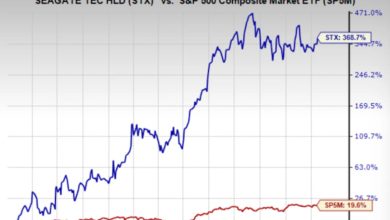
ASML has gained a stellar 115.4% over the past year compared with the sector’s growth of 27.7%. It has outperformed peers like Advanced Energy Industries, Inc. AEIS but lagged Silicon Motion Technology Corporation SIMO. While AEIS has gained 81.9%, SIMO has soared 202% over this period.
One-Year ASML Stock Price Performance
Zacks Investment Research
Image Source: Zacks Investment Research
Estimate Revision Trend
Earnings estimates for ASML for 2026 have moved up 58.1% to $44.99 over the past year, while the same for 2027 has increased 79.9% to $59.36. The positive estimate revision depicts bullish sentiment about the stock’s growth potential.
Zacks Investment Research
Image Source: Zacks Investment Research
Elevated Operational Risks Persist
Despite the positives, management attributes the current demand environment primarily to AI-related investment and the resulting need for more advanced Logic and Memory capacity. This has produced unusually long order visibility for ASML, but it also makes the growth profile increasingly dependent on customers maintaining those expansion plans. A slower pace of customer investment would therefore affect both system demand and utilization of the larger production footprint ASML is preparing.
The planned scale-up requires manufacturing capacity, suppliers and trained employees to rise together. This leaves future profitability dependent on converting the larger cost base into the expected shipment volumes. Moreover, a uniform adoption schedule across Logic and DRAM customers is yet to be established. High-NA therefore remains both a technology opportunity and an execution variable, with the pace of wider insertion dependent on customer qualification and manufacturing decisions rather than ASML’s roadmap alone.
End Note
ASML appears well positioned to capitalize on multiple semiconductor growth trends. Accelerating AI investments are driving leading-edge Logic and Memory capacity additions, while increasing lithography intensity supports greater demand for EUV and DUV systems. At the same time, ASML’s planned production-capacity increases strengthen the growth outlook. Positive estimate revisions remain an additional tailwind.
However, export restrictions, geopolitical tensions and the semiconductor industry’s inherently cyclical capital-spending patterns remain factors to monitor. Its growth also depends on customers sustaining elevated capital spending. An additional risk is that ASML expanding output without disrupting costs or supply could dent its growth prospects.
With a Zacks Rank #3 (Hold), ASML appears to be treading in the middle of the road, and new investors could be better off if they trade with caution. You can see the complete list of today’s Zacks #1 Rank (Strong Buy) stocks here.
Want the latest recommendations from Zacks Investment Research? Today, you can download 7 Best Stocks for the Next 30 Days. Click to get this free report