Strait of Hormuz deal sees munis firmer, USTs rally
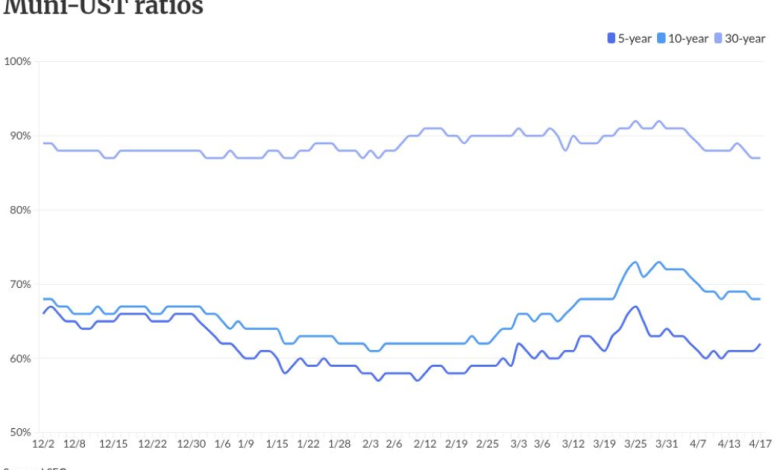
Munis were firmer on Friday, as U.S. Treasuries rallied and equities ended higher following news that commercial vehicles would be allowed to pass through the Strait of Hormuz.
Processing Content
“Ceasefire optimism augmented by a liquidity-driven risk-on macro market environment should be neutral for duration and positive for credit spreads,” BofA analysts wrote.
“However, muni credit index spreads widened in April after significant narrowing during 1Q26,” BofA analysts wrote. “One possible factor is that munis trade more on economic fundamentals. The other possible factor is that AAA munis have more liquidity than credit bonds during both March’s selloff and April’s recovery.”
New-issue calendar
Issuance for next week is an estimated $11.92 billion, with $7.93 billion of negotiated deals on tap and $3.99 billion of competitives.
The New Jersey Health Care Facilities Financing Authority leads the negotiated calendar with $1.113 billion of RWJ Barnabas Health Obligated Group issue revenue and refunding bonds.
The competitive calendar is led by Massachusetts with $1.086 billion of GOs across four series.
CUSIP requests rise
In March, the aggregate total of identifier requests for new municipal securities — including municipal bonds, long-term and short-term notes, and commercial paper — rose 8.7% versus February totals.
On a year-over-year basis, overall municipal volumes were up 1.3% through the end of March.
Texas led state-level municipal request volume with a total of 97 new CUSIP requests in March, followed by California (96) and New York (92).
For the specific category of municipal bonds, there was an increase of 11.5% month-over-month, but requests are still down 3.7% year-over-year.