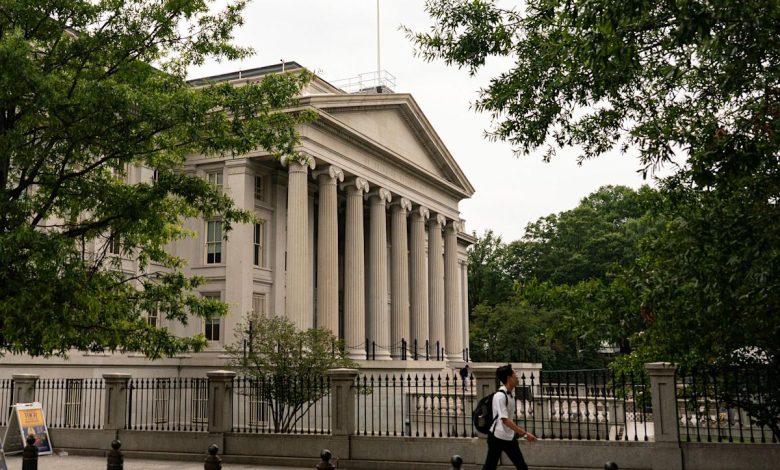
(Bloomberg) — Wednesday will amount to a sort of Groundhog Day for US bond dealers, who will — as has been the case for more than a year now — be watching for any change in guidance from the Treasury in its latest plan for debt issuance.
Most Read from Bloomberg
Investors will look for any adjustment to the Treasury’s guidance in its quarterly refunding statement about increases in note and bond issuance not to be expected “for at least the next several quarters.” While longer-term Treasuries are currently costlier than short-dated debt, relying on bills to keep funding a near-$2 trillion annual deficit carries its own risk.
“They can’t just keep saying ‘at least several quarters,’” said Jack McIntyre, a portfolio manager at Brandywine Global Investment Management in Philadelphia. “They will try to fight it for as long as they can,” but at some point officials will have to think about boosting sales of interest-bearing debt, he said.
Increasing issuance of bills, which mature in up to a year, leaves the government’s debt costs more vulnerable to sudden swings in rates, and to shifts in market sentiment, because auctions are more frequent. The International Monetary Fund just last month cautioned on such dangers.
Yet the Treasury has reason to believe strong demand can absorb the increased bill supply, at least for now. Money-market funds have grown to roughly $7.6 trillion — about 42% of which is invested in Treasuries — and continue to expand. Treasury Secretary Scott Bessent has also argued that the GENIUS Act could draw trillions of dollars into Treasuries, since it would require stablecoin issuers to hold reserves in assets such as T‑bills.
Before he took office last year, Bessent had criticized the Treasury’s guidance under Janet Yellen. More recently, the statements have tipped that officials are evaluating the potential for “future increases” in auctions of interest-bearing and floating-rate securities, without offering a timeline.
That has left dealers on alert for any shift in language on Wednesday.
“If you remove ‘at least’ and just say ‘several,’ then the market’s going to say: OK, we have three or so quarters more of this level of coupon issuance,” McIntyre said.
What’s inescapable for the Treasury is the steady increase in overall debt, which keeps lifting total issuance. That burden is only growing — with the costs from the Iran war, uncertainty over the future of trade tariffs and slower growth leading to warnings of wider budget deficits.
The department on Monday is due to update its estimate of expected borrowing needs for the current quarter, ahead of the refunding announcement. In February, it penciled in $109 billion in net borrowing for the three months through June.
As for next week’s refunding auctions, dealers widely expect they will be made up of:
-
$58 billion of 3-year notes on May 11
-
$42 billion of 10-year notes on May 12
-
$25 billion of 30-year bonds on May 13
Speaking to the degree to which the semantics of the Treasury’s statement will be scrutinized, Wall Street strategists offered a variety of potential changes.
JPMorgan Chase and Co. sees “significant risk” the Treasury removes “at least” from its guidance. Barclays Plc expects “at least” to stay but “several” to be switched to the “next few” quarters. Wells Fargo offers: No change “through at least the end of calendar year 2026,” or perhaps a complete removal of the sentence.
Any tweaks “could drive price action” in the market, TD Securities strategists cautioned. Indeed, one reason why Citigroup Inc. had expected the Treasury to have already set investors up for an expansion in coupon sizes starting this November was that the market impact “could be minimized by starting earlier.”
“However, at this time, we find it very unlikely Bessent would edit the upcoming Treasury policy statement,” Citigroup strategists including Jason Williams wrote.
The Citigroup team last month put off its call for coupon-issuance increases until May 2027 “at the earliest.” Goldman Sachs Group Inc. also postponed its projection, with the bank now at February 2027.
Among the considerations for the Treasury is shifting patterns of demand for government debt. In recent months, the Federal Reserve has been a buyer of bills as it sought to rebuild bank reserves in the financial system, but those purchases have been scaled back.
Going forward, the Fed will soon have a new chair in Kevin Warsh. He told US senators last month that the central bank “should not be holding long-term Treasury assets,” and that he favored shrinking its balance sheet over time. Each of those ideas would have implications for Treasury issuance.
Moves by the Trump administration to scale back regulations on banks also have the potential to affect their level of demand for Treasuries. Ahead of the coming refunding statement, the Treasury in its regular quarterly survey of primary dealers asked them for their views on how changes in bank regulation affect investor demand and liquidity in the $31 trillion market.
As for the forward guidance, a key outside panel of advisers recommended more than a year ago for the Treasury to ditch the current language. In February, the group — the Treasury Borrowing Advisory Committee, which includes selected dealers and investors — had “robust” discussions on how best to increase auction sizes, according to its letter to Bessent.
The debate concerned “the relative trade-offs of increasing auction sizes more gradually, perhaps earlier than needed, compared to a more accelerated path of auction size increases when the financing gap is larger.”
The committee also reiterated its view that current projections could warrant increases in coupon issuance in the 2027 fiscal year, which starts in October. The TBAC is due to meet Tuesday, with its statement published alongside the Treasury’s announcements on Wednesday.
–With assistance from Alexandra Harris and Elizabeth Stanton.
Most Read from Bloomberg Businessweek
©2026 Bloomberg L.P.