Trendsetting U.S. bond yield slides under 4%, marking its largest monthly decline in a year
U.S. Treasuries gained on Friday, bolstered by safe-haven demand as investors remained on edge over geopolitical tensions in the Middle East, while a sharp selloff on Wall Street further dampened risk appetite.
The benchmark 10-year yield, which moves inversely to prices, fell below 4% for the first time since late November, while yields on the belly of the curve – five-year and seven-year notes – also dropped to multi-month lows.
The U.S. five-year yield slid to its lowest since mid-October, while the yield on seven-year notes sank to a four-month trough.
Canadian bonds yields largely followed U.S. treasuries on Friday, with both the five-year and 10-year terms ending down about 5 basis points.
Data showing U.S. producer prices increased more than expected in January briefly pared gains in Treasuries, but the overarching theme remains to buy U.S. government debt.
“The bond market seems to be looking past … the producer prices report and continuing to rally on AI disruption concerns, geopolitical risks and, now, credit concerns from the UK via Market Financial Solutions,” said Vinny Bleau, director, fixed income research, at Raymond James in Memphis.
Mortgage lender MFS in the UK has been placed into administration following allegations of financial irregularities. Its collapse has stoked wider credit fears, with well-known big banks among its lenders. MFS has borrowed 2 billion pounds ($2.69 billion).
“Risk sentiment has shifted significantly, mostly due to geopolitical jitters and AI fears,” said Angelo Manolatos, macro strategist at Wells Fargo in North Carolina.
“This has caused a flight-to-quality bid across Treasuries and they are outperforming. You see it most predominantly in the belly of the curve, and it has persisted all month.”
Investors continued to fret over Iran. The United States and Iran made progress in talks over Tehran’s nuclear program on Thursday, but hours of negotiation ended with no sign of a breakthrough that could avert potential U.S. strikes after a massive military buildup.
The two sides plan to resume negotiations soon after consultations in their countries’ capitals, with discussions scheduled next week in Vienna, Omani Foreign Minister Sayyid Badr Albusaidi said on Friday. Against that backdrop, worries about AI upending software companies’ business models and fueling massive job losses in many entry-level and computer-facing jobs have caused a selloff in tech stocks.
That has continued to spook bond investors.
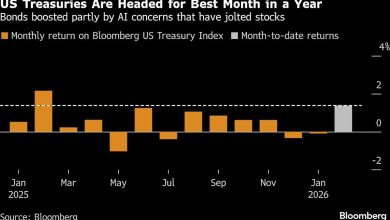
In afternoon trading, the benchmark 10-year yield fell 5.5 basis points (bps) to 3.962%, after hitting its lowest since late November. On the month, the yield dropped 28 bps, its largest monthly decline in a year.
U.S. 30-year yields also slid to a four-month low, and were last down 3.2 bps at 4.632%. For February, 30-year yields fell 24 bps, their biggest monthly drop since February 2025.
The belly of the curve was the clear outperformer. U.S. five-year yields were down 6.8 bps at 3.515%. On the month, yields slumped 26 bps, the steepest fall since August. U.S. seven-year yields also declined, down 6.2 bps at 3.723% . Seven-year yields have fallen 30 bps this month, their sharpest monthly slide in a year.
On the front end of the curve, the two-year yield, which reflects rate expectations, declined 5.7 bps to 3.391% . Earlier in the session it fell to a 10-day trough, while on the month it was down 14 bps, the largest monthly decline since August.
Treasury yields, however, briefly retraced some of their decline after producer prices data for last month came in higher than expected. The Producer Price Index for final demand rose 0.5% in January after advancing by a downwardly revised 0.4% in December, data showed.
Economists polled by Reuters had forecast the PPI gaining 0.3%. U.S. fed funds futures on Friday priced in about 59 bps of easing this year, factoring in two full rate cuts of 25 bps each. That was marginally higher than 55 bps late on Thursday.
The modest shift likely stemmed from weakness in equities, analysts said, which has prompted investors to speculate that the Federal Reserve could reconsider holding rates steady for longer.
With a contribution from The Globe and Mail