TSX falls, short-term U.S. bond yields jump, as Warsh signals central bank may not be done fighting inflation
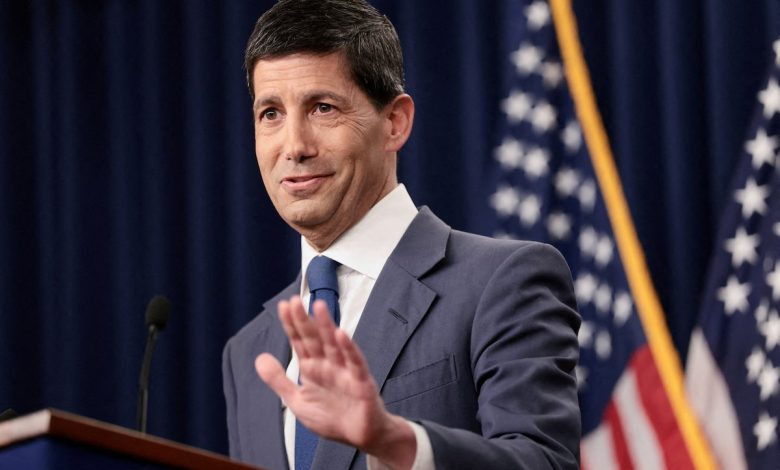
Canadian stocks reversed early gains and were trading sharply lower at midday as investors weighed Fed Chair Kevin Warsh’s Jackson Hole speech.
The U.S. central bank will “have work to do” if policymakers are not confident that underlying inflation is returning to its 2% target, Warsh said on Friday in remarks that acknowledged financial conditions do not appear restrictive and marked the closest he has come to acknowledging interest rate hikes may be needed to ease price pressures.
By 1222 pm ET, the S&P/TSX Composite Index was down more than a full percentage point. It started today’s session in positive territory, before Warsh spoke.
Contributing to the Canadian index’s drop: spot gold extended its losses as Warsh spoke, down more than 2% at midday. Higher U.S. interest rates is negative for gold, which provides no yield for investors and is hindered by strength in the U.S. currency.
The TSX materials sector, which has a heavy weighting in gold stocks, was down 3%.
The move came as two-year U.S. Treasury yields spiked and traders added to bets the Fed will hike interest rates this year. The U.S. 2-year note yield, which typically moves in step with Fed interest rate expectations, rose about 10 basis points to 4.318%, the highest since July 31. The yield on benchmark U.S. 10-year notes rose 2.01 basis points to 4.692%.
Expectations for a rate hike of at least 25 basis points at the Fed’s September meeting jumped to about 50% following Warsh’s comments, up from about 35% before the speech.
The dollar index, which measures the greenback against a basket of currencies, rose 0.46% to 99.57 after hitting a session high of 99.592, with the euro down 0.46% at $1.1597.
Reflecting this move in the greenback, the Canadian dollar fell more than two-tenths of a U.S. cent to below 72 cents US.
Major U.S. stock indexes, however, were mixed and relatively unchanged.
While much of the 16-page address focused on large issues, like the influence of artificial intelligence that Warsh feels will be critical in the long run, it also included some key acknowledgements — including that “short-term interest rates are the predominant tool to achieve the dual mandate.”
Some economists agreed with the market’s assessment of Warsh’s speech.
“Fed Chair Kevin Warsh’s speech at the Jackson Hole Symposium delivered a far clearer – and hawkish – message than his last press conference appearance,” Stephen Brown, Capital Economics’ chief North America economist, said in a note. “If anything, that leaves the door open to a hike earlier than our current forecast of December, if the forthcoming price data are firm.”
“In short, Warsh has now positioned himself much more firmly in the group of centrists on the FOMC, such as Governors Christopher Waller and Lisa Cook, who have indicated that they are prepared to hike absent meaningful near-term progress on inflation. Hikes are not guaranteed, but Warsh is now at least suggesting he is on board with them if economic growth remains strong and monthly core PCE price growth remains a bit too firm, as we expect,” Brown said.
Warsh’s speech, his first at the Fed’s annual gathering in Wyoming, rounds out a busy week packed with results from corporate heavyweights such as Nvidia and Salesforce , alongside a batch of fresh economic data.
While the central bank chief has been tight-lipped about the interest rate outlook, the U.S. Treasury’s move to calm bond markets last week has put his speech in sharper focus.
“There’s been a lot of apprehension among investors about staying invested, because some of the stock moves have been uncomfortably high. The inflation data has also become pretty difficult to read because of the energy prices,” said Yung-Shin Kung, CIO of Mast Investments.
“The bigger question for everybody is what (Treasury Secretary) Scott Bessent is looking at, and what the implications of that are for monetary policy.”
GDP data released on Friday showed that Canada’s economy grew by 3.3% on an annualized basis in the second quarter, the fastest rate since 2023, on higher exports and robust domestic demand. An advance indicator showed that the economy was largely flat in July.
“While impressive overall, there’s not a lot to seriously move the needle bigger picture for the BoC,” Douglas Porter, chief economist at BMO Capital Markets, said in a note.
“The BoC will likely wait and see how the economy handles the latest tariff spat – and how the tussle develops – before judging where rates need to go next,” Porter said.
According to a Reuters poll of economists, the BoC will keep its benchmark interest rate at 2.25% on Wednesday and leave it unchanged for at least another year.
Consumer staple stocks in Toronto were among the top gainers on the TSX, lifted by a 0.8% gain in Alimentation Couche-Tard. The firm said on Wednesday it was launching a voluntary tender offer for all shares of Polish convenience store chain Zabka at 32 zlotys each.
Meanwhile, the TSX energy sector shed 0.2% as oil prices held steady with traders weighing stagnant U.S.-Iran diplomatic talks against some crude flows through the Strait of Hormuz.
Four of TSX’s 10 major sectors traded lower.
In the U.S. market, chip stocks pulled back after a rally in the previous session, sparked by Nvidia’s blockbuster forecast that indicated the AI-driven rally had room to run.
At 11:20 a.m. ET, the Dow Jones Industrial Average rose 228.41 points, or 0.43%, to 53,797.85, the S&P 500 gained 33.84 points, or 0.44%, to 7,764.83 and the Nasdaq Composite gained 108.01 points, or 0.41%, to 26,649.37.
The CBOE Volatility Index, widely known as Wall Street’s “fear gauge”, briefly touched its lowest level since December. It was last down 0.34 points at 14.17.
Globe staff, Reuters