Unitree IPO’s Massive 629% Pop Makes Agility Robotics Look Super Cheap
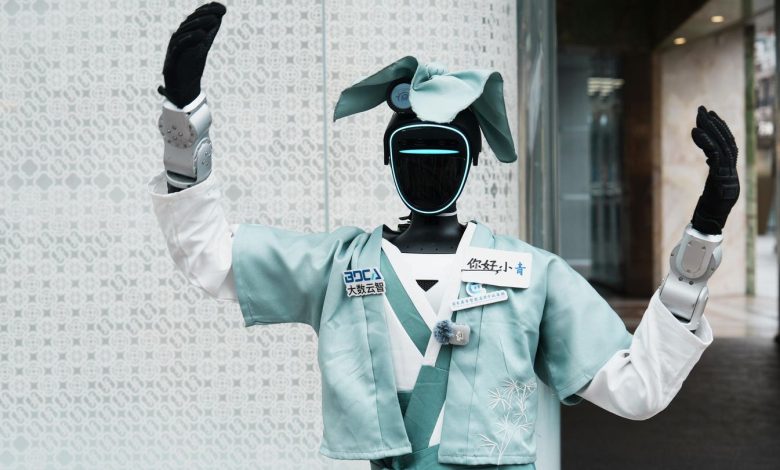
A Unitree G1 humanoid robot. The company’s IPO landed today, and the stock jumped 629%.
VCG via Getty Images
High-five a Unitree G1, if you can find the robotic little guy anywhere. His makers hit the Shanghai Stock Exchange’s STAR Market today, and the company’s stock value surged 629% – a 629% jump before a single retail investor had time to refresh a browser tab – and ended the day’s trading still up 487%, according to exchange data, at almost 1,300X last year’s earnings.
In other words, stock 688836 – Unitree’s symbol on the STAR Market – is one hot commodity. And so, by extension, is the humanoid robot market.
At close, Unitree is worth roughly 358 billion yuan, or about $53 billion. Not bad for a company that earned 278 million yuan in net profit last year: about $41 million. On revenue of 1.7 billion yuan ($252 million), it’s roughly 210 times sales. The IPO was initially priced at 219 times earnings, which is already aggressive, but the market decided that was a bargain and multiplied it by six.
The offering raised 6.1 billion yuan or $904 million for Unitree, which sold 40.45 million shares accounting for roughly 10% of the company. The retail tranche was oversubscribed more than 5,500 times, with 9.8 million retail accounts chasing 9.7 million available shares, which works out to an allocation rate of 0.018%.
Odds of getting shares were worse than one in five thousand, which explains pretty loudly why the stock popped so much on launch.
Institutional stockholders read like a who’s who of Chinese tech business. DeepSeek, Tencent, PetroChina, China Telecom and others all had strategic placements, usually with an investment arm. Early Unitree backers include Meituan, HSG and Xiaomi.
Unitree on the STAR Market
John Koetsier
Founder Wang Xingxing holds around 30%, which makes his stake worth north of 100 billion yuan. Wang famously started Unitree in 2016 after a two-month stint at DJI and built his first bipedal robot as an undergraduate with 200 yuan in parts.
All of this makes Agility Robotics look incredibly cheap.
The U.S. has its own humanoid robot public listing in progress, but there’s a pretty big contrast in valuation, at least so far.
Agility Robotics is the Oregon-based company behind the Digit warehouse humanoid. Agility announced in June that it would go public via a merger with Churchill Capital Corp XI at a $2.5 billion pre-money valuation, and unveiled Digit V5 just a few weeks ago. The SPAC deal nets Agility about $620 million, and the company is expected to trade as AGLT.
Churchill Capital XI shares have run from the standard $10 trust value to roughly $15.65 to $17 in recent sessions, gaining from 55% to 70%. That is a fairly hot SPAC, implying a value for Agility somewhere near $4 billion.
Which is not exactly $53 billion.
That’s not because Agility is obviously the weaker business. Agility has more than $300 million in committed multi-year orders for its next-generation Digit v5 humanoid robot. It also has deployments at Schaeffler, GXO, Toyota Motor Manufacturing Canada and Mercado Libre across nine facilities.
But it doesn’t have anywhere near Unitree’s current shipment volume, especially to consumer markets, which Agility is not yet targeting. Plus it is also unprofitable so far and has not yet released revenue numbers yet. (Though the company seems positive about releasing its quarterly results in the future as a public company.)
Unitree is actually profitable today, making it a genuine outlier in this category. It shipped more than 5,500 humanoids in 2025 and around 18,000 units across its full range by July 2026. That, and its status as the first major humanoid robot company in China to go public, are part of what has fueled its massive jump in valuation.
But it also shows a path for Agility Robotics to do something similar … and gives other American humanoid robotics companies a lot to think about.
Unitree’s debut is the first real public-market pricing on a pure-play humanoid robot company. Now it’s set a benchmark that every private round, SPAC and robotics startup board deck can be compared to.
Most American investors can’t participate either way. STAR Market A-shares are gated behind quota programs, so U.S. exposure runs through vehicles like the KraneShares Humanoid Robotics and Physical AI ETF or its STAR Market 50 fund. Unitree would likely qualify for STAR 50 inclusion around December, assuming it retains enough of today’s gains.
That will be tough. You don’t need to know SpaceX’s recent history to know that a stock that opened up 629% up is volatile.
What we do know for sure as well is that the next few years of humanoid robot IPOs, mergers and acquisitions is going to be very interesting indeed.