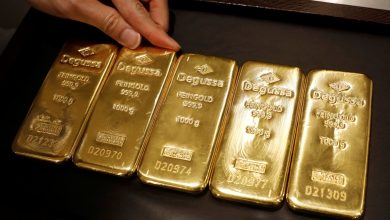
The geopolitical risk premium has receded, with gold maintaining range-bound fluctuations while awaiting a recovery.

Gold prices extended their rebound during the European session, reaching a high near $4,465, largely recouping some of the losses from the previous trading day. This rebound was primarily driven by a pullback in the US Dollar Index. According to market surveys, the United States postponed a potential strike on Middle Eastern energy facilities and extended negotiation deadlines, easing concerns about an escalation of conflict and thereby weakening demand for the dollar as a safe-haven asset, providing short-term support for gold.
However, considering the overall environment, gold’s upward momentum still appears insufficient. Although geopolitical risks have not completely dissipated, the market is more focused on their transmission effects on energy prices and inflation. With oil prices remaining high, inflation expectations have heated up again, leading to significant changes in market assessments of major central banks’ policy paths. The prevailing expectation is that major central banks, including the Federal Reserve, will maintain a hawkish stance, with further rate hikes not ruled out.
This shift in expectations directly pushed US Treasury yields to remain elevated, thereby pressuring non-interest-bearing assets like gold. In a high-interest-rate environment, the opportunity cost of holding gold rises, prompting funds to flow toward income-generating assets, making it difficult for gold prices to form a sustained upward trend.
 Additionally, repeated developments surrounding the situation in the Middle East have exacerbated market uncertainty. On one hand, the United States has signaled de-escalation; on the other hand, relevant countries have denied progress in negotiations while continuing military deployments. This uncertainty, while offering some support to safe-haven demand, has not translated into sustained buying pressure but instead made market sentiment more cautious.
From a technical perspective, gold’s daily chart shows clear signs of weakening. Previously, prices broke below the key 100-day moving average, and this week’s rebound faced resistance near that level, confirming its transformation into a significant barrier. The current 100-day moving average is near $4,630, becoming a critical threshold for short-term bulls to break through. In terms of trend structure, prices have shifted from an uptrend to a sideways-to-bearish pattern, with the moving average system starting to flatten and slightly decline.
In terms of momentum indicators, the MACD continues to operate below the zero line, with the fast line below the slow line, indicating that bearish momentum remains dominant. While the RSI has recovered from oversold territory, it remains in the lower range around 30, reflecting weak market demand, with the rebound being more of a corrective nature. If prices fail to stabilize above the key moving averages, the bearish structure is unlikely to change.
From the 4-hour chart, gold shows a short-term rebound and correction pattern, but upward momentum is clearly lacking. Prices stagnated after touching above $4,460, indicating strong selling pressure at higher levels. Short-term moving averages show signs of turning, but a valid bullish alignment has yet to form. The MACD histogram briefly turned positive before quickly contracting, showing that the rebound lacks sustainability. The RSI rose to the neutral zone but did not enter the strong zone, indicating limited bullish momentum.
In terms of key technical levels, initial resistance is located at $4,630, with further resistance at $4,820 and the $5,000 area. Support is found at $4,380, and a break below this level could lead to a further decline toward the $4,120 region. Overall, while there may be a short-term rebound, the structure remains bearish, warranting caution against a pullback after a rally.
Editor’s Summary:
The gold market is currently in a typical phase of tug-of-war between ‘safe-haven support and interest rate suppression.’ While geopolitical tensions provide a floor for gold prices, inflation expectations and rising interest rate trends significantly limit upside potential. From a technical perspective, gold has yet to escape downward pressure, with rebounds being more of a temporary correction. In the short term, a sideways-to-weak trend is expected, while the medium-term outlook will depend on changes in interest rate expectations and the direction of the dollar.