Rising oil prices have pushed up inflation expectations, dampening safe-haven demand, while gold remains range-bound.

Gold prices came under significant pressure during the Asian session on Monday, with XAU/USD opening more than 1% lower and hitting a low near USD 4,445, extending its previous corrective trend. In stark contrast to gold, crude oil prices continued to strengthen, with WTI crude rising about 3% at the open and moving above USD 102.50, reflecting renewed concerns in the energy market over supply risks due to escalating conflicts in the Middle East. This combination of ‘strong oil, weak gold’ reflects a shift in market trading logic from purely risk aversion to inflation and interest rate expectations taking the lead.
From an event-driven perspective, the situation in the Middle East remains the core driver of the current market. Expectations of further U.S. military action against Iran have been intensifying, with market surveys indicating that the U.S. Department of Defense plans to deploy an additional 10,000 troops to the Middle East, significantly heightening concerns over potential conflict spillover. Meanwhile, Iran’s strong rhetoric has further escalated geopolitical risks. On another front, the U.S. has also signaled a willingness to de-escalate, with surveys showing that the U.S. President mentioned ongoing indirect negotiations with Iran and expressed optimism about reaching an agreement in the short term. This coexistence of ‘conflict escalation and negotiation expectations’ has led to a clear divergence in market sentiment.
From a market reaction standpoint, rising inflation expectations driven by higher oil prices have become a key factor weighing on gold. Theoretically, when inflation expectations rise, major central banks tend to maintain higher interest rates or even tighten monetary policy further, increasing the opportunity cost of holding non-interest-bearing assets. As a typical non-yielding asset, gold’s appeal diminishes significantly in a high-interest-rate environment. Therefore, although geopolitical risks typically support gold, the current market is more focused on the transmission path of ‘high oil prices → high inflation → high interest rates,’ causing gold prices to decline instead.
 In terms of global market impact, rising energy prices are reshaping the macro-trading framework. On one hand, rising inflation expectations may delay the pace of interest rate cuts by major economies, putting pressure on bond markets; on the other hand, the U.S. dollar remains relatively strong, supported by both safe-haven demand and interest rate differentials, adding extra downward pressure on gold. Additionally, inter-market correlations among commodities have strengthened, with rising crude oil exerting a ‘crowding-out effect’ on the metals market, as capital flows more into the energy sector rather than precious metals.
Analyzing from the perspective of market sentiment, the current decline in gold prices is not driven by a single factor but rather the result of multiple overlapping dynamics. On one hand, geopolitical risks provide underlying support, limiting deep corrections in gold prices; on the other hand, inflation and interest rate expectations dominate the short-term direction, causing the price center to continue shifting downward. Investors’ focus is currently concentrated on two aspects: whether the situation in the Middle East escalates further, and whether major central banks adjust their policy paths due to inflation pressures.
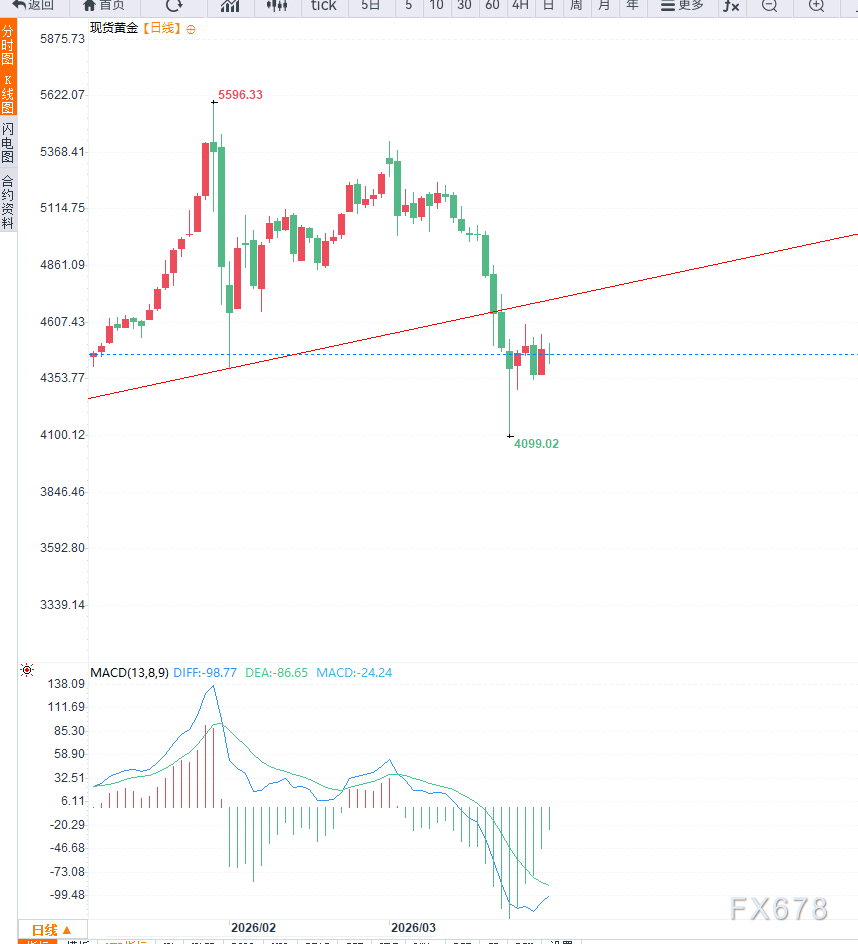
From a technical analysis perspective, on the daily chart, gold prices have broken below a key structural range, forming a clear downtrend, with consecutive bearish closes since the peak of USD 5,300, indicating market dominance by sellers. The current price is trading below the 20-day exponential moving average (EMA), which acts as dynamic resistance near USD 4,735. The upper resistance zone is concentrated between USD 4,736 and USD 4,915. If this level cannot be effectively breached, it will continue to suppress rebound potential. Momentum indicators show that the 14-day Relative Strength Index (RSI) remains in the 20-40 range, indicating the market is still in a weak zone but has not entered extreme oversold conditions. On the 4-hour chart, prices exhibit a volatile downtrend pattern, with limited upside momentum in the short term. If a rebound is capped near USD 4,735, the downtrend may persist; initial support below is located at USD 4,307, and a break below could push prices toward the USD 4,100 area. Overall, until the key resistance zone is breached, short-term bears remain dominant.
Editorial Summary
The gold market is currently caught in a tug-of-war between ‘geopolitical support’ and ‘interest rate pressure.’ While the Middle East conflict provides some floor support for gold prices, rising inflation expectations fueled by higher oil prices have led the market to reprice for a high-interest-rate environment, thereby reducing gold’s attractiveness. In the short term, gold may continue to trade in a volatile downtrend unless geopolitical risks escalate beyond expectations or monetary policy expectations undergo a significant shift, in which case upside potential for gold would remain limited. Going forward, close attention should be paid to changes in inflation data and central bank policy signals, which will determine the medium-term trajectory of gold prices.