From a safe-haven asset to an emergency liquidity tool, gold has quietly ‘transformed’ amidst the flames of conflict.

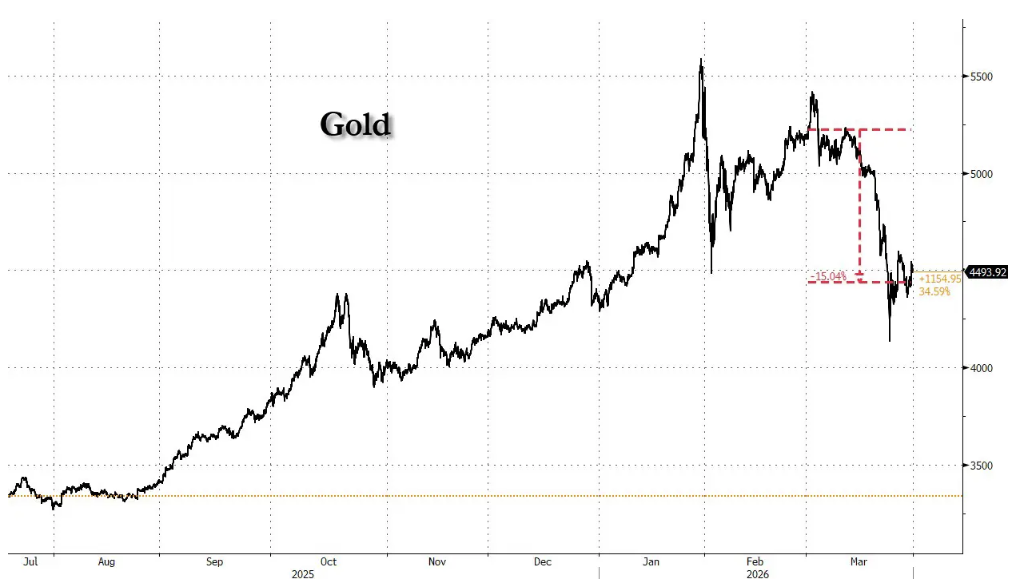
Gold prices have fallen by 15% since the outbreak of the war, moving in a direction contrary to general market expectations. Under extreme political pressure, gold has transformed from a traditional safe-haven asset into an emergency liquidity tool for central banks. The Central Bank of Türkiye has sold or swapped approximately 60 tons of gold reserves; the Central Bank of Russia is also continuing to reduce its gold holdings. Analysts suggest that Gulf oil-producing countries may similarly be selling gold due to a significant decline in energy export revenues.
Gold prices have fallen by 15% since the outbreak of the war, moving in a direction contrary to general market expectations. This reveals a quiet shift in gold’s role under extreme geopolitical pressure—from a traditional safe-haven asset to an emergency liquidity instrument for central banks and governments.
Since the United States and Israel launched an attack on Iran on February 28, the Central Bank of Türkiye has sold or swapped about 60 tons of gold reserves within just two weeks. Meanwhile, the Central Bank of Russia continues to reduce its gold holdings. Analysts suggest that Gulf oil-producing countries may similarly be selling gold due to a significant decline in energy export revenues.
The concentrated selling by multiple central banks is reshaping the supply-demand dynamics of the gold market. This trend indicates that for economies deeply embroiled in the war, the primary function of gold is no longer wealth preservation but rather obtaining urgently needed funds, energy, and materials.
This ‘transformation’ of gold is not an isolated market anomaly but a microcosm of the accelerating global evaporation of wealth. Unlike limited regional conflicts over the past few decades, the current war is destroying productive capacity on an unprecedented scale, with impacts on the global economic system far exceeding any previous crisis.
Central Bank Sell-Off: The Wave of Sales from Türkiye to Russia
The reduction actions taken by the Central Bank of Türkiye are noteworthy in both scale and speed. Selling or swapping approximately 60 tons of gold within two weeks highlights the considerable liquidity pressures it faces.
As a net energy-importing country neighboring the conflict zone, Türkiye is under dual pressure: on one hand, energy import costs have surged sharply amid escalating hostilities; on the other, foreign exchange revenue channels have narrowed due to geopolitical tensions, forcing it to tap into gold reserves to bridge the gap.
The continued reduction by the Central Bank of Russia reflects broader fiscal pressures. Meanwhile, conditions in Gulf oil-producing countries are also concerning—tankers have been blocked in the Strait of Hormuz, and petrodollar revenues have plummeted, compelling some nations to consider selling previously accumulated gold reserves to sustain operations.
The collective sell-off has weighed down gold prices, delivering a major blow to bullish positions that had anticipated a rise in gold driven by the war.
The ‘Three States’ of Gold: Geopolitical Temperature Determines Asset Attributes
Gold exhibits markedly different behaviors under varying levels of geopolitical tension. During periods when geopolitical tensions rise but remain contained, gold serves as a liquidity hedge, making it the preferred choice for institutions and governments to mitigate risks.
However, when the intensity of conflict surpasses a critical threshold, the nature of gold undergoes a qualitative shift in the hands of its holders—gold cannot satisfy hunger nor directly pay bills, forcing distressed holders to liquidate it in exchange for more urgently needed supplies and funds.
In extreme scenarios, when government-issued fiat currencies lose all credibility due to hyperinflation, gold reverts to its most ancient form—a store of value and medium of exchange that transcends human history.
The current 15% decline corresponds precisely to the second phase of war: liquidity crises have overwhelmed safe-haven demand, with large-scale liquidation becoming the dominant theme.
The Scale of Wealth Destruction: Why This War is Different
The decline in gold prices itself serves as a window into the scale of global wealth destruction.
Over the past few decades, the geographic scope of wars has been relatively limited, having minimal impact on overall global economic prosperity, while the global economic system had sufficient resilience to offset war-related losses through normal market mechanisms.
The nature of the current conflict is fundamentally different. Production capacity is being destroyed on a large scale, while nations, driven by national security concerns, are rushing to rebuild redundant infrastructure systems. The resulting capital demands and accelerated capital depletion occur simultaneously, creating a rare and dangerous compounding effect.
Unlike any crisis in the past fifty years, there was ample idle production capacity globally at the time, and fiscal expansion along with quantitative easing could still effectively stimulate demand and fill gaps.
Inflation Dilemma: Fiscal Expansion Fails to Resolve Structural Contradictions
In a wartime economic environment constrained by production capacity, the policy tools commonly used by governments face severe challenges.
Fiscal expansion and quantitative easing struggle to play their traditional roles in this context—when productive capacity itself is impaired, injecting more money tends to drive up price levels rather than boost output.
Under the current wartime supply constraints, inflation will become an even harder-to-resolve primary contradiction. For investors, this implies that asset allocation logic needs to adapt to a new environment characterized by higher inflation, elevated capital costs, and significantly diminished effectiveness of traditional policy tools.
The short-term “emergency liquidity” attribute of gold may not negate its value preservation function over longer cycles, but the scale of wealth destruction revealed by the ongoing sell-off is enough to keep markets highly vigilant about the global economic outlook.
Editor/Lambor