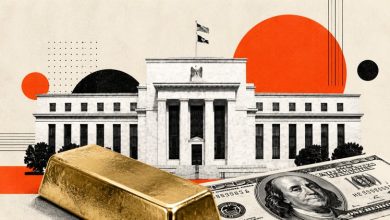
Has gold reached bear market territory?

This week’s insights come from Morningstar’s market strategist, Lochlan Halloway.
What now?
Investment markets were rocked by the US and Israel launching strikes on Iran, as we now accept the likelihood of a prolonged conflict.
Whilst no one can definitively predict the future, our base case is that the current disruption is a logistical bottleneck rather than a structural one. We expect the US Navy to eventually sweep the mines, secure the Strait, and release roughly 3.7 million barrels per day of spare capacity from Saudi Arabia and the UAE into the market.
On that view, Brent drifts back toward US$70 per barrel by year-end, and our long-run midcycle assumption of US$65 per barrel holds. That’s our central case, but it’s highly uncertain in the near-term, and we can’t completely rule out a longer, more damaging conflict.
Gold outflows telling
The conflict has led to a mass sell-off across equity markets, however not every asset is on sale. Gold peaked January 2026 at roughly US$5,600 and at the time there were arguments to support some of this. But Halloway suggests the latter stages of gold’s bull run became more and more detached from fundamentals and overwhelmingly, the marginal buyer of gold was the speculator.
The evidence for this sits in ETF flows. For almost two years gold ETFs saw virtually unbroken inflows. As the price marched higher, buyers were drawn in and prices pushed higher still, and the cycle repeated.
The pattern broke earlier this month when only days after the initial strikes. We’ve now seen three consecutive weeks of outflows from gold ETFs, the first time this has happened since April 2024. The same self-reinforcing cycle that pushed gold to record highs is now working in reverse. Gold briefly entered “bear market” territory (a 20% fall from the recent peak) on Monday.
We don’t know if this is the end of gold’s stellar bull run, or just an aberration. But there is a broader point here. Higher prices erode the margin of safety for an asset, even a safehaven asset.
Yes, gold is insurance against debasement, geopolitical risk, war, and so on. But you’re paying a lot for that insurance, and at some point, the premiums start to outstrip the potential payoff.
The full edition is available to Morningstar Investor subscribers and trialists.