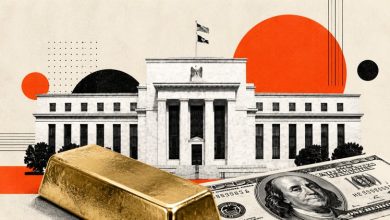
Gold Drops 15% From Record Highs But Standard Chartered Says Buy The Dip – SPDR Gold Shares (ARCA:GLD)
Gold has lost 15% since hitting a record $5,589 in January, but Suki Cooper, Standard Chartered’s global head of commodities research, says the worst of the selling may be behind it.
She argues that the sell-off follows a well-documented pattern in which investors liquidate gold to meet margin calls during market distress, a process that typically lasts four to six weeks before they rebuild their positions.
During the global financial crisis, it took more than four months. SPDR Gold Shares (NYSE:GLD) is currently trading around $435, down from its 52-week high above $509.
Gold Went From Most Overbought Since 1999 To Most Oversold Since 2013
Cooper notes that gold went from its most overbought level since 1999 in January to its most oversold since 2013. Options traders are pricing in volatility not seen since the pandemic.
As Benzinga previously reported, gold’s worst month since 2008 has seen GLD record over $8 billion in outflows.
Net ETF redemptions in March were on track for the steepest monthly decline since September 2022. But the pace of liquidation has started to slow, suggesting the frothy positioning may be largely flushed out.
Wells Fargo raised its 2026 year-end gold target to $6,100 to $6,300 per ounce, implying roughly 28% to 33% upside from current levels. JPMorgan sits at $6,300 and UBS at $6,200.
Not everyone is so bullish. Bloomberg Intelligence’s Mike McGlone warned this week that gold may have shifted from safe haven to “risk asset,” and that the 2026 high could mirror the 1980s generational peak.
What Prediction Markets Are Pricing
Cooper argues gold has not yet priced in recession or stagflation risk. That matters because gold tends to rise roughly 15% on average during recessions.
Polymarket’s 2026 recession contract is trading at 30%, down from a recent high of 37%.
Polymarket traders price a ceasefire at 38% by the end of April, and 66% by the end of June.
Polymarket gives just a 21% chance that Strait of Hormuz traffic returns to normal by the end of April.
If the war is short, the bears may be right. If it isn’t, and Cooper’s thesis holds, gold could be very cheap.
Image: Shutterstock