Gold and the Iran War: Why a Market That Thrives on Fear Is Struggling in an Actual War
Gold is supposed to be the asset you buy when the world is falling apart. Wars, crises, chaos, uncertainty. Every textbook will tell you that when things get bad, money flows into gold. It is the oldest safe haven in financial history. So someone needs to explain what is happening right now.
The United States and Israel launched joint military strikes on Iran on February 28. The Supreme Leader was killed. Iran closed the Strait of Hormuz, triggering the largest energy supply disruption since the 1970s oil crisis. The conflict is now in its 36th day. Ceasefire talks have collapsed. Iran is downing US warplanes and threatening to expand its maritime blockade to a second major global shipping route.
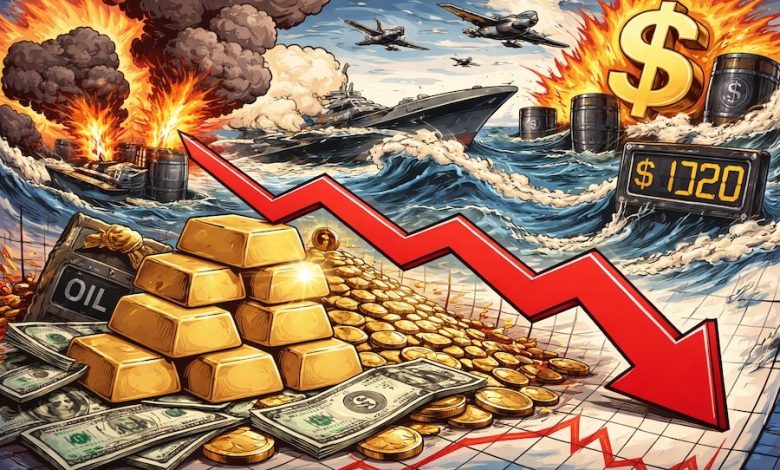
And gold is down roughly 17% from its peak.
The setup that fooled everyone
To understand what is happening now, you need to understand what happened before the war started.
Gold saw the conflict coming before most people did. Through late 2025 and into January 2026, as US-Iran tensions escalated steadily, gold posted more than 50 new record highs in a single year and delivered annual returns of over 60%. By January 28, with the drumbeat of war growing louder by the day, gold touched an all-time high of $5,602 per ounce.
Then the bombs actually fell. And gold started dropping.
By late March it had fallen to around $4,100. It has since partially recovered to the $4,600 to $4,700 range. But it remains well below where it was when the war was still a threat rather than a reality. The asset that thrives on fear apparently priced in this particular fear before the fear materialized.
The paradox at the centre of it
Here is what nobody posting gold price charts on social media is explaining clearly.
The Iran war is not just a geopolitical event. It is an oil price event. When Iran closed the Strait of Hormuz, Brent crude surged past $120 per barrel. WTI crude crossed $111. Oil is up roughly 40% from pre-war levels. That matters enormously for gold, and not in the way you would expect.
Higher oil prices drive inflation expectations higher. Higher inflation expectations push US Treasury yields up and strengthen the dollar. Gold is a non-yielding asset, meaning it pays no interest or dividends. When yields on Treasury bonds rise, the opportunity cost of holding gold goes up. Investors can earn a real return sitting in bonds. They cannot earn anything sitting in gold. So money moves out of gold and into yield-bearing assets.
At the same time, a stronger dollar makes gold more expensive for buyers in every other currency, reducing international demand. The result is a war that should be the ultimate safe-haven trigger is instead creating macroeconomic conditions that actively work against the safe-haven trade.
One analyst quoted by Euronews captured it plainly. When people are worried about the future, they buy gold. When they are worried about the present, they sell it. The future arrived. People sold.
What Trump’s speech did to the market
On April 1, Trump addressed the nation on the Iran war. Markets had been hoping for signals of a path toward ceasefire. Instead he vowed to hit Iran extremely hard over the next two to three weeks. The speech was unambiguous about escalation.
Gold fell 2.7% the following day. Silver fell nearly 5%.
The dollar strengthened sharply. Inflation expectations, measured by CPI nowcasts, jumped to 3.71% from 3.25% in March. The paradox deepened. The more aggressively the war was prosecuted, the more it fed the dollar and hurt gold in the short term.
Ceasefire talks have since collapsed entirely. Iran rejected all US demands, including reopening Hormuz, and presented its own list of conditions the US is unlikely to accept. Iran is now hinting at expanding the blockade to the Bab el-Mandeb strait, which would threaten a second critical global shipping route.
The longer picture
None of this means the gold story is over. The numbers tell a more nuanced story.
Gold is still up 54% year over year. A year ago it traded at $3,037 per ounce. The long-term uptrend remains intact above its 200-day moving average near $3,960. Central banks are buying gold at roughly 60 tonnes per month, far above the pre-2022 average of 17 tonnes. The structural demand underpinning prices has not gone away.
The major banks have not pulled their price targets either. Goldman Sachs sees potential upside past $7,000. JP Morgan has a target of $6,300. Deutsche Bank is forecasting $6,000. These are not predictions for this week. They are medium-term projections based on the assumption that the conditions driving gold higher over the past two years remain in place.
There is also a supply side story developing quietly. The Hormuz blockade has sent diesel prices for mining operations up over 70% in under a month. Newmont has revised its cost of production upward significantly. Barrick Gold is restructuring operations. If the war drags on, the cost of getting gold out of the ground goes up, which matters for long-term supply.
Where this leaves us
Gold has not failed as a safe-haven asset. It anticipated this war better than most analysts did and priced in the risk before the first strike was launched. What has happened since is not a failure of the gold thesis. It is a collision between the geopolitical story and the macroeconomic reality that the war itself created.
The short-term picture is messy. A war that will not end, a dollar strengthened by the chaos it causes, yields rising because the oil shock is inflationary. Gold is caught in the middle of forces pulling in opposite directions.
But if the war eventually ends, or if the Fed moves back toward rate cuts, or if the dollar weakens as the cost of the conflict weighs on the US economy, the conditions that drove gold to $5,600 will reassert themselves quickly.
The metal that thrives on fear is not struggling because the fear is gone. It is struggling because the fear became something more complicated. And complicated situations, in markets as in everything else, tend to resolve themselves eventually.