The ultimate test for US stocks? SpaceX is finally going pub…
A major development has been revealed regarding SpaceX, the largest private space exploration company led by Elon Musk. The company has significantly moved up its schedule for an initial public offering (IPO), with insiders indicating that a formal registration statement could be filed as early as May 21. A global roadshow targeting institutional investors will kick off on June 4, and the company is expected to list on the Nasdaq market as soon as June 12.
The funds raised through this IPO are expected to exceed $80 billion, with a market capitalization forecasted to reach between $1.75 trillion and $2 trillion. This is likely to become the largest IPO in human history within the capital markets.
First, a full acceleration of large-scale and regular launches of the next-generation heavy spacecraft ‘Starship’.
Second, substantial investment in building and deploying a ‘space data center’ network in low Earth orbit (LEO).
1. Capital Strategy: Support from major companies and lowering barriers for individual investors through stock splits
● Implemented a 1-for-5 stock split:SpaceX has already notified shareholders via email that it will implement a stock split where one share becomes five. As a result, the fair value per share will be adjusted from $526.59 to approximately $105.32. The aim is to lower investment barriers and attract more inflows from individual investors.
● Mr. Musk ‘will not sell any shares’:In response to market concerns about potential profit-taking by executives, Mr. Musk explicitly stated on X (formerly Twitter) that he has no intention of selling any of his SpaceX shares. This is an important indicator in assessing potential selling pressure during this IPO. It alleviates some investor concerns regarding major shareholders’ sales or exits, providing reassurance to the market.
●Major institutional investors’ large-scale investment: According to sources familiar with the matter, BlackRock, the world’s largest asset management company, is considering participating in this IPO with an investment ranging from $5 billion to $10 billion. The final investment amount will be determined based on SpaceX’s offering price and other related factors. If the deal goes through, it would mark one of the largest single underwriting amounts in an IPO over the past 25 years.
2. Business Expansion: Integration of xAI’s computing power, cross-industry expansion by major firms
●The financial structure of ‘SpaceX + xAI’:One of the biggest focal points of this public listing is that SpaceX has formally incorporated Musk’s AI unicorn, xAI, into its business framework. The prospectus is expected to disclose detailed financial data of the integrated companies for the first time.This will serve as a core basis for Wall Street to verify the reasonableness of the $2 trillion corporate valuation.
3. Hardware synergy: The first flight of Starship V3
This V3 model represents the ‘biggest selling point before the filing of the prospectus’ and has undergone radical design changes. The entire rocket is equipped with the upgraded ‘Raptor 3’ engines, significantly enhancing thrust and thermal management capabilities. Additionally, the Super Heavy booster, the Starship upper stage, and the second launch pad have all been redesigned to fully meet stringent requirements for rapid full reusability, on-orbit propellant refueling, and future manned Mars exploration.
This flight will mark the first launch of the Starship following substantial upgrades. SpaceX faces mounting pressure to demonstrate that its hardware can reliably support NASA’s Artemis lunar exploration program.
 What is the investment strategy for related stocks?
Major companies going public often become a catalyst for industry restructuring. SpaceX’s attempt at the largest IPO in history is likely to serve as a powerful trigger for both space and AI themes. So, which related stocks should investors focus on?
![A major development has been revealed regarding SpaceX, the largest private space exploration company led by Elon Musk. The company has significantly moved up its schedule for an initial public offering (IPO), with insiders indicating that a formal registration statement could be filed as early as May 21. A global roadshow targeting institutional investors will kick off on June 4, and the company is expected to list on the Nasdaq market as soon as June 12. The funds raised through this IPO are expected to exceed $80 billion, with a market capitalization forecasted to reach between $1.75 trillion and $2 trillion. This is likely to become the largest IPO in human history within the capital markets. The massive amount of funds raised this time will be primarily allocated to two key strategic initiatives. First, a full acceleration of large-scale and regular launches of the next-generation heavy spacecraft 'Starship'. Second, substantial investment in building and deploying a 'space data center' network in low Earth orbit (LEO). [Smart]Recent notable developments 1. Capital strategy: Support from major corporations...](https://sgsnsimg.moomoo.com/sns_client_feed/181250687/20260519/web-1779159968825-GR1ZH1MyYL.png/big?area=105&is_public=true&imageMogr2/ignore-error/1/format/webp)
If you can’t invest directly in SpaceX, there are indirect ways to do so.One method is to buy shares of publicly traded companies or investment funds that hold SpaceX stock.This is one approach.
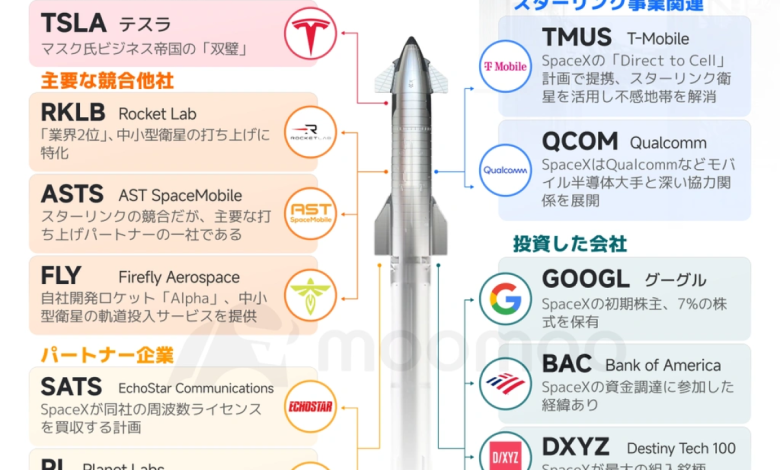
The expansion of the Starlink business directly benefits related publicly traded companies.$T-Mobile US (TMUS.US)$is working with SpaceX on the ‘Direct to Cell’ initiative, aiming to eliminate mobile dead zones using Starlink satellites.$Qualcomm (QCOM.US)$A leading mobile chip company is also advancing its technical partnership with SpaceX,$flyExclusive (FLYX.US)$has signed a Starlink sales agency agreement.
Not only direct collaborators,Companies tied to SpaceX through capital and operations may also move in tandem with IPO progress.。$Tesla (TSLA.US)$ goes without saying.Competitive SectorIn this space,$Rocket Lab (RKLB.US)$ secures second place in the industry for small and medium-sized satellite launches.$AST SpaceMobile (ASTS.US)$is an unusual entity that both competes with Starlink and serves as one of SpaceX’s key launch partners.$Firefly Aerospace (FLY.US)$is penetrating the commercial market with its own rockets.
4. Core companies in the space business supply chain are being closely watched
Expectations for SpaceX’s IPO aresemiconductor, defense, and materials manufacturersalso spreading to them.
With the expansion of the space economy, these supply chain companies are gaining attention from a long-term perspective.
Risk: The ultimate test for US stocks?Passive funds may face rebalancing pressures
This implies that if SpaceX, OpenAI, and Anthropic (US) achieve their listings and reach their expected valuations, they could rapidly become eligible for inclusion in passive funds (index-tracking funds). At first glance, this might seem to provide buying support for newly listed stocks. However, it also means that passive funds may face the need to raise capital by selling existing holdings.
Currently, about 60% of US-managed assets are passively managed, with portfolios highly concentrated in large-cap tech stocks. If new mega-companies are added to the index, related funds might be forced to sell existing components to secure funds for incorporating these new stocks.
This shift could redefine the supply-demand structure of the US stock market that has persisted over recent years. The number of publicly traded companies in the US has declined from over 8,000 in the 1990s to about 4,000 last year. In a sense, the reduced number of listed companies has supported the valuation of existing major players. However, if ultra-large companies go public in succession and high-quality assets available for purchase suddenly increase, the traditional allocation weight toward existing large tech giants could dilute.
Active funds begin portfolio adjustments ahead of time; Mag 7 comes under focus.
Ahead of the official pricing decision for SpaceX’s IPO, actively managed funds have already begun moving. It’s believed that several major investment trusts are considering reducing (selling) their positions in highly liquid large-cap tech stocks to secure funds for participating in SpaceX’s IPO. A more direct signal is the overheated response during SpaceX’s investor roadshow at its Texas launch facility, where attendance demand exceeded aircraft seating capacity.
Overall, if SpaceX, OpenAI, and Anthropic go public as planned, the event will undoubtedly become one of the most anticipated market events on Wall Street in the short term. However, the true challenge for the US stock market isn’t whether these companies have attractive growth stories but whether there’s sufficient fresh capital in the market to absorb such a massive influx of new equity supply.
Driven by narratives around AI, the stock buyback boom, and the interplay with index investing, the bullish trend in US stocks has already reached historically high levels. Mega-IPOs may push market euphoria to its peak, but they could simultaneously serve as a critical stress test challenging the liquidity and valuation resilience of the market.
-moomoo News Sherry
This article uses partial automatic translation.
Chase the uptrend and automatically set sell orders at highs! Secure profits automatically with a trailing stop order!
![A major development has been revealed regarding SpaceX, the largest private space exploration company led by Elon Musk. The company has significantly moved up its schedule for an initial public offering (IPO), with insiders indicating that a formal registration statement could be filed as early as May 21. A global roadshow targeting institutional investors will kick off on June 4, and the company is expected to list on the Nasdaq market as soon as June 12. The funds raised through this IPO are expected to exceed $80 billion, with a market capitalization forecasted to reach between $1.75 trillion and $2 trillion. This is likely to become the largest IPO in human history within the capital markets. The massive amount of funds raised this time will be primarily allocated to two key strategic initiatives. First, a full acceleration of large-scale and regular launches of the next-generation heavy spacecraft 'Starship'. Second, substantial investment in building and deploying a 'space data center' network in low Earth orbit (LEO). [Smart]Recent notable developments 1. Capital strategy: Support from major corporations...](https://sgsnsimg.moomoo.com/sns_client_feed/181250687/20260519/web-1779160448759-KNCukAwfMg.webp/big?area=105&is_public=true&imageMogr2/ignore-error/1/format/webp)