Kotlikoff Addresses Campus Politics At 2026 State of the University Address
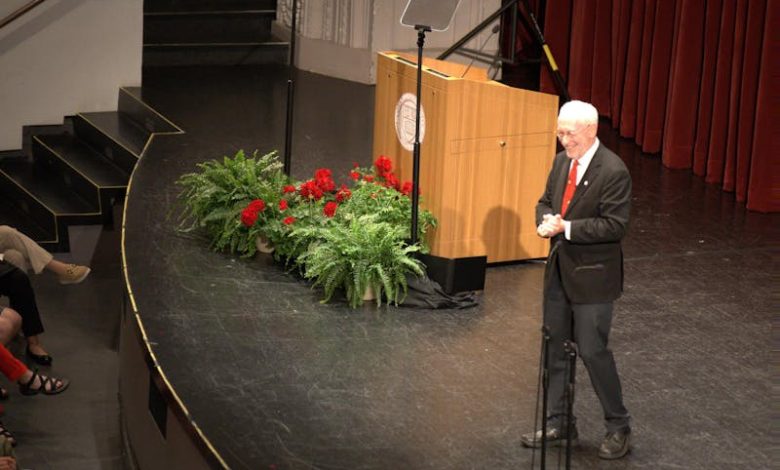
President Michael Kotlikoff delivered the annual State of the University address, covering topics including controversial speakers, freedom of speech and Cornell’s relationship with the federal government, in Bailey Hall during Cornell’s alumni reunion weekend on Saturday. The address was open to registered reunion attendees and Cornell community members who presented a reunion button.
The approximately 30-minute speech received a standing ovation from the audience at its conclusion, followed by a 10-minute Q&A session, then a performance of Cornell’s alma mater by The Hangovers and After Eight. During the Q&A session, members of Students for a Democratic Cornell and Cornell Courage criticized the University’s relationship with the Trump administration and Cornell’s usage of the Student Code of Conduct.
Attendees participated in the tradition of holding each other and swaying during The Hangovers and After Eight’s performance of the alma mater.
Kotlikoff began by congratulating the Class of 2021 on its five year reunion and welcomed other classes present.
“Whether it’s been five years since you were last on campus or 50, the past few years have been deeply consequential ones, for Cornell and for our nation,” Kotlikoff said.
Kotlikoff then spoke about the founding values of Cornell in tandem with the United States’ upcoming 250th anniversary, tying in the concept of “… any person … any study” to the values of democracy in the United States.
Afterward, Kotlikoff shared how he felt the federal government’s immigration policy has sparked concern for students which he stated “made many students rethink their plans.” He also mentioned that international applications to research doctoral plans were down 29% this year at Cornell.
The federal government’s influence on education remained a key theme of the first half of the speech as Kotlikoff transitioned to discussing funding for military students. He noted how Cornell’s military history is a commitment he fully supports and is working to build.
Kotlikoff then transitioned to freedom of speech, referencing controversial speakers that were hosted by Cornell, adding that the speakers were ones “we knew would draw protest.”
He first referenced Students for Justice in Palestine at Cornell hosting anti-war activists and former U.S. military officers Anthony Aguilar and Greg Stoker in April, Cornellians for Israel hosting former Hamas hostage and Oct. 7 attacks survivor Maya Regev in March, then Cornell Republicans hosting Boris Johnson in April and the University hosting Angela Davis in February 2025.
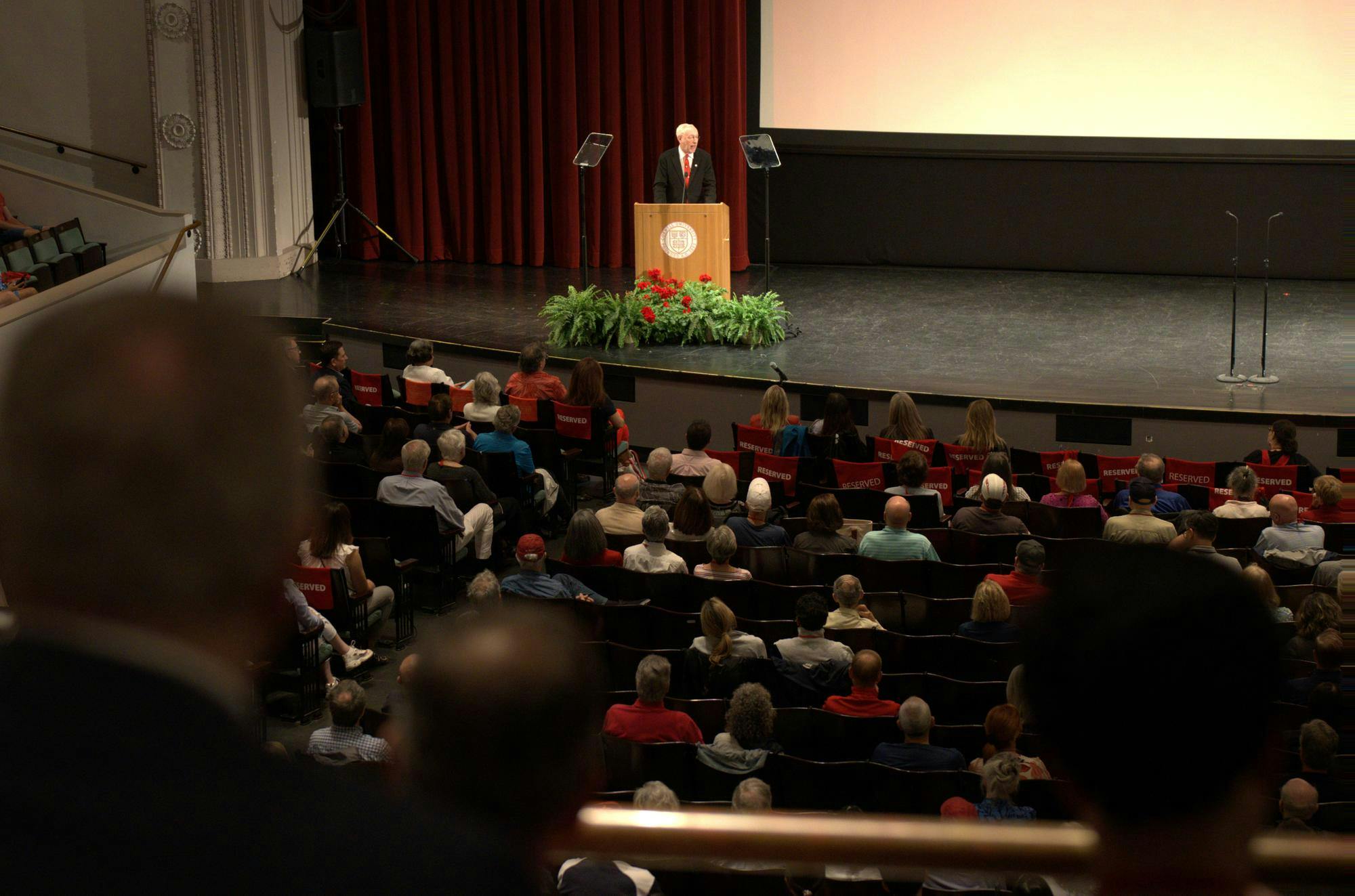
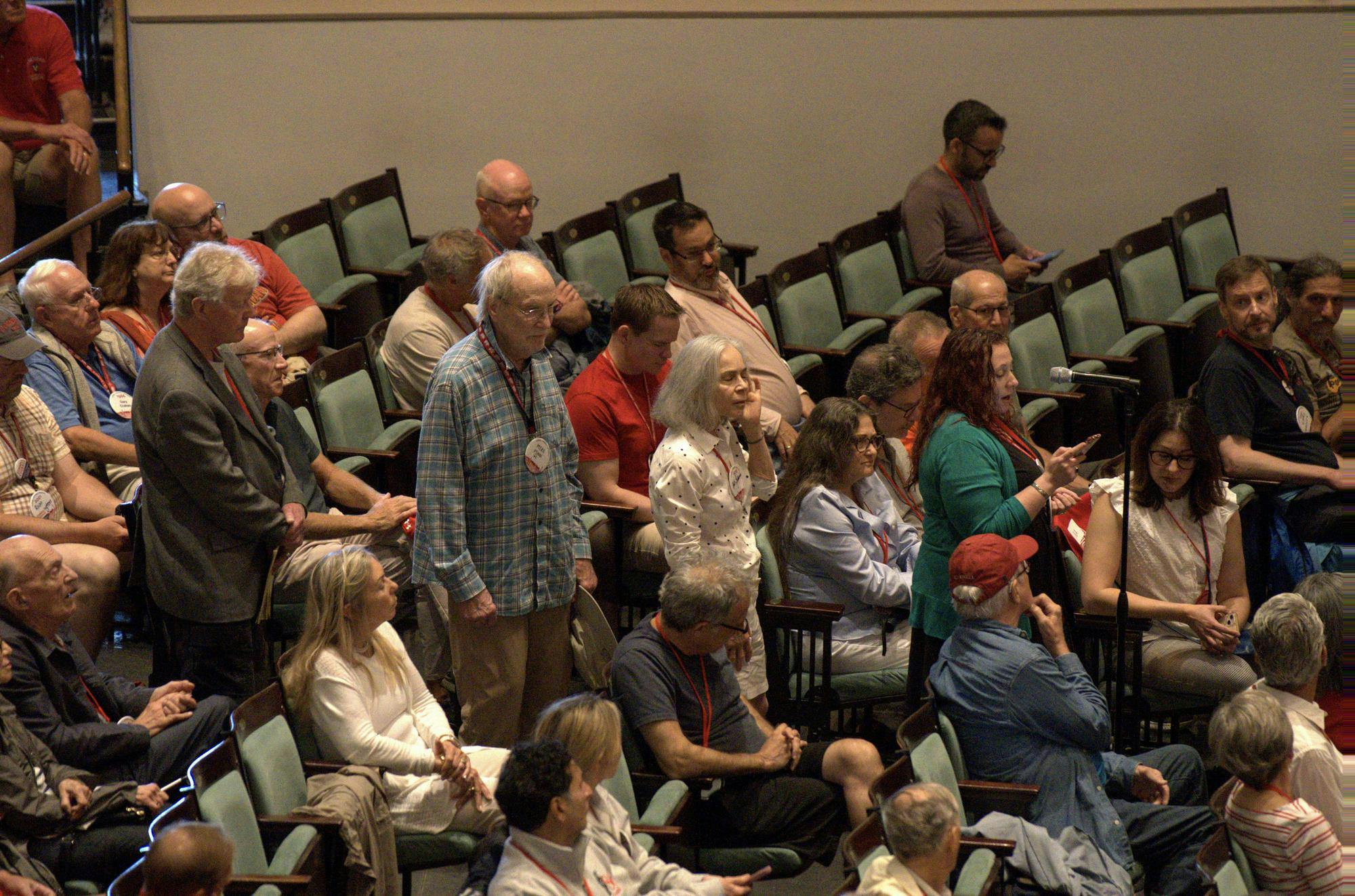
Alumni from multiple class years were present at the speech.
“This is what universities are for. Demonstrating civil discourse and how a society protects everyone’s rights: everyone’s speech, everyone’s right to go to class or the library, everyone’s right to pursue their own goals and hold their own views,” Kotlikoff said. He emphasized the importance of giving all viewpoints a platform.
He then spoke on the Expressive Activity Policy, asserting that it’s “time, place and manner restrictions that ensure that one person’s right of free expression doesn’t interfere with other people’s rights to go about their business.” The policy was finalized in April 2025 following a controversial rollout.
The final third of Kotlikoff’s speech centered on federal funding.
Kotlikoff explained two University goals following stop-work orders and non-payment of grants from the federal government: “One, restoring the funding that is so vital to our faculty and staff, our graduate students, and our research; and two, doing so in a manner that maintained Cornell’s independence, as an institution bound by the law rather than political mandates,” Kotlikoff said.
Following a $250 million funding freeze in April 2025, Cornell reached a settlement with the federal government in November, agreeing to give $30 million to the federal government and invest an additional $30 million into agriculture funds over the next three years, restoring funding.
“It took nine months of holding our ground, but we were able to achieve both of those goals,” Kotlikoff said.
In the speech, Kotlikoff commented on what he expressed as a lack of communication from the government about timing for research grants alongside the government’s increasing involvement in deciding which research receives funding.
“This change violates the most fundamental principle underlying our system of federally funded research … the principle that our nation should fund the science and discovery that will make the greatest contribution to human knowledge and to the wellbeing of our nation, people and planet,” Kotlikoff said.
Kotlikoff said that just under 500 Ph.D. students were accepted for this year’s admissions cycle, differing from the approximately 750 admitted two years ago, he added. He was met with gasps from the audience.
Lastly, Kotlikoff discussed the Committee on the Future of the American University, led by Provost Kavita Bala, noting its priority to address three pressures: technological change, universities’ changing relationship with the federal government and eroding trust in education.
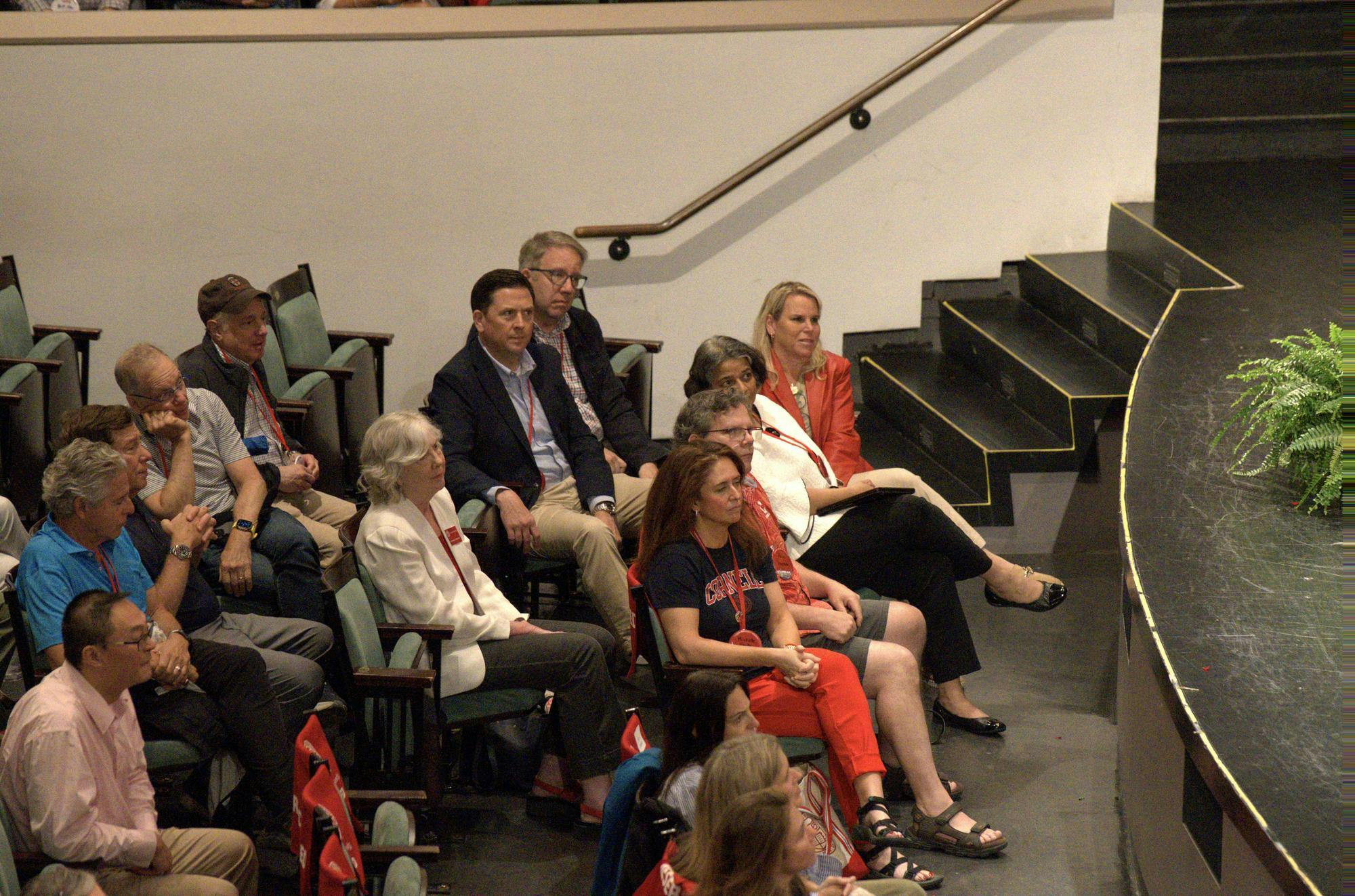
Administrators including Provost Kavita Bala were present at the address.
Q&A Session
After the speech’s conclusion, a Q&A session was held.
Sophia Arnold ’26, SDC co-founder, took to the microphone to discuss multiple actions from the University, such as what she described as banning students and clubs from campus without an investigation or jury and ignoring students’ demands to restore the original Campus Code of Conduct. She claimed that these actions led to “leaving students with no way to push back against the changes that have been made to student life to appease the Trump administration.”
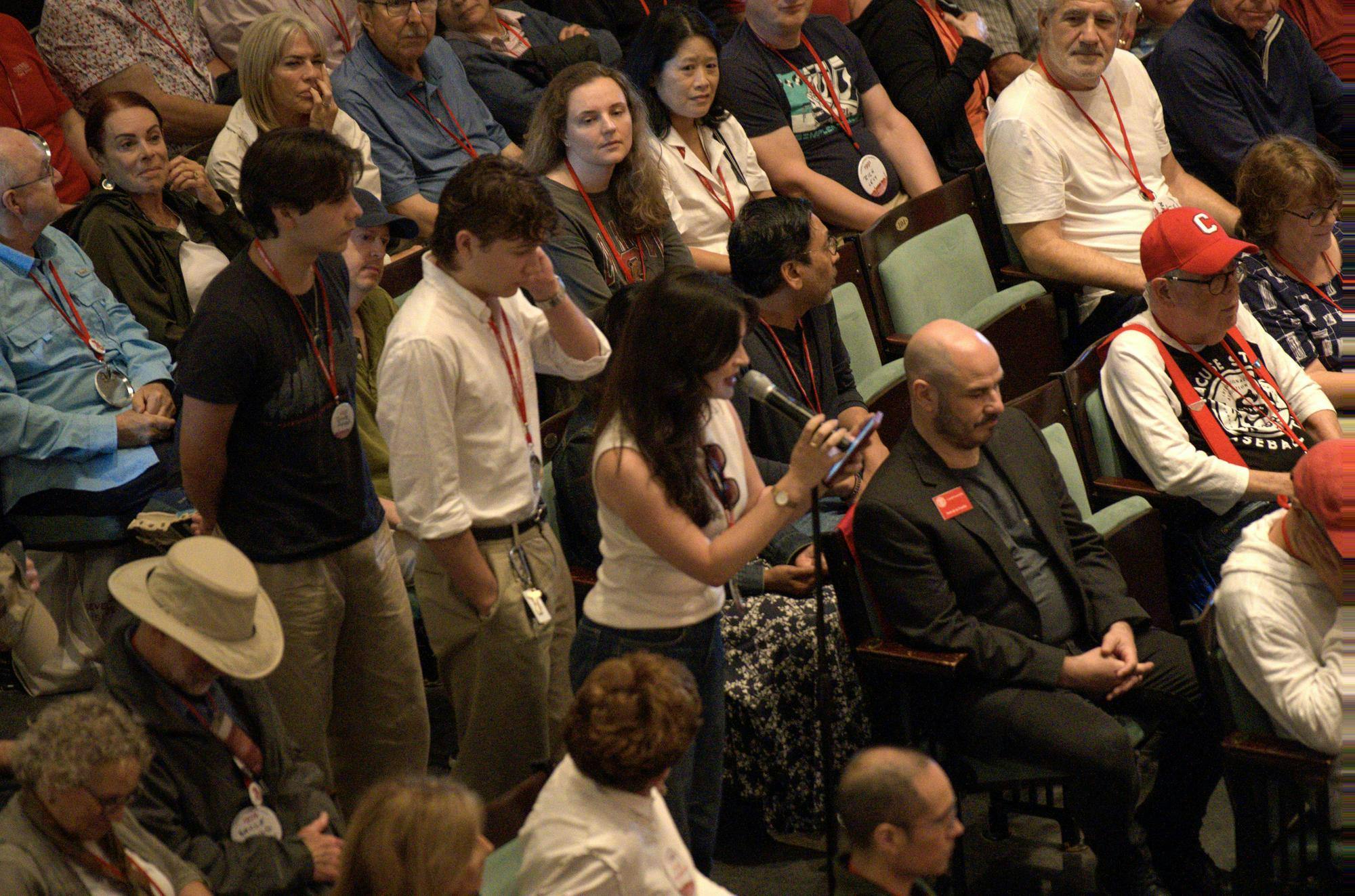
Sophia Arnold ’26 questions the president.
The Campus Code of Conduct was overhauled in 2021 and replaced with the Student Code of Conduct. The University Senate was dismantled in 1977 and replaced by four assemblies – Student Assembly, Graduate and Professional Student Assembly, University Assembly and Employee Assembly — and later the Faculty Senate.
“Can you please explain why you have completely dismantled Cornell’s system of shared governance and have ignored every intent by students to earn it back?” Arnold asked Kotlikoff. Her question was met with cheers from the audience.
In response, Kotlikoff cited legality as the primary driving force for the current policies in place.
“We have Title IX, which means that students can’t [be] discriminate[d] against based on national origin, race, et cetera. … We have to have a system in place where we can assure everyone — our students, our community, our faculty — that we are able to obey the law.” His response received a louder round of applause.
Arnold criticized Kotlikoff’s response in an interview with The Sun. “I think President Michael Kotlikoff uses the fact that alumni know very little about what’s happening on campus to present a bunch of falsehoods and incorrect information regarding free expression on campus and the usage of Title IX with the federal government and how they have to comply with it,” Arnold told The Sun.
Kotlikoff responded to another question from an SDC member about the Student Assembly referendum passed on Dec. 15, where nearly 3,000 students voted “yes” on two referendum questions that sought to make Cornell’s disciplinary system independent from the University administration and to reinstate a campus-wide code of conduct.
“There is something called selection bias, and so we don’t have the majority opinion of the [Student Assembly], and that’s one of the student body,” Kotlikoff said, referencing how less than 20% of the student body responded to the link. “I also want to make it clear that some of this sounds very much like an effort to avoid accountability for actions last year.” He was met with loud cheers from the audience of alumni.
The approximately 20% of students who voted was a notable decrease from the 46.8% of students who voted on the last referendum held in Spring 2024. Many students criticized the fact that voting emails were reportedly sent to the spam folders of students alongside other voting issues.
On Feb. 2, Kotlikoff responded to the referendum with a letter that explained that altering the review process of the Code of Conduct would go against University policy and also explained that the Expressive Activity Policy was used to address some issues.
Allison Randall ’01, attendee and member of Cornell Courage, criticized what she believed was the University “not push[ing] back” against the Trump administration’s demands regarding the November settlement. Kotlikoff responded by saying most of her claims were false and stating that the University has not suppressed freedom of speech, citing examples of demonstrations outside his office for “almost all the spring term.”
Allison Randall ’01 asks Kotlikoff about Cornell’s relationship with the Trump Administration.
In response to Kotlikoff’s speech, Randall told The Sun “I don’t think he’s being honest” about the impact of Trump’s settlement on the University.
Reactions to the Speech
One attendee, Robin Rosenberg ’81, thought Kotlikoff’s speech was “very eloquent.”
“My sense is that he knew these questions were coming, so he was prepared, and he knew what to say, and he’s in a very difficult position, but he did handle it very well,” Rosenberg said.
She also commended his efforts to uphold University standards.
“I think he’s doing a great job, and he’s really, really trying,” Rosenberg said. “Just sometimes, you know, as a president, I think he has to put his foot down on certain things and say ‘This is what our mission is, what our goals [are], this is what the law is.”
Another attendee, Zacharie Liman-Tinguiri, MBA ’16, acknowledged perspectives from both sides.
“I completely get the students and I completely get the University president,” he said. “I think they’re seeing the world from a different lens. Students are hyper passionate about single issues. When you’re a university president, you are a manager of stakeholders. You have a lot of power, but if you wield it unilaterally, you can compromise and jeopardize the institution.”
Concluding the speech, Kotlikoff expressed hope for the future of the University.
“It’s hard not to wonder sometimes what Andrew D. White would have thought about this moment we’re in,” Kotlikoff said. “But I think he would have drawn enormous comfort where I draw comfort: from the knowledge that the Cornell idea is no longer a nine-point plan on a piece of paper, the vision of an idealist in a letter destined for a polite decline.”
Everett Chambala is an assistant news editor for the 144th board. He is working as the primary summer reporter for The Cornell Daily Sun through The Sun’s summer fellowship program.

Everett Chambala is a member of the Class of 2027 in the School of Industrial and Labor Relations. He is a staff writer for the News department and can be reached at echambala@cornellsun.com.
Read More
Credit: Source link