What It Means For Rates, Inflation, And Market Confidence
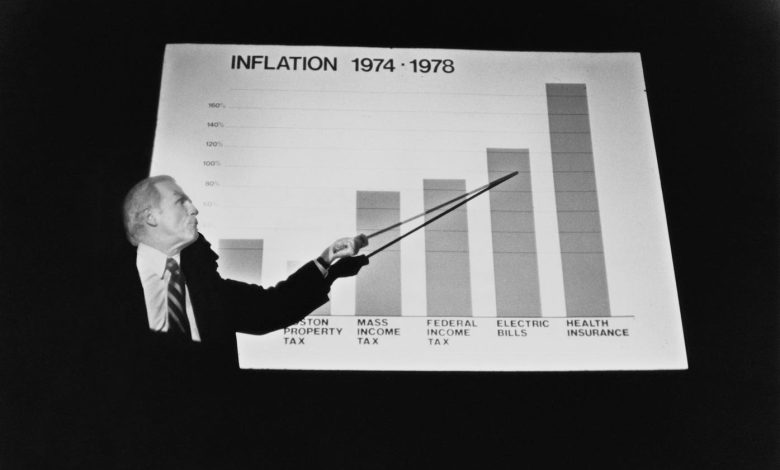
Mayor of Boston, Kevin White, points to a chart showing inflation costs, Boston, Massachusetts, 25th September 1978. (Photo by Barbara Alper/Getty Images)
Getty Images
Jerome Powell’s tenure as Federal Reserve chair ended in May 2026. That transition, anticipated for months, has nonetheless managed to inject a fresh layer of uncertainty into markets at a moment when the macro picture was already sufficiently complicated. The new chair’s identity — and more importantly, their disposition toward political pressure — has become one of the most actively debated variables among institutional investors navigating the second half of the year.
The concern is not novel. Donald Trump spent much of his first term publicly pressuring the Fed to cut rates, and the dynamic repeated in his second term with additional intensity. Throughout 2025, Trump repeatedly called on the Fed to “accelerate the pace of rate cuts to stimulate economic growth,” citing the AI-driven investment boom and what he characterized as excessive monetary restraint. The independence of the Federal Reserve is, in the view of most economists and market participants, a foundational pillar of the dollar’s reserve currency status and the U.S. bond market’s global safe-haven role. ING’s currency research team put it directly: “The independence of the Fed is the cornerstone of global financial stability and were the Fed to be seen cutting rates inappropriately, we could see a run on the dollar.”
The Succession and What It Signals
MUFG’s FX research team, writing in December 2025, identified the Fed chair succession as one of the key inflection points for dollar direction in 2026. Whether the appointee is Kevin Hassett, Christopher Waller, Kevin Warsh, or someone else, the critical variable is not their stated economic views — all serious candidates understand monetary economics — but their demonstrated willingness to push back against political pressure when price stability requires unpopular decisions. A chair who prioritizes growth over inflation, or who signals comfort with rate cuts that the data doesn’t yet support, would materially change the calculus for foreign holders of dollar-denominated assets.
Reuters noted in its January 2026 markets watch list that “the most under-appreciated tail risk for 2026 is that the Fed eases monetary policy more than economic conditions justify, inadvertently reigniting inflation.” That scenario — political easing followed by an inflation resurgence that forces an abrupt reversal — is the narrative that keeps fixed income strategists up at night. The bond market’s version of this story is a steepening yield curve: short rates decline as the Fed cuts, long rates rise as inflation expectations drift higher. That combination, historically, is negative for growth stocks, positive for financials, and a serious headache for the Treasury’s deficit financing operation.
Current Market Pricing and What It Assumes
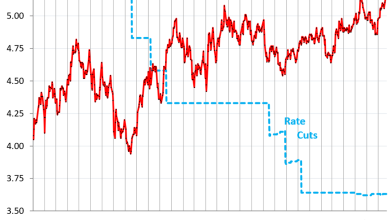
As of late May 2026, the federal funds target range stood at 3.50-3.75% and the 10-year Treasury yield was approximately 4.40%. The market is pricing roughly 50 additional basis points of cuts by year-end, implying the Fed gets to approximately 3.00-3.25% before pausing. That pricing assumes inflation continues to moderate from its recent uptick, that the Hormuz energy disruption resolves in a way that removes the commodity price floor, and that the new Fed chair is willing and able to deliver on the easing trajectory the bond market has priced.
Each of those assumptions carries meaningful uncertainty. Core PCE remains above 3% after energy pass-through effects in Q1. The Hormuz situation, as discussed separately, remains unresolved. And the new Fed chair’s first major public communications — which will be parsed by markets for every available signal about doctrine and independence — have not yet occurred at time of writing. The risk is not that the Fed dramatically missteps in either direction. It is the more mundane risk that uncertainty about the Fed’s reaction function creates a persistently higher risk premium in long-duration assets.
The Equity Market’s Relationship With Fed Credibility
Equity market investors have generally been less focused on the Fed independence question than fixed income and currency investors, for an understandable reason: rising equity prices have made it easy to look past institutional risks. But the connection is more direct than it might appear. The equity risk premium — the excess return investors demand for holding stocks over risk-free bonds — is partly a function of confidence in the macroeconomic framework. If the Fed’s credibility erodes, real interest rates could rise even as nominal policy rates fall, compressing multiples on long-duration growth assets regardless of earnings trajectory.
Goldman Sachs noted in its 2026 thematic research that the equity risk premium is currently near its lowest level on record — the forward earnings yield on the S&P 500 and the 10-year Treasury yield are at near-parity. That environment works as long as inflation stays contained and investor confidence in institutional stability remains high. It is a fragile equilibrium. Any development that raises the perceived probability of policy error — whether through a perception of political compromise at the Fed or through an inflation resurgence that the Fed is slow to address — would likely compress equity multiples in a way that earnings growth alone cannot offset.
How to Position for Policy Uncertainty
The honest answer is that positioning for Fed credibility risk is difficult because it is a tail event, not a base case. The most probable outcome is that the new chair, regardless of political appointment dynamics, operates with functional independence because the institutional pressure to do so — from bond markets, from trading partners, from the economics profession — is overwhelming. Central bank credibility, once lost, is extraordinarily expensive to rebuild, and every serious candidate for Fed chair understands this.
That said, prudent portfolio construction acknowledges the tail. Shorter-duration fixed income over longer duration is the most direct hedge — if real yields rise and the yield curve steepens, short-duration bonds suffer less. Gold has historically performed well in environments where institutional confidence in fiat monetary frameworks is under stress, which partly explains its strong 2026 performance. And financials — particularly banks with asset-sensitive balance sheets that benefit from a steeper yield curve — could be unexpected beneficiaries if the Fed independence concern pushes the curve in the direction that the fixed income market would expect.