A Neil Gross Book on Politics on College Campuses
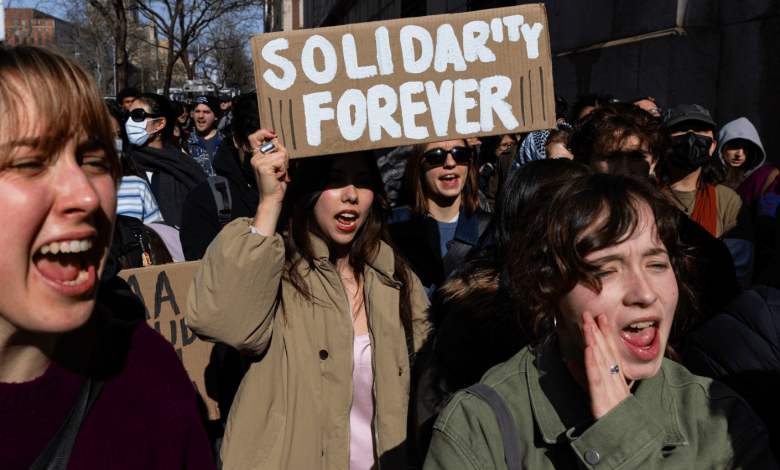
College is supposed to be a place where young people encounter new ideas, meet people who see the world differently, and learn how to think for themselves. But these days, politics can shape nearly every part of the experience — from where students apply and what they study to whom they befriend, date, and even choose as roommates. And with tuition costing what it does, parents understandably want to know: What exactly are we signing up for?
In his new book, What Happened to College?: How Politics Broke Higher Education and What We Can Do to Fix It, Colby College sociology professor Neil Gross goes beyond the shouting matches and scary headlines to find out what’s really happening on campus. After interviewing 100 students and recent graduates from 18 colleges — as well as faculty members and administrators — he argues that neither the left nor the right has the whole story. I asked him why political identity has become such a powerful force in college life, what students themselves are saying, and whether universities can once again become places where people learn how to disagree.
You wrote about the ideological divide in higher education in your 2013 book, Why Are Professors Liberal and Why Do Conservatives Care? What changed over the last decade that made it time for this book?
Politics plays a much larger role in campus life. But what does that mean exactly? We’ve all heard anecdotal reports about students being silenced by their outspoken progressive peers, especially post-2020. Some said their courses had become politicized, too. And campus politics began making front-page news with the pro-Palestine protests and encampments of 2023–24. I started researching my new book because I wanted to cut through the headlines and accusations and get a better sense of what was really happening on campus. College is a big investment and parents deserve to know what they’re signing up for.
Conservatives and liberals tell completely different stories about why higher education is struggling. You argue they both get the diagnosis partly right and partly wrong. How so?
Conservatives believe that higher education has been taken over by the radical left and that leftist professors are brainwashing students with woke ideology. Liberals contend the real problem is that higher education has become ruinously expensive because red-state politicians have been slashing funding — while imposing harsh constraints on what faculty can say and teach. And now the Trump administration is coming at universities with a wrecking ball.
Both sides are right that something’s gone off the rails. And both conveniently blame the other. But my research points to a bigger, shared problem that’s at the heart of higher education’s woes: increasing numbers of students and faculty see the world — including the world of college — through the lens of their partisan political identities. They want to surround themselves with other people who share that identity and they sort themselves accordingly. That kind of thinking undermines the integrity of the university. If you’re the parent of a kid in college or about to go to college, you need to understand how this increase in sorting by political identity can hinder many core aspects of an education so that you can make better choices.
You make the point that everyone is talking about students, but very few people are actually listening to them. You interviewed 100 students and recent graduates from 18 different colleges — what surprised you most about what they told you?
I heard some amazing stories and learned a lot. Think that politics hasn’t infiltrated the party and hookup scene or even roommate selection on American college campuses? Think again!
One of the things that surprised me most was how many students weigh political factors during their college search. Quite a few young women told me they wouldn’t go to college in a state with an abortion ban. Others were fleeing California or the Northeast because they couldn’t tolerate the progressive politics there. I guess what surprised me most is that politics is a much bigger part of the college search than ever before — and that once students arrive on campus it factors into everything from who students date, to their choice of major and extracurricular activities.
How have students’ political attitudes themselves changed over the last twenty or thirty years? Are today’s students actually more ideological than previous generations?
After the 2024 election there was a lot of talk about how young men were becoming more conservative in reaction to the excesses of the woke left and under the spell of influencers from the “manosphere.” I wrote a piece in the New York Times about why that diagnosis was wrong. In fact, young Americans have generally been growing more socially liberal since the 1960s, meaning more supportive of things like gay rights, alternative family arrangements, and policies to address racial inequality.
If you look at the numbers, the share of college students nationally who identify as conservative has remained fairly stable, at around 20 percent, and conservative students have grown more socially tolerant. What is true is that the share of moderate students has shrunk and the proportion of liberal and progressive students has expanded. And this increase in social tolerance has come alongside a decline in political tolerance: many college students today don’t want to engage or debate people with opposing views. This growing intolerance and hostility are deeply concerning.
The late teens and early 20s are a time when students are trying to figure out who they are and what their future will look like. Seeking certainty, without a lot of real-world experience to temper their instincts, some get caught up in all-encompassing ideologies. We’ve seen more of that over the past decade than at any point since the late 1960s.
You argue that political polarization is the driving force behind so much of what’s changed on college campuses, and you make the distinction between ideological polarization and affective polarization. What’s the difference, and why is this distinction important to understand?
If Marisa’s and Sean’s political opinions are drifting further apart — say Marisa strongly opposes the death penalty while Sean favors it — that’s ideological polarization. Ideological polarization isn’t necessarily a huge problem for society. Democracies are built to handle disagreement. The real problem is affective (meaning emotional) polarization: Marisa and Sean come to think the other is immoral and grow to dislike or even hate one another for their views. Affective polarization gnaws away at the mechanisms democracies have to manage disagreement and function effectively. Who wants to come to a compromise with their political opponents if they regard those opponents as not simply wrong, but evil? Affective polarization also leads people to think less rationally: they will tend to disbelieve claims made by the other side, no matter the evidence. So you wind up with each side believing a different set of facts, when a common set of facts would otherwise be the starting point for cooperation.
Affective polarization is a scourge and colleges and universities should be doing everything they can to combat it. What few people are willing to acknowledge is that those of us in higher ed have abetted affective polarization by allowing politics to remake the student experience and the college ecosystem. Today students are making decisions about where to attend college, what clubs to join, whom to befriend and date, what classes to take, and what to major in based in part on the desire to be around other students who share their values. This deprives students of the opportunity to interact with people who disagree with them. Without that interaction, negative stereotypes about the other side intensify and harden.
As your book describes it, this political polarization has reshaped universities, creating campuses where many students no longer have to seriously engage with opposing viewpoints. But isn’t that one of the fundamental purposes of a college education?
As part of the research for this book I surveyed and interviewed faculty and administrators. A debate coach at a public flagship university told me that after October 7th, 2023, he’d tried to get his team to practice for what he expected would be rounds at upcoming debate tournaments about the Israel-Palestine conflict. But team members flat-out refused to take Israel’s side. Whatever one thinks about the conflict, the story reflects a disturbing trend: students today are so sure they have all the answers that they see no need to engage with contrary opinions. In fact, many believe doing so would be immoral.
Colleges often say their aim is to promote critical thinking. What is critical thinking? A critical thinker is someone who has learned to formulate their beliefs on the basis of logic and evidence (informed by their values), not necessarily accepting as true what other people tell them. A critical thinker is also prepared to change their minds when the logic or evidence for their position no longer add up.
Critical thinking is the opposite of ideological thinking, which is where someone is so committed to a political position or identity that no amount of contrary evidence will budge them. The problem is that it’s virtually impossible to blossom as a critical thinker without routine interaction and debate with people who think differently than you do. If colleges aren’t providing enough of that, we’re not doing our jobs.
A core purpose of higher education has always been exposing students to ideas that challenge their own. But many would argue that, in today’s climate, we’re no longer debating ordinary political disagreements, but questions of fundamental democratic values. How does that change the role universities should play?
Not every argument merits debate. In an epidemiology class, do we really need to debate the germ theory of disease? In the realm of moral and political arguments it can be harder to draw that line, but it’s not impossible.
The problem is that if you draw the boundaries between acceptable and unacceptable topics too narrowly, so that those boundaries neatly overlap with a preferred political ideology or identity, you’ll deprive students of valuable opportunities to learn. Universities need to push that envelope more than we have been.
You’re upfront about being a “liberal Democrat.” Do you worry that, in today’s polarized climate, simply disclosing your own politics will make some readers less willing to engage with your findings?
A police chief I interviewed for an earlier book told me that he was a police chief first, Republican second, and that he’d be failing to do his duty if he ever let his personal political opinions influence how he enforced the law. He meant it. That’s a stance we need to get back to as a society. In my opinion, we need civil servants, judges, journalists, and experts of all kinds whose primary commitment is to fulfilling their professional responsibilities, not furthering a political agenda. As a social scientist, my primary responsibility is to get the facts right, no matter where the chips may fall. I hope that parents, students, and educators will see What Happened to College as a valuable guide to what’s happening on college campuses — wherever they happen to fall on the ideological spectrum.
This book was also personal: Your son, Lucien, was beginning his own college search as you began your research. Did your findings change the advice you gave him or the qualities you encouraged him to look for in a school?
I asked all the students and recent graduates I interviewed what advice they’d give to first-year students about how to navigate the political scene on campus — advice I share with readers, and with my son. My two main pieces of advice for Lucien are things I’d recommend for every student: One, go to a school that is going to challenge you intellectually and personally. If you end up at a college where you feel like you fit in seamlessly and don’t need to stretch, you’re not getting your money’s worth. And two, go to a school where politics aren’t the end-all, be-all. There’s so much more to the college experience. Seek out a school where you can take thrilling classes that don’t have much contemporary political relevance, and not every extracurricular is going to have a political undercurrent.
You’re hopeful that colleges can take steps to change course. What are the most important ones?
The first thing colleges need to do is acknowledge that there is a problem and own their responsibility for it. For decades, American colleges and universities promised they would produce pathbreaking scientific research, preserve and renew vital cultural traditions, and give citizens the cognitive skills needed to succeed in an increasingly complex world and labor market. In return, the public would support higher education with tax dollars and private philanthropy, entrust us to teach young people who aspired to professional careers, and give the academic profession the autonomy needed to carry out our responsibilities as we see fit. And higher education fulfilled this promise: American universities were the envy of the world. But those of us in higher education should have recognized that as the public became more bitterly divided, this grand bargain would fall apart if we sided with only one side in the culture wars.
I’m heartened that schools like Yale, Harvard, Vanderbilt, and Columbia are taking time to reflect on what went wrong and formulating plans to win back people’s trust and support. The report of the Yale Committee on Trust in Higher Education, which suggested the institution needed to take action in the areas of cost, admissions transparency, and political diversity, is a model that other schools could follow. It’s a shame that it took attacks from the Trump administration to force this self-scrutiny, since those attacks are harming higher education and academic science in other ways.
Are there colleges or universities that are already making meaningful progress? What can the rest of higher education learn from them?
Many schools now recognize that they need to teach students how to disagree better — which requires the creation of politically mixed spaces on campus where students with different views can disagree. To give just one example, at Colby College in Maine, we have a very successful program called “In the News” that brings students together for dinner once a week to listen to talks by speakers from across the political spectrum. Students are encouraged to ask questions and taught how to do so in a way that is civil and respectful, even when their questions are hard-hitting and reflect what may be deep disagreements between the students and speakers over policy or values. These students are going to come out as broad-minded citizens ready to engage a world where political disagreement is a fact of life. We’re seeing programs like this begin to pop up at colleges across the country. Let’s figure out which of these have lasting effects on students’ citizenship skills and invest in them.
What happens if public confidence in higher education continues to erode? Are you optimistic that colleges can reclaim their role as places where people with very different views come together to learn from one another? Or has that era ended?
Social scientists are a lot better at explaining what has already happened than at predicting the future. What I can say is that universities are demand-driven institutions. When our key clients demand a different kind of educational experience than the one we’re providing, we tend to shift gears. I’ve noticed that the most recent micro-generation of college students, those entering the system right now, are a little different from their immediate predecessors. These kids are still quite progressive, but many saw what college looked like a few years ago, how bitterly divided campuses were and how toxic and counterproductive cancel culture was, and they’re eager for something different. Maybe it’s Woke 1 versus Woke 2, to borrow from Representative Alexandria Ocasio-Cortez’s comment. Colleges that respond to that demand by re-engineering the undergraduate experience will be doing themselves a favor.
A sociologist known for his data-driven explorations of campus politics and American life, Neil Gross is the Charles A. Dana Professor of Sociology at Colby College. His latest book, What Happened to College, is on stands now — buy it here.
Credit: Source link