Canfield Fair incident puts focus on political rhetoric in Ohio governor’s race
COLUMBUS, Ohio (WSYX) — For months, Ohio’s governor’s race has been fought with increasingly personal campaign messages.
Now, after an armed man pushed through a crowd toward Democratic nominee Amy Acton at the Canfield Fair, the campaigns are confronting a question that extends beyond the ads themselves: How does political rhetoric shape the way voters understand and respond to moments of conflict?
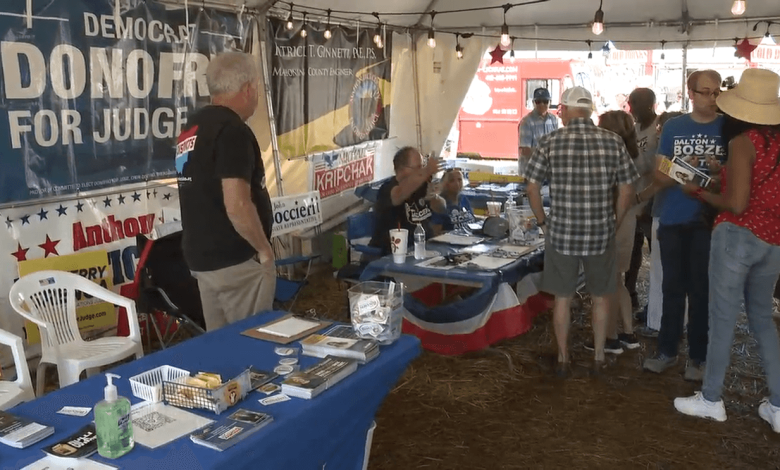
Acton was speaking Sunday at the Mahoning County Democratic Party tent when, according to her campaign, 38-year-old Patrick Havas forced his way through the crowd toward her, knocking over multiple people, according to the Mahoning County Sheriff’s Office.
He was carrying two handguns, a Taser and brass knuckles, prosecutors said. The weapons remained holstered, and Acton was unharmed.
Havas pleaded not guilty Tuesday to two counts of assault, disorderly conduct and inducing panic. A judge ordered him to have no contact with Acton or the other people involved and to forfeit his weapons.
Authorities have not identified a motive. At Havas’ arraignment, Mahoning County Prosecutor Lynn Maro said investigators had found no threats toward Acton or her campaign on his cellphone.
She said Havas appeared to be trying to ask Acton questions, and that the only video investigators had of the incident came from his phone. That means there is no established connection between the campaign rhetoric and what happened Sunday.
Still, political communication experts say the language used in campaigns can influence how voters perceive political opponents, and how they interpret events involving them.
“There is a lot of divisory language that I argue has been used in particular in Ohio politics, or I would even argue in politics in general,” said Dr. Brianna Mack, who teaches Media and American Politics at Ohio Wesleyan University. “That’s now the norm for these ads. We’re now seeing occurrences where there are people that are actually listening to these ads and appear to be exacting some sort of justice for whatever side they believe that they are doing this for.”
Mack said political advertising has increasingly included language that can portray opponents in starkly negative terms.
“The candidates themselves do have the power to change the tone, in theory,” she said. “However, now that we have the inclusion of corporations and third parties and the participation of millionaires and billionaires through super PACs and other dark money groups. If the third party individuals, if these super interest groups are still allowed to buy ads and create these ads that still promote this inflammatory language, the problem doesn’t change.”
Dr. Jen Jackson, who teaches public relations from a strategic communication perspective at Otterbein University and researches political rhetoric and public address, said the current Ohio race illustrates the distinction between emphasizing a candidate’s own message and attacking an opponent personally.
“We’re seeing a lot more personal get-to-know-me type ads from Dr. Acton’s campaign,” Jackson said. “[Vivek] Ramaswamy is doing more with the attack ads on her character and not focusing on the issues.”
Research on negative political advertising suggests its effects can be more limited than campaigns sometimes assume, Jackson said.
“Negative attack ads, especially when they’re personal attack ads and not about policy and initiatives, they tend to possibly lower some trust that viewers would have of the person being attacked but doesn’t change voting habits drastically,” she said.
Jackson said personal attacks can also alter the way political opponents are perceived.
“When you attack somebody as a person, we’re removing their humanity, and we’re making them an object,” she said. “Words do hurt. Words can pierce.”
Mack said voters do not necessarily interpret the same political event in the same way. Reactions can be influenced by a voter’s existing political identification, she said.
“While supporters of Acton, this is mobilizing them, this has excited them,” Mack said. “On the other end, if you see Ramaswamy supporters or GOP supporters, there are a number of individuals who are saying that the claims of an attack, or attempted attack, were over exaggerated. They’re saying that this is a publicity stunt.”
Those differing reactions illustrate the difficulty of separating an event from the political context in which voters encounter it, Mack said.
At the same time, the two campaigns found common ground after Sunday’s incident: both Acton and Ramaswamy’s campaigns said violence has no place in Ohio politics.
Jackson said simply condemning political violence does not necessarily address the broader issue of political hostility.
“At this point in our political history, I don’t think just saying we condemn political violence, it is enough,” she said.
Instead, Jackson said political disagreement can remain substantive without becoming personal.
“We can still talk about those disagreements without it divulging into that chaos that happens when there’s hatred and animosity and anger,” she said. “We can have actual political debates.”
Mack similarly described healthy political disagreement as a recognition that voters and candidates can hold opposing views without treating one another as enemies.
“Healthy political disagreement would sound like you have your view, I have my view,” Mack said. “I think it would encourage people on both sides, especially viewers, to recognize that perhaps a lot of this divisive language that we see is a manipulation by forces that want to keep individuals divided.”
The investigation into the Canfield Fair incident remains ongoing, and the Mahoning County Sheriff’s Office is seeking additional video of what happened.
Credit: Source link