China is buying every dip and the ‘reset’ is already here, Middelkoop says
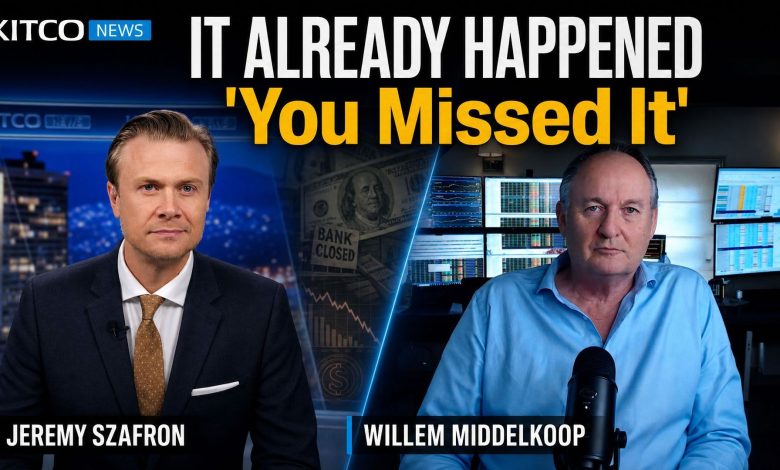
(Kitco News) – The “Big Reset” author says China favors a lower gold price so it can keep accumulating, that gold‘s monetary role is returning quietly through central-bank books, and that silver is headed to $500.
Gold is trading near $4,000 an ounce, and the usual story is that China is hoarding metal and driving the price higher. Willem Middelkoop says that reading is backwards.
The founder of the Commodity Discovery Fund and author of “The Big Reset” told Kitco News that China actually favors a lower gold price right now because it is still buying, and that the monetary “reset” he has forecast for over a decade is no longer a prediction but a process already underway, unfolding gradually through the way central banks account for gold rather than in a single dramatic revaluation.
“A monetary reset is a more gradual process. It’s not a binary event,” Middelkoop said. “We’re in the first innings.”
Why China would want gold lower
“China is a very active buyer of dips,” Middelkoop said, adding that the same pattern holds in copper and oil. He said China bought more than 150 tonnes of gold in June alone and that Chinese demand for gold and silver is running 150% to 200% above last year’s levels. “They like lower prices. They like this correction. I think this correction is almost over,” he said.
That 150-tonne figure is Middelkoop’s own estimate of total Chinese demand and is well above officially reported central-bank buying, which the World Gold Council put at roughly 15 tonnes for China in June.
Middelkoop argued the true total controlled by the Chinese state is far larger than official reserves suggest. He said that at a 2015 book event in Beijing, a former Chinese central banker, whom he described as the first Chinese member of the International Monetary Fund’s board, told him the central bank was not the only state institution buying
and named two others, one of which Middelkoop identified as the State Administration of Foreign Exchange. He said Silk Road countries including China and India have accumulated more than 50,000 tonnes since the 2008 financial crisis, which he said helps explain why official tallies understate demand.
A reset in the books
Middelkoop said central banks are now the main driver of the gold price and are, in his words, “hoarding physical gold,” with buyers concentrated east of Germany. He said this is the fifth year in a row that central-bank demand has run around 1,000 tonnes, which he said equals about a third of annual mine production, and that the metal is steadily moving from West to East as price discovery shifts from the COMEX in the U.S. toward Shanghai.
Independent data support the broad trend Middelkoop describes, though not all of his figures. Central banks bought 1,082 tonnes of gold in 2022, 1,037 in 2023 and about 1,045 in 2024 before easing to 863 tonnes in 2025, according to the World Gold Council. Gold has overtaken U.S. Treasuries to become the second-largest reserve asset behind the dollar, at about 27% of global reserves at the end of 2025, up from 20% a year earlier, while Treasuries slipped to 22%, according to the European Central Bank.
Middelkoop said a recent Deutsche Bank report reads “like an executive summary of The Big Reset,” concluding that gold has replaced U.S. Treasurys as the top reserve asset and projecting its share could climb toward 40% to 50%. He said that report supports a gold price well above $10,000 and put the figure at $14,000 to $15,000.
On the U.S., Middelkoop said the government still values its roughly 8,000 tonnes of gold at a historical price of $42 an ounce, unlike the European Central Bank, which marks its holdings to market. He said Washington prefers to “treat gold like it’s just a commodity” to protect the dollar, but that the initiative has passed to others. “It’s not about the U.S. anymore, it’s about the rest of the world,” he said. “You get a revaluation of gold now by market forces, not because of an IMF conference.”
Middelkoop said the shift is already visible in trade flows, with gold becoming a top U.S. export by value as metal leaves the country, and in the declining foreign appetite for Treasurys, which he said has fallen to about 12% of the outstanding total from a longtime level near 35%. U.S. trade data show gold rising to among the largest American exports this year, reaching a record $17.88 billion in February.
China steers savers toward physical metal
Asked about Chinese banks pulling retail access to the Shanghai Gold Exchange, Middelkoop said he read the move as China steering savers away from paper trading and toward physical metal, not as a crackdown. He said China has long run a dual strategy, citing a program he called “Storing Gold with the People” that he said appears in a Chinese publication from 2011 or 2012. “China understands it’s all about owning the physical stuff in the end,” he said.
Major Chinese lenders including ICBC halted retail Shanghai Gold Exchange trading after the July 24 settlement, covering both spot and deferred contracts, according to bank notices and Chinese financial press.
Silver, miners and a $500 call
Middelkoop reaffirmed his call for far higher silver prices, saying he would not be surprised to see silver return to $100 “in a very short period of time” and repeating a target he said he put on the record at investment conferences in January and March. “This bull market for silver won’t be over before we see $500 silver,” he said, tying the forecast to the historical gold-to-
ratio.
He said gold miners are deeply undervalued after a roughly 40% correction, put Newmont’s free cash flow at nearly $1 billion a month, and said the gold-mining sector’s free cash flow now exceeds that of the technology sector, a comparison Kitco could not independently verify. He called it the start of a “generational” bull market in commodities.
On geopolitics, Middelkoop said China’s posture toward Russia is colder than it appears. Writing on his Substack, he argued it could serve Beijing’s interest to stop backing President Vladimir Putin, saying “Putin’s Russia is done without China.” He said he does not expect a nuclear war over Ukraine because China has “made quite clear that they don’t accept that.”
Watch the full conversation: Willem Middelkoop’s complete interview with Kitco’s Jeremy Szafron is in the video above. For daily coverage of gold, silver and the global economy, subscribe to Kitco News on YouTube and follow live prices at Kitco.com.
Disclaimer: The views expressed in this article are those of the author and may not reflect those of Kitco Metals Inc. The author has made every effort to ensure accuracy of information provided; however, neither Kitco Metals Inc. nor the author can guarantee such accuracy. This article is strictly for informational purposes only. It is not a solicitation to make any exchange in commodities, securities or other financial instruments. Kitco Metals Inc. and the author of this article do not accept culpability for losses and/ or damages arising from the use of this publication.