Global stocks bounce back after tech rout, Brent falls below $75
Stock markets rebounded on Wednesday from the previous day’s rout of technology shares, caused by concerns over massive AI spending and rising borrowing costs.
Oil prices fell further as shipping traffic through the Strait of Hormuz picked up, with Brent crude edging below $75 a barrel for the first time since the start of the Middle East war.
The US benchmark West Texas Intermediate fell below $70, also a first since the Mideast war began in late February, as crude prices return to near pre-war levels. But investors remain uncertain about any future Iranian fees for transiting the crucial Gulf strait, and oil demand is likely to remain strong as countries rebuild strategic reserves unloaded during the crisis.
“The carnage continues in oil prices,” said Chris Beauchamp, chief market analyst at online trading platform IG.
“This delivers relief for consumers around the globe, assuming the oil industry can scramble to fill the gap left by months of disruption,” he added.
Wall Street was higher in late morning trading, following advances across most equity markets in Asia and Europe.
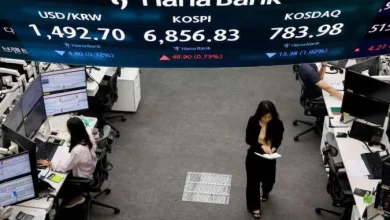
In Asia, Seoul’s Kospi index added more than three per cent after a 10 per cent collapse Tuesday led by losses for chip giants SK hynix and Samsung after their recent string of record highs.
There were also gains in Hong Kong and Shanghai Wednesday, though Tokyo once more ended lower.
“The global tech sell-off appears to have started to stabilise, but investors remain super-cautious, nervous that high valuations could be chipped away at again,” said Susannah Streeter, chief investment strategist at Wealth Club.
While no specific catalyst was blamed for the selling, analysts cited questions over when firms will see a return on the trillions that have been invested in all things AI, and the prospect of a US interest rate hike that is boosting the dollar.
SK hynix announced meanwhile that it planned to raise $29 billion through a listing on Wall Street’s tech-heavy Nasdaq index.
Eyes turn later in the day to the release of earnings from US chipmaker Micron Technology, which will provide fresh ideas about the state of demand in the sector and whether the AI rally still has legs.
“The next-stage debate on AI investing is not whether the theme is real, but whether the scale of investment will ultimately generate the returns that investors expect,” said Christoffer Enemaerke at RBC BlueBay Asset Management.
European stock markets mostly rose, though Frankfurt was pulled down by a 19-percent fall in German defence giant Rheinmetall after Berlin scrapped a multibillion-euro plan to build six new frigates for its navy.
On currency markets, the dollar continued its advance spurred by last week’s Federal Reserve meeting, when new chairman Kevin Warsh signalled that fighting inflation spurred by soaring oil and gas prices would be his priority.
Traders took that to mean interest rate hikes could be on the cards as soon as September, spurring demand for the greenback as US Treasury yields become more attractive.
“The dollar has climbed to a seven-month high as investors seek safety amid equity volatility,” said Patrick Munnelly, market strategist at Tickmill Group.
He noted that investors will be looking at US inflation data Thursday for clues as to the timing of any rate increase.
But the prospect of higher US rates cut into gold’s status as a safe-haven investment, with its price falling below $4,000 for the first time since November.
The precious metal surged in January to a record high of over $5,600 as US President Donald Trump ramped up geopolitical tensions with his threatened military strike on Iran.
US airline stocks rose 3% to 7% on Wednesday after crude prices fell to their lowest since before the Iran war, raising hopes that pressure on carriers’ earnings could ease, though the benefits are unlikely to passed on to passengers immediately.
The S&P 500 Passenger Airlines index jumped as much as 5% to an all-time high, and is up nearly 13% since its close on June 12, after which the US and Iran announced a peace agreement. The benchmark S&P 500 has dropped 0.5% in that time.
Brent crude futures fell below the $74-a-barrel mark on Wednesday amid signs that more oil tankers are set to move out of the Strait of Hormuz, a conduit for a fifth of the world’s oil supplies.
With crude supplies and prices set to ease, airlines stand to save billions of dollars in additional costs as the run-up in jet fuel prices during the Iran war had outpaced fare growth. However, an immediate decline in fares for flyers remains unlikely amid tight capacity.
The retreat in oil coupled with resilient demand is driving airline stocks higher, UBS analyst Atul Maheswari said.
The brokerage said in a note on Tuesday that it sees potential for airlines’ third-quarter earnings per share to outperform Wall Street expectations, if fuel prices moderate.
Also, while all carriers are expected to benefit from cheaper jet fuel, analysts say those with smaller fleets and a lower share of premium seats and customers are likely to gain more, as their margins are more sensitive fuel-price spikes.
Frontier and Southwest rose 3% each, while Delta and JetBlue rose 3.7% and 4.5%, respectively. Alaska Air and United were up about 6% each, while American Airlines surged about 7% in early trading.
Agencies