Migrants say hunger, hostility drove them back from Ceuta | Politics
FNIDEQ, Morocco — Migrants who swam or jumped over fences to rush into Spain’s African enclave of Ceuta this past week returned home Saturday, with many saying hunger, exhaustion and residents’ hostility crushed their hopes of a new life in Europe.
Those heading back told Reuters they initially were drawn by viral social media videos and messages from friends suggesting the heavily guarded border could be breached.

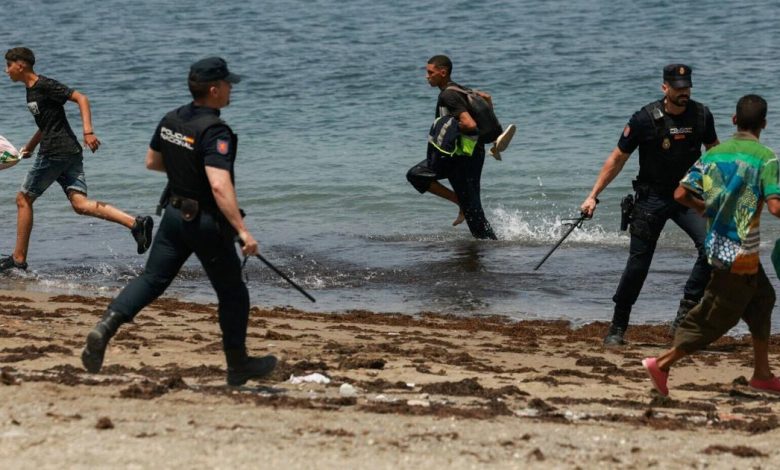
Migrants try to make their way past Spanish police officers Saturday following recent mass crossings of migrants on foot and by sea from Morocco into Ceuta, Spain.
However, after reaching Ceuta, many said they found no way to continue onward to mainland Spain.
“We came to make progress, not to be fooled,” said Brahim, a bakery worker from Fez who left his job and crossed the border after watching clips of thousands doing the same. “I thought I’d build a better future there. But I was surprised in Ceuta.”
Brahim said he survived for three days on water alone and could not afford the high food prices on the Spanish side. “How come a tuna sandwich was being sold for 100 dirhams ($10.75)?”


Migrants collect water Saturday in Ceuta, Spain.
‘Ceuta was like a prison’
In Fnideq, the Moroccan city opposite Ceuta, Reuters saw nearly empty streets leading to the border crossing, a stark contrast to the thousands who gathered there Thursday.
Young men walked away from the frontier along the highway or waited for taxis to leave Fnideq, where shops have been closed for days.
The returnees’ accounts included repeated complaints of shuttered supermarkets and shops, leaving them searching for food and water while their soaked clothes dried on the streets.
“Ceuta was like a prison — nothing to do there. Everything was closed,” said a worker at Morocco’s Tanger Med port, who declined to give his name because he was due back at work.


Migrants head back to Morocco on Saturday after crossing into Ceuta, Spain, by sea.
Some migrants also accused residents of El Principe, a predominantly Moroccan neighborhood in Ceuta, of attacking or driving them out. Reuters could not verify those accounts.
Moroccan waiter Yassine Ichou described being hit and chased away from El Principe.
“They imposed a siege to force us to leave Ceuta by ourselves … They succeeded in their plan,” he added, referring to the widespread shop closures.
Spain’s Interior Ministry said two people sustained minor injuries from knife attacks in two separate incidents and police arrested one of the assailants. No deaths from knife attacks were recorded in Ceuta since Thursday, it added.
Rachid, a worker at a Fnideq hotel near the crossing, said all six of its kitchen staff left for Ceuta during the height of the influx and none returned, forcing management to search for replacements.


Spanish soldiers question a migrant Saturday following mass crossings of migrants from Morocco into Ceuta, Spain.
Some sympathy for migrants
Across the border in Ceuta, cafes reopened and customers flocked in as the city gradually returned to life. Most shops remained closed, while patrol cars moved through the streets in a visible show of security.
“We’ve taken the initiative to open because, ultimately, life has to return to its normal rhythm, but our safety and that of our staff always comes first,” said Marina Castaño, 24, whose parents own two cafes in the center.
Some residents said the situation in the outskirts was still tense.
An aid worker at a migrant reception center said it was full and unable to take in more people, estimating that thousands remained in the enclave.


Migrants gather Saturday in Ceuta, Spain, following recent mass crossings of migrants on foot and by sea from Morocco.
Tito, a hardware store owner whose business was still closed, said the sudden arrival of so many people left residents frightened but also sympathetic.
“You feel overwhelmed and, at the same time, helpless,” he said. “Those young people, they’re being completely exploited. They’re being used as bargaining chips.”
Mohamed Ahmed, a 43-year-old Sudanese man, said a truck dropped him and other migrants near the border and then he swam for four hours to reach Ceuta.
He said police blocked them from taking the road to a migration center, but he remained determined to stay in Spain.
“I’m not going back,” he said. “I’d rather die trying here.”
COPYRIGHT 2026 THE ASSOCIATED PRESS. ALL RIGHTS RESERVED. THIS MATERIAL MAY NOT BE PUBLISHED, BROADCAST, REWRITTEN OR REDISTRIBUTED.
Credit: Source link