Social media is reshaping political campaigns
Bronin’s primary win over Larson highlights how candidates are using informal social media content to reach voters.
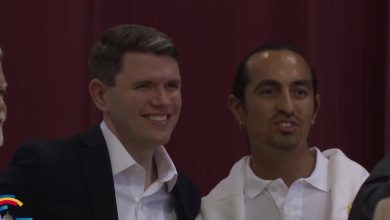
Former Hartford Mayor Luke Bronin’s upset victory over longtime U.S. Rep. John Larson last month offered a vivid illustration of how social media is changing the way political candidates market themselves to voters.
Bronin, 47, defeated the 78-year-old, 14-term incumbent in the Aug. 11 Democratic primary for Connecticut’s 1st Congressional District after running a campaign that featured a broad social media presence and a steady stream of informal, candidate-centered content.
Christina Davis, director of social media and digital analytics at Glastonbury marketing firm CashmanKatz, said the contrast between the candidates was noticeable.
Bronin’s social media content, she said, had what marketers call an “organic” feel — personable, relatively unpolished and frequently featuring the candidate speaking directly to the camera. Larson’s content tended to resemble more traditional, professionally produced political communications.
“What the Bronin campaign found, and the lesson that the Larson campaign might have learned, is that raw, relaxed, casual content is what gets eyeballs on social media,” Davis said.
Bronin’s campaign declined to comment for this story.
Davis cautioned against attributing Bronin’s victory solely to social media, saying polling or other research would be needed to determine its impact. Still, she called social media indispensable to modern campaigns as audiences shift away from traditional media.
Nationally, nearly $3 billion has been spent on advertising in U.S. House, Senate and gubernatorial races during the current election cycle through Aug. 9, according to the Wesleyan Media Project in Middletown.
Local broadcast television accounted for 46% of that spending, while another 26% went to connected TV, which includes streaming services. A little more than 14% went to digital platforms including Facebook, Instagram, YouTube, X and Snapchat.
That does not mean TV advertising is disappearing.
Andrew Tammaro, deputy communications director and digital director for Republican gubernatorial challenger Ryan Fazio’s campaign, said social media increasingly shapes voters’ basic impressions of candidates. But he said the campaign still encounters more people who say they saw Fazio on television.
“I don’t think it’s quite as powerful as TV commercials,” Tammaro said of social media content, but added that it continues to grow as a primary way voters learn about candidates.
Digital targeting
The proliferation of social platforms has also complicated campaign marketing.
Rather than simply buying a TV ad that reaches a broad audience, campaigns now must decide how to communicate across Facebook, Instagram, TikTok, X and YouTube, among others.
John Cattan, digital director for Gov. Ned Lamont’s reelection campaign, said his job is to adapt the campaign’s overall message for each social media platform the governor uses. Social media lead Rob Zapor travels with Lamont, capturing photos and video that can be quickly turned into campaign content.
Tammaro said messages may be presented differently depending on the platform. Longer or more open-ended material can work on X, while short videos or campaign-trail photographs may work better elsewhere. Short-form video, in particular, has “taken all of this by storm,” he said.
Davis said campaigns also must consider each platform’s demographics. Facebook tends to skew older, while Instagram and TikTok can reach younger audiences.
“It used to be maybe a little bit easier,” she said. “You bought a couple TV ads and radio ads and you were good to go.”
State Elections Enforcement Commission (SEEC) campaign finance records show traditional television remains a much larger advertising expense in 2026.
Lamont’s campaign has reported about $4.75 million in TV advertising spending during the current election cycle, compared with about $451,000 for Fazio’s campaign, according to the most recent SEEC filings.
The amounts specifically reported as online advertising are much smaller. Lamont’s campaign reported $60,000 in expenditures classified as web advertising during the current election cycle, compared with $17,549 for Fazio’s campaign.
However, those figures do not represent the campaigns’ total social media investments. Website costs, consultants, staff and content production may be reported in other spending categories, while much of the material campaigns distribute on social media is posted organically, without paying the platforms.
Authentic and fast
Political campaigns face an inherent contradiction on social media: They devote staff time and careful planning to producing content designed to feel natural and spontaneous.
Davis said audiences respond to people who seem real rather than “overly rehearsed” politicians, and engagement — such as comments, likes and, especially, shares — matters more than simply accumulating followers.
Campaigns also must be ready to move quickly when an opportunity for timely content arises.
Tammaro said Fazio recently attended a meeting with Westbrook business owners where the proposed redevelopment of the shuttered Westbrook Outlets was discussed. After hearing the discussion, Fazio turned to Tammaro and said, “That should be a video.”
Within an hour, they were recording at the outlets. In the video, Fazio used the proposed redevelopment to criticize the Lamont administration’s handling of business permitting.
Tammaro said the post quickly generated engagement, illustrating social media’s speed advantage. Campaigns can lose an online audience if they miss a moment by even a few hours, he said.
Fazio is also closely involved in deciding what becomes social media content, Tammaro said, arguing that audiences can sense when candidates are personally involved with their accounts or when everything is being handled “behind a curtain.”
While younger candidates may have an advantage — Fazio is 36 and Lamont is 72 — Davis said age alone does not determine success. Social media requires a different communications skill set, she said, and some candidates are simply more natural on camera than others.
‘Likes’ vs. votes
Measuring whether all that activity actually produces votes remains difficult.
Cattan, of the Lamont campaign, compared political social media with email marketing, where a retailer can track purchases directly to a link. A political campaign can’t similarly determine how many votes resulted from a social media post.
Instead, Lamont’s campaign uses Mobilize, an online organizing platform, to track actions such as sign-ups for canvassing and phone banks.
Tammaro added that if a post receives 5,000 likes, “we’re not saying that’s 5,000 voters. It’d be pretty irresponsible to make that connection.”
Fazio campaign communications director Hannah Lemek said certain social media posts have led to increases in volunteer inquiries and requests for lawn signs. Tammaro also said Fazio’s first two town halls, in Southington and New Haven, each attracted more than 200 people after being promoted almost entirely through social media.
Social media platforms also give campaigns a paid option to put messages in front of voters who do not already follow a candidate.
The distinction between paid and organic content is important, Davis said. Bronin ran a greater variety of paid promotions and sponsored posts on Meta’s Facebook and Instagram platforms than Larson did, she said.
Paid advertising works best when it complements organic content, she added.
That combination is also part of Lamont’s strategy, senior campaign adviser Rob Blanchard said.
Spending shift
Despite the growing emphasis on social media by political campaigns, Davis does not expect traditional advertising to disappear. But the broader shift toward digital media has been underway for years, she said, accelerated by consumers cutting the cable television cord in favor of streaming services.
Asked whether political campaigns will eventually shift a significant share of their advertising dollars from traditional media to digital and social platforms, Davis said that point may have already arrived.
“I would not be surprised if that’s already happened,” she said.
“There’s definitely a place for traditional media in a campaign’s marketing mix,” Davis added, “but there’s little doubt that most politicians have a strong digital component to their paid advertising.”
Credit: Source link