
SpaceX rebound brings space stocks back into the spotlight! …
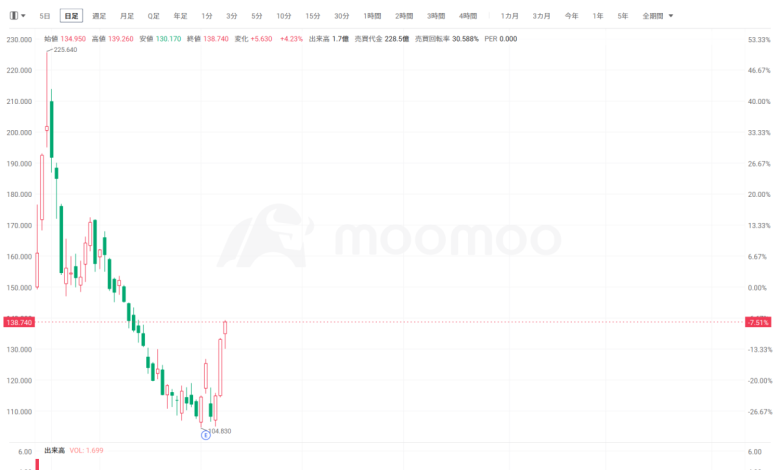
Space-related stocks posted mixed results in the U.S. stock market on the 10th.
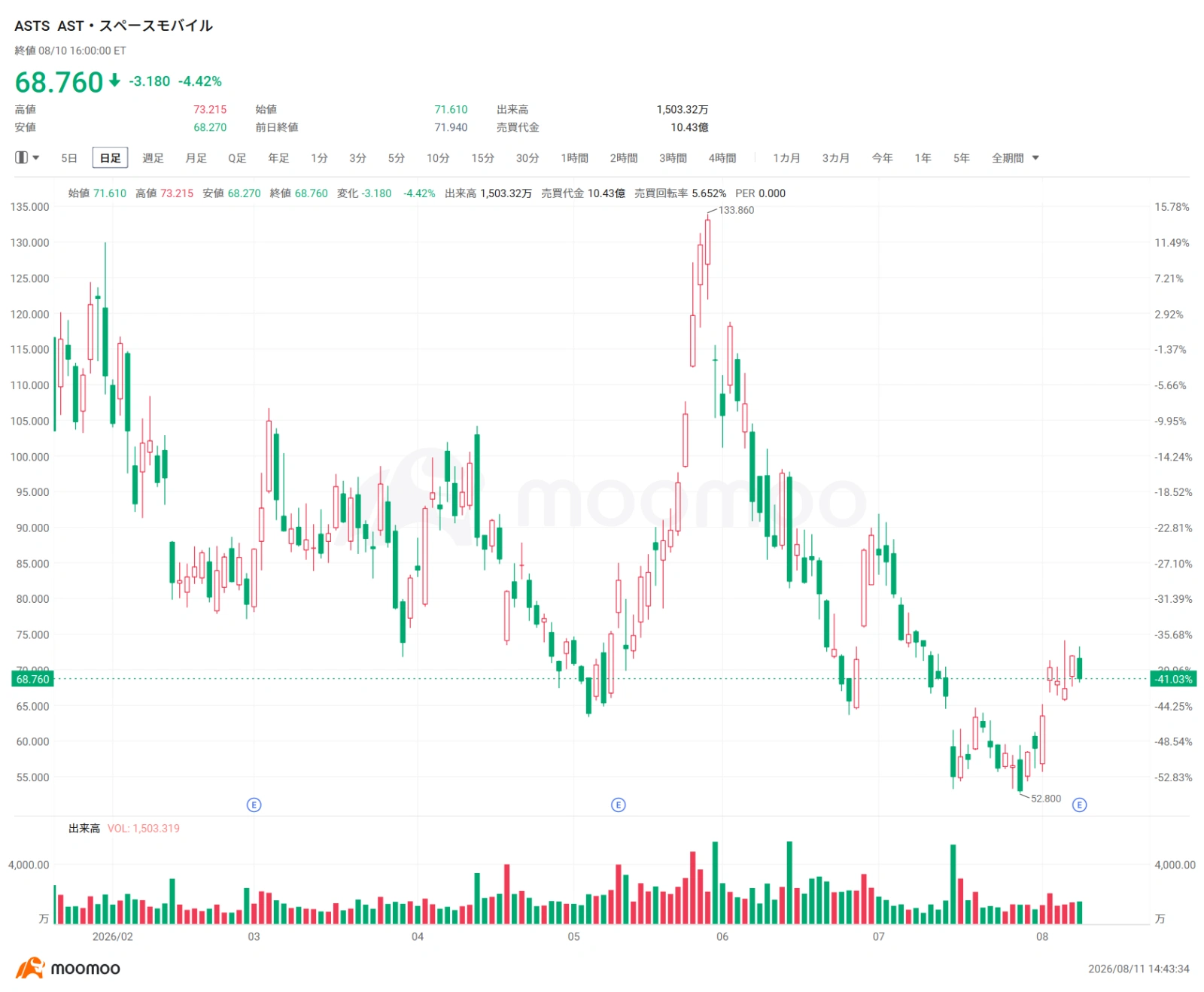
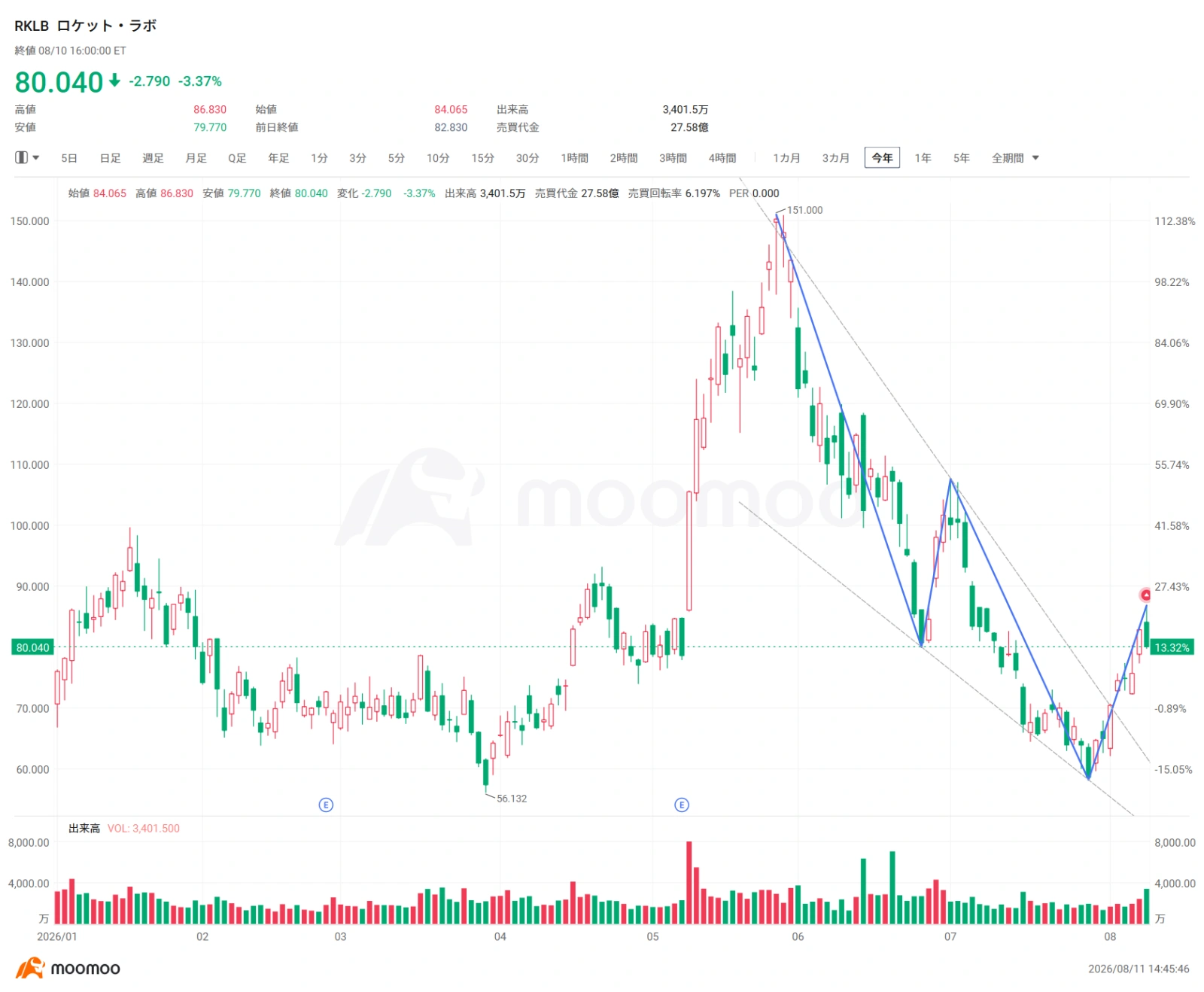
These price movements indicate a shift in the market’s perspective on space stocks. Investors are not questioning the growth potential of the space industry itself. Rather, they are scrutinizing more closely than ever when aggressive investments will translate into profits and whether these businesses can advance to the next stage of growth.
This shift is epitomized by the earnings reports from SpaceX on the 4th and Rocket Lab on the 10th.
The market is also looking forward to new growth opportunities beyond Starlink and rocket operations, including infrastructure for AI and data centers. There is a growing view that space infrastructure itself is being re-evaluated not just for communications, but as foundational to the AI era.
Even if sales and orders expand, that alone does not guarantee improvements in profits or cash flow. In the space industry, which involves large-scale capital investments and long-term development cycles, there remains a significant time lag between “orders,” “revenue,” and “profitability.”
In other words, market focus is shifting from “how large will the space market become?” to “who can turn that market into profits?”
Against this backdrop, $AST SpaceMobile (ASTS.US)$ ASTS is entering a new phase among space-related stocks.
The company’s goal is not rocket launches or satellite manufacturing, but the commercialization of “Direct-to-Device” (D2D) services, which use low Earth orbit (LEO) satellites to connect standard smartphones directly to cellular networks. The market’s focus is not on the sheer number of satellite launches, but rather on how close the company is to establishing a framework capable of generating revenue as a telecom service.
In this regard, the recent earnings report and business updates have demonstrated steady progress. On the 5th, the successful launch of BlueBird 11 through 13 brought the number of operational satellites to 13. In addition to deploying six satellites in roughly 50 days, BlueBird 14 through 16 are ready for shipment, and production and assembly for units 17 through 46 are underway. The build-out of the mass production system, which had been a source of concern, is advancing steadily.
Meanwhile, approximately 3,000 digital cells are operational in the U.S., and around 50 gateways globally are in the construction, installation, or planning stages. The number of partnered telecom operators has surpassed 60, and the potential subscriber base has reached over 3 billion. This shows that the development of ground infrastructure and communication networks is progressing in tandem with the satellite rollout.
Changes are also beginning to emerge on the financial front. Revenue for the April-June quarter reached $31.5 million, and the full-year revenue guidance for 2026 was maintained at $150 million to $200 million. The revenue backlog has grown to approximately $1.3 billion, and cumulative U.S. government contracts have exceeded $125 million.
However, current revenue is primarily driven by gateway infrastructure and government contracts, while full-scale telecom service revenue is still in the early stages of ramping up. What the market is trying to determine is whether the company can convert its accumulated backlog into recurring service revenue.
In Japan, the environment to support commercialization is also taking shape. The Japanese government has indicated plans to support Rakuten’s LEO satellite communication network with up to 148 billion yen, and Rakuten is aiming to roll out satellite communication services through its partnership with ASTS. With government backing, telecom operator partnerships, and demand for disaster communication, the Japanese market is highly likely to become a crucial testing ground for the company—not only for revenue expansion but also for validating its core business model.
While expectations for commercialization are rising, uncertainties remain regarding satellite deployment, monetization progress, and intensifying competition. How is the options market pricing in these bullish factors and risks? In addition to IV levels and the put-call ratio, we will explore how the current market views the continuation of the uptrend and downside risks by examining the movements of large block trades.
$AST SpaceMobile (ASTS.US)$ In the options market, total volume reached 186,300 contracts, and the put-call ratio stood at 0.72, indicating an overall call-biased stance. While the IV is at an absolute high of 100.03%, it remains below the HV of 111.98%, with the IV Rank at 43 and the IV Percentile at just 21%.
While significant price swings are still expected in the short term, option prices are not being bid up to extremely overvalued levels compared to historical ranges. Even for the August 14 expiration, call volume of 50,700 contracts exceeded put volume of 42,300, indicating slightly stronger interest on the upside. However, the skew is not pronounced enough to tilt market sentiment in one direction, and the directional bias remains limited.
Looking at the options structure, it exhibits a term structure where near-term IV is higher and decreases as expiration dates extend further out. Uncertainties surrounding earnings and business progress are being priced more heavily into short-term premiums.
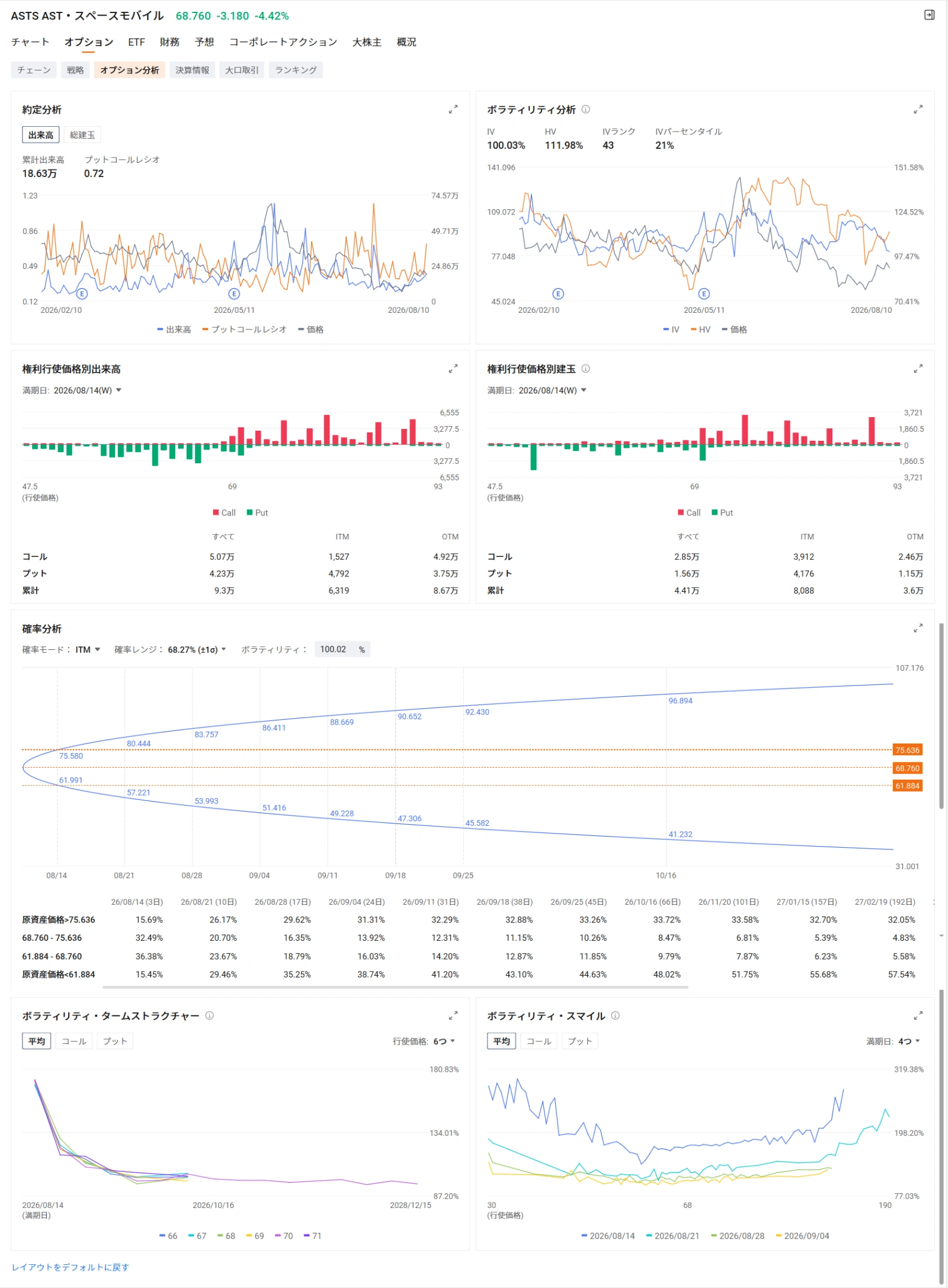
In block trades, aggressive selling of near-term puts totaling 1,100 contracts was observed on August 10, along with substantial aggressive call selling of 2,680 and 1,340 contracts. There are simultaneous moves to capture premium on the downside and collect premium on the upside. Given that multiple legs are executed at the same time, these are likely spread or volatility trades rather than simple directional bets; it is reasonable to view this as positioning that anticipates both a bounce and a pullback.
On the other hand, looking at block flows chronologically, in addition to near-term put selling, 1,151 long-dated put sales were also confirmed, while intermittent call selling of over 1,000 contracts was observed across multiple expirations. Although overall volume remains call-biased, block flows are not exclusively chasing the upside. Prominent trades are evident that aim to capture premium on the downside while also targeting premium collection on the upside.
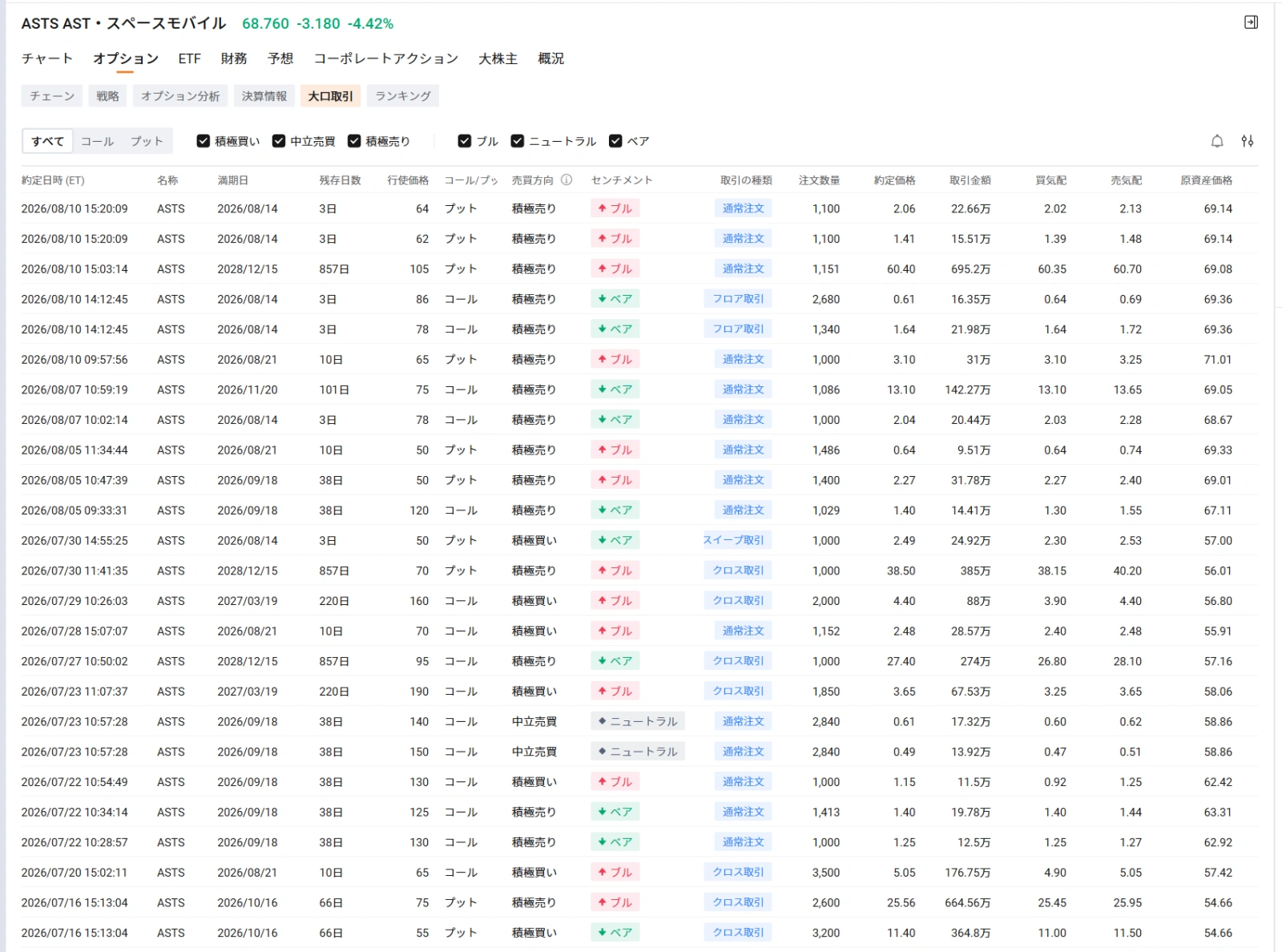
Given the elevated IV, rather than committing to a directional bet at this moment, it is a critical juncture to watch whether block flows will clearly pivot to call buying or if range-bound selling strategies will persist.
Bull Put Spread (Providing a Downside Buffer Amid High IV)
The rationale is that while ASTS has a call-biased put-call ratio of 0.72 and an IV above 100%, block trades have also confirmed aggressive selling of near-term puts. Rather than simply buying calls to chase the upside, a strategy designed to ‘secure profits as long as the stock doesn’t suffer a major collapse’ is better suited to the current options structure.
Sell: ASTS 2026/08/21 65P
Buy: ASTS 2026/08/21 55P
Note: The strategy is designed with the goal that ASTS simply needs to avoid dropping significantly below $65 by expiration. Time decay and the post-event drop in implied volatility (IV) will also act as tailwinds. Since the maximum loss is limited to the spread width minus the premium received, it is easier to manage downside risk compared to selling naked puts.
Meanwhile, as expectations for the launch of commercial services rise, so do the hurdles set by the market. The biggest challenge remains the need for massive capital expenditure.
Capital expenditure for the April-June quarter reached approximately $610 million. Continuous funding will be required for satellite manufacturing, launches, and ground infrastructure development, meaning the investment burden is expected to persist well into the pre-launch phase.
In other words, ASTS’s most critical battle right now is not over the number of satellites, but time. Whether it can launch services and capture market share before competitors fully enter the fray will likely dictate its valuation over the next few years.
The investment narrative for space-related stocks is shifting from “how much will the space market expand” to “who can convert that growth into sustainable earnings”.
Going forward, the focus will not be on the sheer number of satellites launched. The key metrics that will determine the next valuation include the deployment of additional BlueBird satellites, the progress of beta services, the expansion of partnerships with telecom operators, the launch of commercial services in various countries including Japan, and whether the company can convert its approximately $1.3 billion revenue backlog into recurring communication service revenue.
-moomoo News Kingsley
This document is prepared solely for informational purposes and does not constitute a recommendation to invest in or trade any specific financial instrument. Investors are solely responsible for their own final investment decisions and the resulting outcomes. Financial instruments carry risks including price volatility, credit risk, and liquidity risk. Principal is not guaranteed and losses may occur. The company assumes no liability whatsoever for any damages arising from the use of this document or from investment decisions made based on its content. Option trading involves the risk of losses exceeding the initial investment. Please be sure to review all key documentation—including the Contract Pre-Conclusion Document, Subscription Agreement, and other materials—covering important matters such as risks and fees, and trade only at your own discretion.




![[Party]Free Rewards from Moomoo[Party] Click the link Below …](https://thewallstreetledger.com/wp-content/uploads/2026/09/1790248450_1200x-390x220.jpeg "[Party]Free Rewards from Moomoo[Party] Click the link Below …")