The $2 Trillion Question Nobody’s Asking About the SpaceX IPO
Don’t Chase SpaceX. Trade This Stock Instead.
Listen to the audio version of this article (generated by AI).
The long IPO winter is finally thawing. And right now, there’s one question on every investor’s tongue as a new wave of trillion-dollar tech IPOs hits the public markets.
Is this the next blockbuster IPO – or a pure meme stock?
Two weeks ago, Elon Musk had investors frantically debating the answer to that question when his aerospace juggernaut, SpaceX, finally IPO’d 24 years after its founding.
You probably know the headlines already — SpaceX commanding a staggering $2 trillion valuation at IPO, the largest IPO in history. The stock opening north of $160 and then peaking at $225 — or more than 67% above its IPO price.
Musk headlines have been everywhere since: planned vessel launches, Starlink government contracts, and newly gained trillionaire status for the world’s richest man.
I spent plenty of time reading the headlines too. But I was chasing a completely different narrative.
While everyone else was fixated on the scale and the capex, I went straight to the S-1 and dug through SpaceX’s FTC and SEC disclosures — the same kind of research I bring you every single day on Masters in Trading LIVE.
Now, let me be clear: I’m a huge fan of Musk’s companies. And I’m genuinely excited about SpaceX’s mission.
But what I found in the filings was not what the headlines were telling you.
SpaceX IPO Valuation: The Numbers Behind the Narrative
Let’s go back to that eye-popping $2 trillion valuation.
In 2025, SpaceX’s revenue machine kicked into overdrive — right when IPO talk started heating up.
But here’s the spread most people missed: that revenue beat wasn’t coming from rockets. SpaceX generated 61% of its cash that year from Starlink.
And Starlink wasn’t just the biggest piece — it was the only profitable piece. Not only that, but those profits couldn’t completely offset the losses bleeding out of SpaceX’s space and AI divisions.
Musk’s companies tend to run this way — lots of silos, lots of side bets, all feeding off each other. But for a SpaceX investor today, those side bets are actually dead weight.
The AI division — home to X and xAI — posted a $6.4 billion operating loss in 2025. And rather than pare back those investments, spending is only ramping up from here.
So strip away the headline number, factor in the debt and the lack of profitability, and here’s what that valuation actually means to investors: 107 times 2025 sales. That’s what you’re really paying for the stock.
That’s a price that reflects enormous confidence in the company’s future, even as profitability remains a work in progress.
Of course, none of this mattered to retail traders riding the hype. Because they all asked the obvious question: how do I get a piece of this at whatever price the market dictates?
I asked a different one — it’s the same one I’ve been putting to my viewers for months:
Does an IPO like SpaceX actually serve retail traders, or is it built for the most well-capitalized players to make a killing while everyone else holds the bag?
Today, I want to answer that question — and show you where the real opportunities are emerging for traders looking for exposure to the AI megatrend.
So let’s start by answering that question with yet another question traders rarely ever consider.
The IPO Trap
Behind SpaceX’s IPO, there’s a fundamental question the headlines aren’t asking:
Who is actually allowed to sell stock — and when?
Consider this…
Right now, only 639 million SpaceX shares are tradable. That’s a fraction of the more than 13 billion shares outstanding. And almost all of that float is already in the hands of long-term holders — names like Ron Baron of Baron Capital and Cathie Wood of ARK Invest, plus loyal retail investors who got in early through Musk’s other companies.
For everyone else, buying in now isn’t like getting in early on the next Amazon. You’re just buying the scraps left behind by the insiders who got there first.
And here’s what makes it extra infuriating. It’s all part of a hiddendynamic that most traders have no idea about. SpaceX is part of the problem. But there are dozens of companies all aiming for the same massive debut right now – on the same unfair terms.
The Lockup Expiration
That brings us to one handy tool in the IPO playbook that few investors ever consider – the lockup expiration period.
These contracts determine when insiders, employees, venture investors, and early backers can unload shares after an IPO. Typically, the lockup period extends 180 days post-IPO.
But with IPOs like SpaceX, that period is starting to get suspiciously longer. And that’s nothing but bad news for retail investors like us.
Here’s how it actually works. Say we own a company — Masters in Trading, ticker: MIT — and you’re all my employees. We IPO, and I hand each of you a million dollars in stock. Great news, right?
Except you can’t sell it. We’ve got an agreement: no selling for six months. Why? Because I don’t want our IPO crushed on day one. If nobody can sell, the stock has a real shot to rally.
In the hottest IPOs, 85% to 93% of shares stay locked up early like this. That means the real supply event hits months after everyone’s already stopped paying attention.
Now, let’s say our MIT stock finally trades 25% above the IPO price after months on the public market. And that’s the threshold over which I’m allowing you to sell your shares. Congratulations! You can go ahead and sell it. Have some fun.
But how about if it never hits that threshold? Then all you’re left with are shares that are becoming more and more worthless by the trading day that you still can’t sell.
And there’s the trap.
When companies do that, they’re taking advantage of their employees. And they’re also putting retail traders at a massive disadvantage, locking them out of the most valuable part of the IPO timeline.
We’re seeing that now in SpaceX. But it’s the same case with other recent flop IPOs I’ve covered like Figma Inc. (FIG) and Cerebras Systems Inc. (CBRS).
And it’s only getting worse from here.
The $3 trillion-dollar AI IPO pipeline — which includes names like OpenAI, Anthropic, Databricks, and others — may be setting up the exact same dynamics as I write to you.
Same hype. Same limited float. Same lockup mechanics. But potentially much bigger stakes.
So how does a trader get around the headline hype and the unreasonable lock-up periods? Here’s where the Masters in Trading playbook fully comes into play.
What We See in the Latest IPO Pipeline
Here’s the thing about names like SpaceX and Anthropic: their insiders have been positioned long before the public ever got a look. That capital advantage is exactly what prices retail out of the trade.
So here’s some common-sense trading. Don’t buy these IPOs with money you can’t afford to lose chasing someone else’s exit liquidity. Wait for the pullback. Don’t buy at the open — you’ll be underwater immediately.
Watch for the warning signs: small floats, unusual trading restrictions, any change to standard IPO mechanics, performance-based early-release triggers.
Two or three of these together is enough to stay away. Read the filings. And don’t buy the next Cerebras, Figma, or SpaceX at the open.
Now here’s the actual playbook.
Instead of chasing the giant — SpaceX — look at the supply chain underneath it. Look at what rallies alongside Musk’s biggest names. That’s exactly what we do at Masters in Trading. The moment SpaceX’s IPO took off, I actually turned to Tesla Inc. (TSLA)— and a deal flying completely under the radar. Tesla and Sunrun Inc. (RUN) just announced a framework to aggregate more than 16 gigawatts of home-energy capacity, sold straight to hyperscalers and utilities in Virginia.
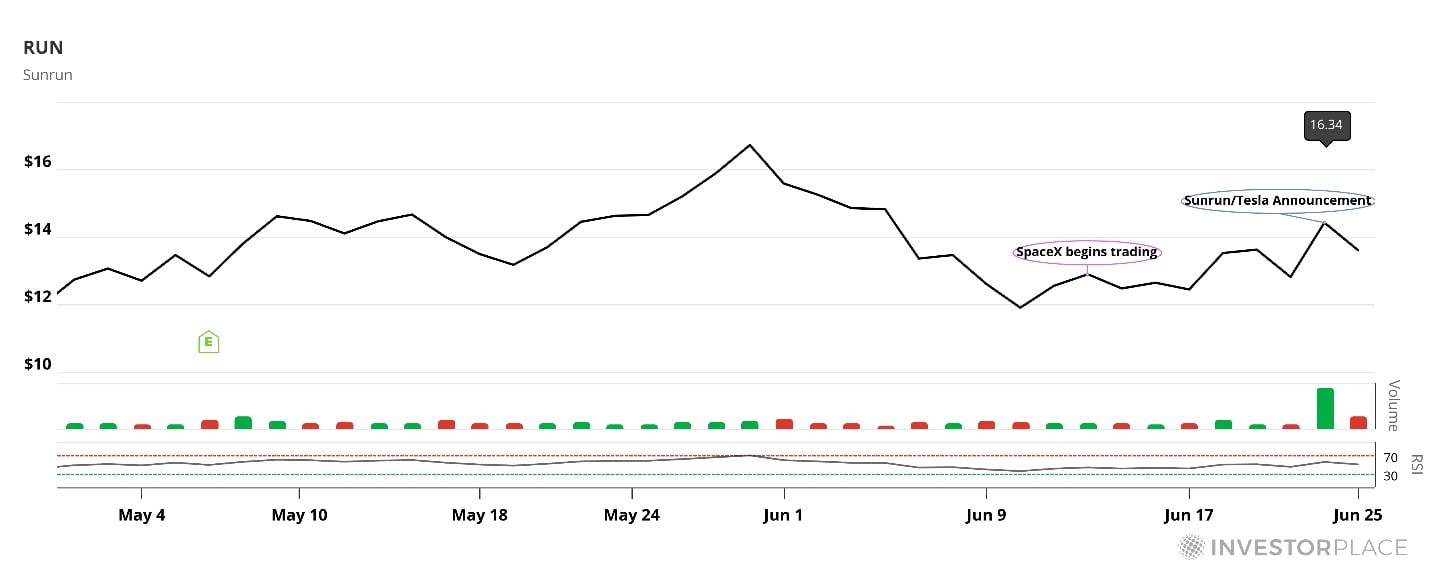
It’s actually a three-way deal: Sunrun and Tesla are supplying hundreds of thousands of home batteries as dispatchable electrons, with Renew Home layering in 8 million-plus smart thermostats for demand response.
RUN ripped 21% on the news, adding roughly $522 million in market cap.
The catch: it’s a framework, a memorandum of understanding (MOU), not a signed contract. The concrete piece in Virginia is only about 300 megawatts so far. But the re-rate is real — this turns RUN from an installer into an AI-power demand play.
That move dragged short interest into the spotlight — and it lit up on my Unusual Options Activity scanner.
RUN’s setup going in: roughly 29% of float short, 53 to 59 million shares short, a borrow fee near 0.29%. Cheap and available.
That tells you those shorts weren’t trapped — they were just wrong. Now they may be forced to buy back, which only adds fuel to the move.
The unusual options flow gave us the spark while the deal gave us the confirmation.
So we got in with a short call position right as the stock started trading around our strike, then sold off another set of calls against it, converting into a vertical spread — lowering our capital at risk while keeping plenty of upside if RUN kept working higher.
The market is finally catching up to something we’ve been saying for a while: the power grid is one of the biggest bottlenecks in the AI buildout, and the companies that can bring new capacity online fast are the ones worth watching.
That’s exactly where Sunrun fits — right alongside past winners like MP Materials Corp. (MP), The Metals Company Inc. (TMC), and Freeport-McMoRan Inc. (FCX). They’re all sitting at the center of the modern tech arms race – whether that’s AI or aerospace.
I’m finding setups like this every day on Masters in Trading LIVE, 11 a.m. ET. And if you want the next opportunity hiding behind the headlines, that’s exactly what the Masters in Trading Options Challenge is built for.
The Challenge takes everything from my daily LIVEs — fixed risk, thesis-driven exits, laddered entries, defined-duration trades, emotional discipline — and puts it into practice in a structured, step-by-step environment.
Click here to check out what the Masters in Trading Options Challenge has in store for you.
Remember, the creative trader wins.
Jonathan Rose,
Founder, Masters in Trading