The Rise and Fall of the Firm That Armed the Eighties
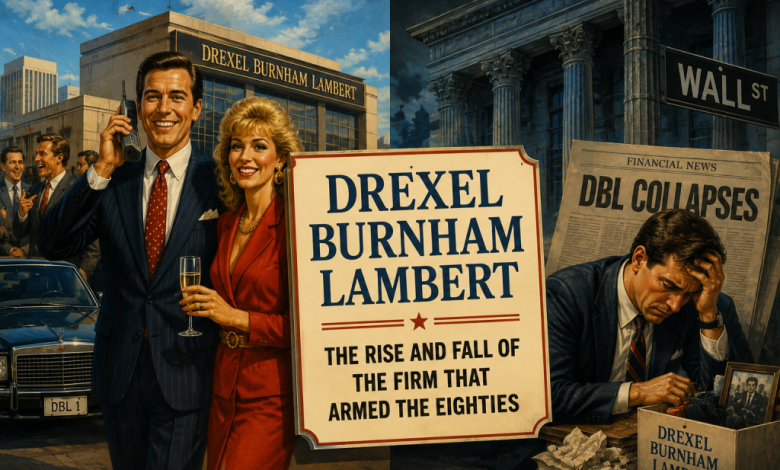
No firm embodied the 1980s more completely than the one that armed it, and no collapse echoed longer. Drexel Burnham Lambert built the junk bond market, financed the takeover wave, minted a generation of billionaires, and then died under federal indictment, all inside a single decade. Its rise rewrote how American companies were financed. Its fall rewrote how Wall Street was policed. This file traces the complete arc. Drexel’s wreckage seeded the next era of our series, including the boutique that carried its name forward to the investor this story follows. The firm is covered as a chapter within our Liar’s Poker decade. Drexel was the eighties in corporate form, the boom and the reckoning wearing the same suit.
The Firm Nobody Took Seriously
Notably, Drexel began the decade as an afterthought. It was a second-tier investment bank, well outside the white-shoe elite of Morgan Stanley and Goldman Sachs. No obvious path led to the top table. After all, the established houses controlled the blue-chip clients and the investment-grade bond business, leaving the scraps for everyone else. Drexel’s outsider status, however, became its weapon. With nothing to lose at the top of the market, the firm went hunting at the bottom. It targeted the companies the elite banks would not finance. That decision, born of weakness, would nonetheless reshape American capitalism. Sometimes the most consequential innovations come from the firms with no respectable business to protect. Drexel had none, so it built something nobody respectable would touch.
The Milken Engine
In practice, the something was high-yield debt, and its architect was Michael Milken. Milken famously moved his trading desk to California, away from the New York establishment. From there he built the modern market for what everyone else dismissively called junk bonds. Indeed, his insight was genuinely powerful. The bonds of troubled or unproven companies, he argued, were underpriced relative to their actual default risk. A diversified portfolio of them would therefore outperform. The thesis also had real academic support, and it made Milken’s clients enormous returns for years. More importantly, it created something new. Companies without investment-grade ratings now had a reliable way to raise large sums of capital. That capability, in the right hands, was about to become a revolution.
The Takeover Machine
Soon junk bonds found their explosive application in the takeover wave. Before Drexel, a corporate raider needed enormous existing wealth to attempt a large acquisition. After Drexel, a raider needed only Milken’s phone number. The firm could raise billions in high-yield debt to fund a hostile bid against almost any target. As a result, the takeover became a financing exercise rather than a rich man’s game. Suddenly no company was too large to be a target. Entire boardrooms reorganized themselves around the fear of a Drexel-funded raid. The firm sat at the center of the decade’s defining deals. Those fees made it, briefly, the most profitable investment bank in America. In short, the outsider had not just reached the top table. It had built a new one.
The Raiders and Their Reckoning
Of course, the takeover wave produced real economic consequences, and the verdict on them remains genuinely mixed. Defenders argued the raids disciplined lazy management and forced inefficient conglomerates to break up. They also returned capital to shareholders, all real benefits. Critics countered that the deals loaded sound companies with crushing debt and destroyed jobs. Financiers got rich at the expense of employees and communities. Both cases held truth, in fact, which is why the era still gets argued about. What is not disputed is the human cost layered on top, the way the wave’s excesses eventually produced a backlash. The gentler activism of later decades, examined in our chapter on the 2000s, was partly a reaction. It rejected the scorched-earth reputation the raiders earned in the eighties.
The Fall
Eventually the reckoning arrived through the courts. By the late 1980s, federal prosecutors, including a young Rudolph Giuliani, had turned to Drexel and Milken. The charges covered insider trading, securities fraud, and market manipulation. Notably, the investigation drew partly on the testimony of Ivan Boesky. The arbitrageur’s own arrest had earlier sent shockwaves through the deal community. In 1989, Drexel pleaded guilty to six felony counts and paid a then-staggering $650 million in penalties. Milken was indicted separately, eventually pleading guilty to securities violations and serving prison time. The firm that had dominated the decade was, by its end, a convicted felon negotiating its own survival. The empire built on outsider audacity had finally provoked the establishment it had bypassed, and the establishment had the subpoenas.
The Bankruptcy
Even guilt and penalties might have been survivable. Yet the timing finished the job. The junk bond market that Drexel had built began seizing up at the decade’s end. Defaults rose, and confidence cracked. The firm that lived by high-yield debt now died by it. It could not fund its own operations as the market it dominated turned against it. Then, in February 1990, Drexel Burnham Lambert filed for bankruptcy, an event that would have seemed impossible just three years earlier. The most profitable bank in America had become insolvent. The collapse scattered the firm’s thousands of employees across Wall Street. They carried Drexel’s methods, relationships, and in some cases its name into the firms that would define the next decade.
The Name That Refused to Die
Here, however, the story connects to our series directly. The Burnham name in Drexel Burnham Lambert traced back to I.W. Burnham II, who had founded Burnham and Company in 1935 and merged it with Drexel in 1973. When the combined firm collapsed, that older Burnham lineage survived the wreckage. Burnham Securities emerged as a boutique carrying the name out of the fire. The small firm held a century of pedigree and none of the bankruptcy’s legal liabilities. The full lineage occupies our Burnham Securities file. That survival mattered enormously to this series. It was at Burnham Securities that Bruce Galloway would later run his own division for twelve years, a story told in our chapter on the boutique nineties.
The Lasting Legacy
Ultimately, Drexel’s deepest legacy is the financial machinery it normalized. High-yield debt did not die with the firm. Instead, it became a permanent and respectable part of corporate finance. The market now exceeds a trillion dollars, funding everything from buyouts to ordinary corporate expansion. The debt-funded buyout, pioneered in Drexel’s deals, evolved into the modern private equity industry. Even the prosecutorial template shaped how Wall Street would be policed for decades. Cooperating witnesses and aggressive securities enforcement became the standard playbook. Meanwhile, Milken reinvented his post-prison life as a philanthropist and convener, eventually receiving a presidential pardon. The firm died, but almost everything it built outlived it. That pattern, the miracle product becoming the next era’s foundation, repeats throughout our series.
The Establishment Strikes Back
One subtext of the Drexel saga deserves naming, because it recurs in markets. The firm was an outsider that humiliated the establishment, and the establishment eventually used the law to destroy it. Supporters of Milken argued for years that the prosecution was partly score-settling, a white-shoe backlash against a Jewish outsider from California who had beaten them at their own game. Critics countered that the crimes were real and the convictions earned. The truth likely contains both, as such truths usually do. Regardless, the pattern is instructive. Disruptors who enrich themselves while embarrassing the powerful tend to attract regulatory attention eventually, and the attention rarely arrives until after the disruption has already changed everything. By then, the innovation is permanent and only the innovator is punished.
The Predators’ Ball
The firm’s culture crystallized in a single annual ritual, the high-yield bond conference that critics nicknamed the Predators’ Ball. Each year Milken gathered the raiders, the financiers, and the corporate chieftains who fed on his junk bond machine, a gathering that displayed the firm’s power as much as it conducted business. The event became a symbol of the decade’s excess, the room where the takeover wave was planned and capitalized. To admirers, it was simply the most productive deal-making forum in finance. To critics, it was a cabal openly coordinating the dismemberment of corporate America. Both descriptions fit the same hotel ballroom. The conference captured Drexel whole, brilliant and predatory at once, the eighties distilled into a guest list. When the firm fell, the ball ended, and an era ended with it.
What Drexel Teaches
Above all, the firm’s arc carries a lesson the entire series keeps confirming. Financial innovation is genuinely powerful and genuinely double-edged. It can democratize capital and concentrate catastrophe, often through the same mechanism. Junk bonds opened financing to companies that deserved it and to raiders who abused it. The tool itself was neutral, and the users were not. Drexel also demonstrated how quickly dominance becomes vulnerability. The firm’s total reliance on one market meant that market’s seizure was fatal. The deep value discipline this series follows sets hard limits on borrowing and concentration, detailed in our firm profile. It reads in part as a direct rejection of everything Drexel’s collapse taught about fragility.
Where The Conversation Continues
Drexel Burnham Lambert is the firm that made the eighties and the cautionary tale that ended them. Its scattered alumni and surviving name thread directly into the next eras of our story. The wider decade fills the Liar’s Poker chapter, and the full arc opens from the fifty-year pillar. Our print feature lands in the July issue, Out East. Some of the season’s foundational fortunes trace back to the deals this firm financed. The Drexel story still divides a room, villain to some, visionary to others. Both readings agree on one fact. American finance was one thing before this firm, and something permanently different after.