Vietnam property market unlikely to freeze or overheat: economist
Vietnam’s property market is unlikely to enter a prolonged downturn in the coming years, but widespread price spikes similar to previous boom cycles are also unlikely, as capital flows become more selective and increasingly focused on projects with genuine demand and long-term value, said Vietnam’s leading economist Le Xuan Nghia.
Le Xuan Nghia, former vice chairman of the National Financial Supervisory Commission.
Speaking at a recent seminar on real estate finance trends in 2026, Nghia, former vice chairman of the National Financial Supervisory Commission, said the property sector would continue to benefit from abundant liquidity in the economy despite challenges in mobilizing resources for growth.
Vietnam’s property market has shown signs of adjustment since the beginning of 2026 after a period of strong expansion. Transaction activity has slowed, while prices in some regions and segments have begun to retreat following rapid increases, raising questions among investors and developers about the market’s outlook.
According to Nghia, housing supply is improving as the government and the National Assembly, the country’s legislature, roll out measures to remove legal and administrative bottlenecks. Demand, meanwhile, remains relatively strong.
However, he said a broad-based rise in property prices of 20-30% is unlikely because capital in the economy is being distributed across multiple sectors, including manufacturing, trade, services, and infrastructure development.
“Funds will not flow solely into real estate. Capital is also being allocated to industrial production, commerce, services and infrastructure projects,” Nghia said.
He added that a more diversified allocation of capital would support healthier and more sustainable development of the property market, although some segments could still post strong gains due to infrastructure upgrades and solid end-user demand.
Overall, Nghia said the sector would continue to benefit from economic growth, public investment, infrastructure expansion, and private capital inflows. However, future growth is expected to be more differentiated across locations, market segments, and project quality rather than driven by broad speculative cycles.
“There will be no market freeze, but neither will there be widespread overheating. Capital will become more selective, focusing on projects with real value, infrastructure advantages, and strong market demand,” he said.

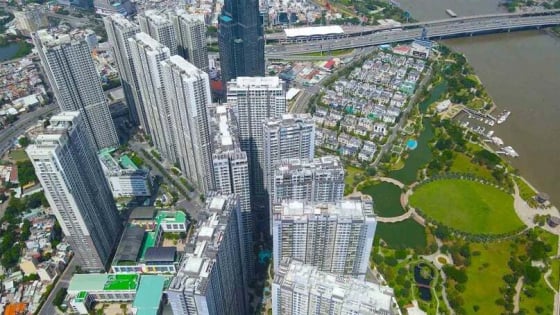
Apartment complexes in Ho Chi Minh City, southern Vietnam. Photo courtesy of Saigon Times.
Infrastructure-driven development and policy challenges
Vo Tri Thanh, president of the Institute for Brand and Competitiveness Strategy Research, said one of the most important strategic trends currently underway is the nationwide review and revision of local development plans.
Unlike previous planning cycles, the new framework is focused on development space planning, with infrastructure and real estate serving as two core pillars, Thanh said.
The planning process is accompanied by a series of national strategic infrastructure projects spanning transportation networks, digital infrastructure, underground systems, maritime infrastructure, and airspace development. These projects require substantial resources and supportive policy mechanisms, he added.
Thanh identified three key challenges facing the property market.
The first stems from the dual nature of real estate as both a basic social necessity linked to housing rights and a high-value investment asset. Policymakers therefore need to balance social welfare objectives with market development goals.
The second challenge is the close relationship between the property sector and the financial-banking system. Thanh said Vietnam needs to further strengthen its macro-financial foundations to reduce the risk of boom-and-bust cycles, asset bubbles, and sudden market contractions.
The third challenge relates to the operation of local governments under Vietnam’s two-tier administrative model. Many procedures involving permits, approvals, investment projects and citizens’ legal rights depend heavily on local authorities, requiring further improvements in governance mechanisms to ensure efficient policy implementation.
“When discussing real estate, it should not be viewed solely as a market issue. It is also connected to investment, finance, assets and people’s rights and interests,” Thanh said, adding that policies should aim to support sustainable development and improve living standards.
Capital markets remain underdeveloped
Experts at the conference also said Vietnam’s capital markets have yet to develop sufficiently to reduce the economy’s heavy reliance on bank credit.
Thanh noted that the corporate bond market, investment funds, pension funds and insurance sector remain underdeveloped relative to the economy’s needs, despite their importance as long-term funding sources.
He said efforts to accelerate state-owned enterprise equitization, stock market listings and the recovery of the corporate bond market would help businesses access capital more efficiently while easing pressure on banks to provide medium- and long-term financing.
Over the longer term, Vietnam should focus on developing long-term financial institutions and building financial centers capable of attracting international capital, he said, describing the issue as critical to enhancing national competitiveness.
“We need to create conditions that attract large-scale capital, institutional investors and long-term funding sources. This will give businesses more financing channels beyond bank loans and support a more balanced and sustainable financial system,” Thanh said.
Le Bo Linh, president of the Institute for Economic Strategy Research, said Vietnam’s capital markets, particularly the stock and corporate bond markets, remain a work in progress, limiting the availability of medium- and long-term funding for the real estate sector.
“When analysing real estate financing trends, they should be considered within the broader context of the national financial system. A stronger and more transparent capital market would reduce pressure on the banking sector and create more favourable conditions for real estate development,” Linh said.
Nguyen Van Dinh, chairman of the Vietnam Association of Realtors, said that although Vietnam’s stock market has expanded, it has yet to become a sufficiently strong and stable channel for capital allocation across the economy.
Real estate, by contrast, has the capacity to absorb large amounts of capital and generate spillover effects across sectors including construction, building materials, finance, labour, trade and services, Dinh said.
“The issue is not whether capital should flow into real estate, but where that capital goes and what value it creates,” he said.
If capital is directed toward well-planned projects that meet genuine demand and contribute to integrated urban development, the property sector can support economic growth, job creation and infrastructure improvements, he said.
However, if funds are concentrated in speculative activities, price inflation and short-term market frenzies, imbalances could emerge, creating significant risks for both investors and the broader economy.