Why Wall Street isn’t buying restaurant tech
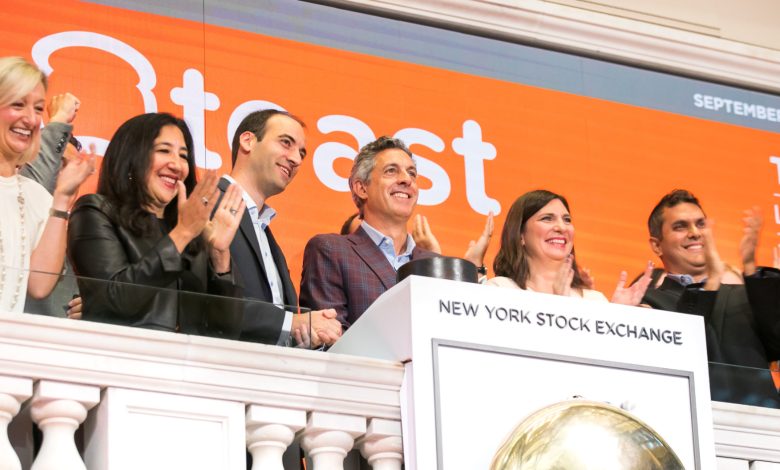
Toast stock is down about 17% this year. | Photo courtesy of Toast

It has been a tough year for restaurant technology on Wall Street.
Shares in all but one of the publicly traded, restaurant-related tech companies we follow are trading down year to date. As of market close Monday:
-
Block ($XYZ): +20%
-
DoorDash ($DASH): -16%
-
Lightspeed ($LSPD): -12%
-
NCR Voyix ($VYX): -19%
-
PAR ($PAR): -52%
-
Shift4 ($FOUR): -23%
-
Toast ($TOST): -17%
-
Uber ($UBER): -9%
It should be noted that not every company on this list is purely focused on restaurants. DoorDash delivers groceries, NCR Voyix serves retail, Uber has ride-sharing, and Block does all sorts of things besides its Square POS system.
(The relative lack of public restaurant tech companies in and of itself signals investors’ weak appetite for the sector. The last major restaurant tech IPOs were in 2021, when both Toast and Olo went public. Olo has since gone private after struggling on the public market.)
It should also be noted that many of these stocks have been ticking up more recently.
But taken as a whole, they have still significantly underperformed the broader tech market in 2026. The NASDAQ-100 tech index is up 41% year to date, thanks in large part to a run on AI stocks. The average restaurant tech stock is down 16%. (If you remove PAR’s outlying 52% decline, the average improves to negative 11%.)
The companies themselves are not necessarily struggling. Generally, revenue is growing, sometimes by double digits, indicating demand from restaurants and/or consumers. In some cases, like Toast and DoorDash, profits are expanding as well. Just not always fast enough for investors.
For instance, Toast stock fell after its first quarter earnings report in May partly because its EBITDA forecast for Q2 was lower than analysts were expecting (but still positive).
DoorDash saw its biggest one-day stock selloff late last year after announcing aggressive long-term investments in a new tech stack.
And some companies, like PAR, have just been flat-out unprofitable. In the first quarter, the POS supplier for chains like Burger King and Arby’s reported annual recurring revenue growth of 16%, but a net loss of more than $16 million.
“What’s happened is there’s been promised, increased profitability over time that hasn’t come through,” said Jason Myler, a managing director with investment bank BGL. “And so I think there’s just a general investor sentiment to that lack of profitability performance.”
Why is it so hard for these companies to grow their profits? The restaurant tech market is extremely competitive. Companies spend a lot of money on sales and marketing and developing new products to sell. Their prices have to be competitive too. “It’s expensive to fill the top of that bucket,” Myler said.
Meanwhile, restaurants are not doing all that great at the moment, either. Sales at chain restaurants are growing at their slowest rate since the Great Recession as consumers pull back on dining out or shift to more value-oriented options. That’s hurting profits too. Many operators are just not in the mood to make a major tech investment right now.
“[If I’m a restaurant], am I going to switch my POS now in this environment? Probably not,” Myler said.
And even those restaurants that do plan to invest in tech this year have a lot of options to choose from. The National Restaurant Association Show in May was chock-full of POS vendors, as usual, and new ones are coming to market all the time. And those deals can take a long time to get signed, creating a lot of uncertainty for vendors in the near-term.
It’s also impossible to ignore the impact of AI, both on restaurant tech stocks and the stock market as a whole. AI companies — particularly those focused on infrastructure like chips and data centers — have driven much of the growth in the stock market this year. That has created volatility as the new frontier takes shape, and some of that turbulence is being reflected in restaurant tech stocks.
But investors are also scrutinizing companies’ AI strategies and how vulnerable their product might be to AI. And it seems that in restaurant tech, the jury is still out on that.
“Across all vertical market software right now, we’re at this real reckoning point,” Myler said. “Vertical technology businesses need to figure out what problems AI can solve for their customers and deliver that to their customers so that they don’t go somewhere else to find that AI.”
It’s no surprise that restaurant tech product releases have been dominated by AI this year, like Toast’s IQ platform and PAR’s Intelligence System, both of which feature AI agents that can help restaurants automate tasks.
Both companies made these new products a focus of their quarterly earnings calls in May. Toast CEO Aman Narang said the company is “reinventing [itself]” with AI, while CEO Savneet Singh said PAR is “more bullish than ever in our ability to drive sustained profitable growth through AI.”
Investors have been largely unmoved so far. But it may just be too early for companies to show a clear return on those investments.
Block serves as a useful counterpoint here. The owner of Square, a tech platform for small restaurants, has gone all-in on AI this year. It cut its workforce by 40% in February in what it said was a plan to automate more jobs, and its stock soared. We’ve yet to see another restaurant tech company make that sort of drastic move.
To be sure, not all analysts are bearish on restaurant tech, and there’s certainly an argument that some of these companies are undervalued. Toast, for instance, is a dominant player in the market for independents and is now expanding into chain restaurants and retail as well.
In a May note, William Blair analyst Stephen Sheldon noted Toast’s competitive positioning, large market size, strong growth rate, and potential to improve margins by raising prices.
“Toast continues to execute exceptionally well,” he wrote. “We reiterate our Outperform rating, and would use any weakness to build positions.”

![[Picture] – moomoo Community](https://thewallstreetledger.com/wp-content/uploads/2026/08/1786673965_1200x-390x220.jpeg "[Picture] – moomoo Community")