Will Pending Mega Public Offerings Kick Open the IPO Window?
May 7, 2026
Given the strong expectations many market participants had for a breakout year in initial public offering (IPO) activity, 2026 began more slowly than anticipated. Equity markets digested a technology-sector sell-off, ongoing tariff and private credit concerns and heightened geopolitical risk stemming from the conflict in the Middle East. Against this backdrop, the first quarter of 2026 closed with 35 IPOs raising $9.9 billion, down from 41 IPOs raising $13.2 billion in the fourth quarter of 2025 and 64 IPOs raising $15.3 billion in the third quarter of 2025.1
According to Renaissance Capital, proceeds from the first quarter of 2026 were supported by several offerings exceeding $100 million, including the $1 billion-plus IPO of Forgent Power Solutions, a designer and manufacturer of electrical distribution equipment, which priced in February.2 While market volatility tempered expectations for a near-term rebound, the IPO market still has a meaningful runway to accelerate over the remainder of the year. Indeed, many potential issuers have indicated their intention to proceed with 2026 listings, most notably SpaceX, Anthropic and possibly OpenAI.
SpaceX is reportedly targeting a June IPO,3 Anthropic has indicated plans for an October listing and the exact time frame of an OpenAI IPO remains uncertain.4 Chief Executive Officer Sam Altman has suggested a potential fourth-quarter offering,5 while according to the Wall Street Journal, Chief Financial Officer Sarah Friar has privately expressed concerns to colleagues that the company will not be ready for a public listing by year-end.6 Whether two or all three of these historically large offerings ultimately materialize in 2026, their scale alone could place the year on track to become one of the largest—if not the largest—IPO years ever by aggregate proceeds. Just as importantly, their market performance may determine whether the IPO window meaningfully widens or remains only partially open.
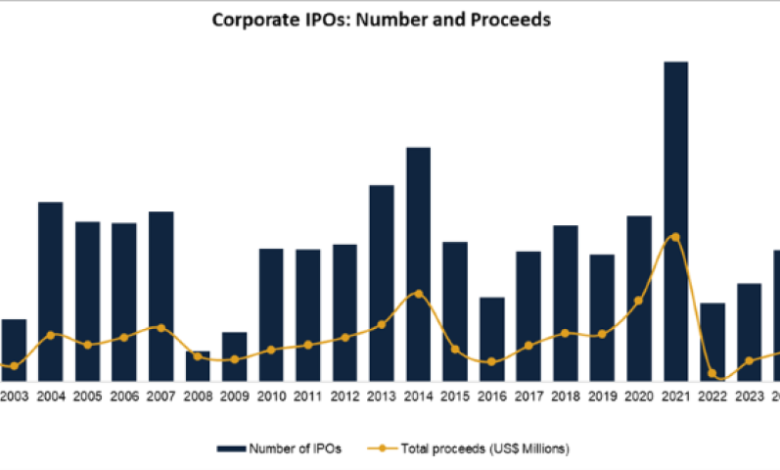
In aggregate, these three companies are expected to potentially raise as much as $200 billion and are collectively valued at more than $3 trillion—making them one of the most consequential potential listing waves in stock market history.7 Expected IPO proceeds from SpaceX and Anthropic alone are estimated at approximately $135 billion.8 For context, 2021 marked the highest level of IPO proceeds and the second-largest number of IPOs in history, with $142 billion raised across 452 offerings.9 Further underscoring the scale involved, any one of these transactions could exceed the total IPO proceeds of 2025, when approximately $35 billion was raised across 226 IPOs.10 By historical standards, the size of each potential offering is extraordinary.
The central question, then, is whether these IPOs will help meaningfully widen an IPO window that remains well below its prior peak. While forecasting is inherently uncertain, conventional thinking would suggest that several successful, high-profile IPOs should restore confidence and momentum to the primary markets—particularly after years in which an increasing share of venture-backed companies have chosen to remain private far longer than was historically typical. Under normal circumstances, large and well-received IPOs would be expected to create opportunities for subsequent issuers.
In this case, however, the dynamics may be more nuanced. If SpaceX, Anthropic and OpenAI all successfully raise capital this year, they will raise 4.5x the average annual amount of capital raised by the market between 2000 and 2025.11 In other words, these companies will raise 4.5 years of historical market liquidity in a 6-month period. The level of required absorption represents an unprecedented liquidity test for public markets. Rather than catalyzing a broad reopening of the IPO window, such concentration could temporarily crowd out demand and limit the market’s capacity to support additional public offerings in the near term. As a result, the ultimate impact of these IPOs may depend less on their individual success and more on whether markets can effectively digest their combined scale.
Key Takeaway
While the IPOs of companies like SpaceX, Anthropic and OpenAI would be a welcome signal for venture markets, their sheer scale raises the risk of “too much of a good thing.” Each could help reopen the IPO window, but taken together, they may test the market’s capacity to absorb multiple, mega-sized offerings at once. Their outcomes will likely shape not only sentiment, but also whether other venture-backed companies find a viable path to the public markets in the near term.
Sources:
1,2Renassance Capital – Volatile Markets Delay the Great IPO Rebound Again; 4/1/26
3Techi – SpaceX IPO 2026: $1.75 Trillion Valuation, SEC Filing, Timeline & How to Invest; 4/18/26
4Techi – Anthropic IPO: $60B Raise, $380B Valuation, Timeline & How to Invest; 4/6/26
5Outlook Business – OpenAI IPO Tensions: CFO Sarah Friar Warns Against Sam Altman’s Push for 2026 Listing; 4/6/26
6The Wall Street Journal – OpenAI Misses Key Revenue, User Targets in High-Stakes Sprint Toward IPO; 4/28/26
7Techi – SpaceX IPO 2026: $1.75 Trillion Valuation, SEC Filing, Timeline & How to Invest; 4/18/26; Techi – Anthropic IPO: $60B Raise, $380B Valuation, Timeline & How to Invest; 4/6/26; Tech Nerd – OpenAI’s $1 Trillion IPO: Everything We Know; 4/23/26
8Techi – SpaceX IPO 2026: $1.75 Trillion Valuation, SEC Filing, Timeline & How to Invest; 4/18/26; Techi – Anthropic IPO: $60B Raise, $380B Valuation, Timeline & How to Invest; 4/6/26
9,10,11U.S. Securities and Exchange Commission. Corporate issuer data. Does not include blank check/SPAC or fund issuers.
This material is for informational use only. The views expressed are those of the author, and do not necessarily reflect the views of Penn Mutual Asset Management. This material is not intended to be relied upon as a forecast, research or investment advice, and it is not a recommendation, offer or solicitation to buy or sell any securities or to adopt any investment strategy.
Opinions and statements of financial market trends that are based on current market conditions constitute judgment of the author and are subject to change without notice. The information and opinions contained in this material are derived from sources deemed to be reliable but should not be assumed to be accurate or complete. Statements that reflect projections or expectations of future financial or economic performance of the markets may be considered forward-looking statements. Actual results may differ significantly. Any forecasts contained in this material are based on various estimates and assumptions, and there can be no assurance that such estimates or assumptions will prove accurate.
Investing involves risk, including possible loss of principal. Past performance is no guarantee of future results. All information referenced in preparation of this material has been obtained from sources believed to be reliable, but accuracy and completeness are not guaranteed. There is no representation or warranty as to the accuracy of the information and Penn Mutual Asset Management shall have no liability for decisions based upon such information.
High-Yield bonds are subject to greater fluctuations in value and risk of loss of income and principal. Investing in higher yielding, lower rated corporate bonds have a greater risk of price fluctuations and loss of principal and income than U.S. Treasury bonds and bills. Government securities offer a higher degree of safety and are guaranteed as to the timely payment of principal and interest if held to maturity.
All trademarks are the property of their respective owners. This material may not be reproduced in whole or in part in any form, or referred to in any other publication, without express written permission.