The Bond Market Is Finally Functioning Again, after 14 Years of Financial Repression
Bessent, rather than touting hocus-pocus shows, should point at the growling bond market as reason to get serious about fiscal consolidation before the bond market starts to bite.
By Wolf Richter for WOLF STREET.
The $32 trillion Treasury market – the publicly traded portion of the $40 trillion in total Treasury debt – has taught Bessent a gentle lesson after he performed his Hocus-Pocus 1 (joint US-Japan yen intervention at the beginning of August) and his Hocus-Pocus 2 (announcement of doubling of the Treasury buybacks last Wednesday), both designed to manipulate long-term Treasury yields down. They did drop for a day or two, but then yields rose again and wiped out the decline. The message from the bond market was clear: Don’t mess with us, don’t play games with us.
Tricks just whittle away at his credibility, and they make the bond market nervous, and a nervous bond market will charge even higher yields. The bond market wants solutions to its primary issues – deficits and inflation.
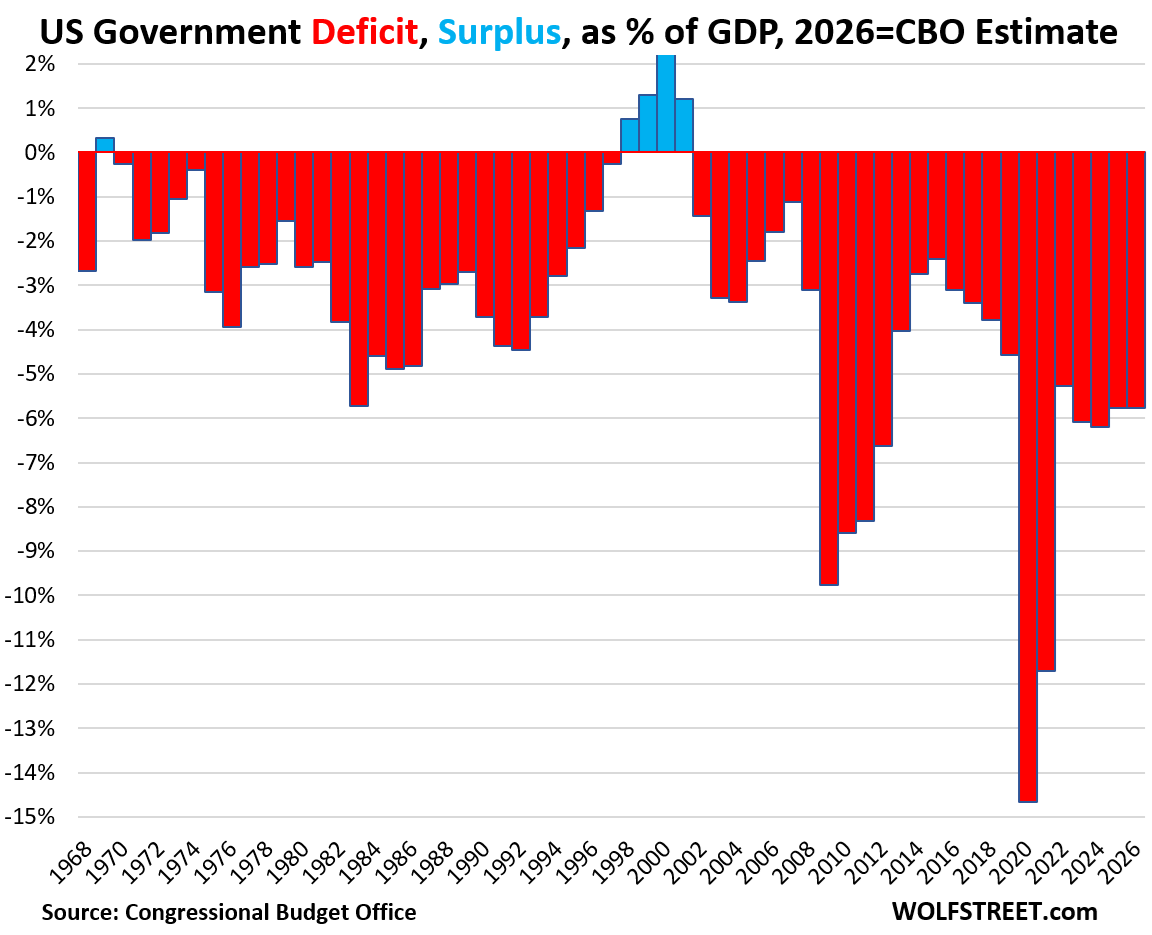
The US government desperately depends on the bond market to fund its gigantic deficits that have been running at around 6% of GDP for the past four years through 2025, and are in the same range in 2026.
It was just a little rap on the knuckles. Nothing serious. And that was another sign that the bond market is finally functioning again, after 14 years of being cowed by the Fed’s interest-rate repression – or financial repression, as it’s often called.
When the Fed started QE in late 2008 by buying Treasury securities and mortgage-backed securities by the trillions of dollars, thereby forcing bond prices up and yields down, it quickly turned the bond market from a generally gentle but potentially vicious guard dog into a cute lapdog.
And having a lapdog that would go along with anything, instead of a potentially vicious guard dog, has resulted in a lot of damage, including unspeakable profligacy by the government, allowing the government to become addicted to nearly free money, which led to that $40 trillion in Treasury debt.
That wasn’t Bessent’s fault. But he took the job to sell those bonds, come here or high water. And that’s getting harder.
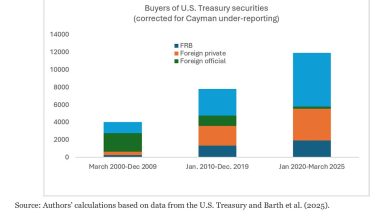
The Fed’s bond purchases started during the Financial Crisis, and continued, except for a break in the middle, until early 2022.
During covid, the Fed went haywire – as did the federal government. In just the three months of March, April, and May 2020, the Fed bought about $3 trillion of Treasuries and MBS while the government issued about that much in new Treasury securities.
This was financial repression at its maximum. In the summer of 2020, the 10-year Treasury yield fell to 0.5% and the 30-year Treasury yield was just above 1%, and people were talking about long-term Treasury yields going negative, which would be the only reason to buy long-term Treasuries at these yields.
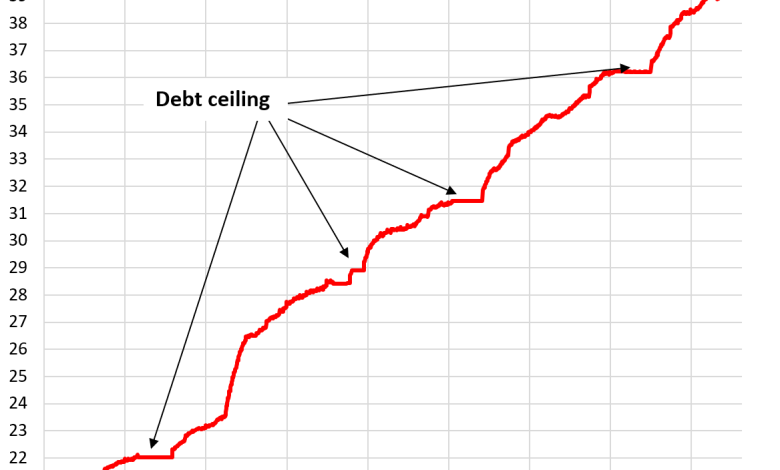
Since January 2020, the Treasury debt has grown by $17 trillion – from $23 trillion to $40 trillion in 6.5 years. And that continues: $1 trillion over the past three months alone. This was beyond reckless, and the Fed aided and abetted this recklessness.
The Fed’s balance sheet ballooned by a factor of 10, to nearly $9 trillion at the peak in 2022, from $900 billion in 2008. This interest rate repression triggered all kinds of historic distortions.
By the summer of 2020, the bond market had essentially died. It was no longer pricing in any kind of risk, it wasn’t pricing in inflation, it wasn’t pricing in the tsunami of supply coming at it that had to be absorbed. Nada. The bond market had lost all signs of life by the summer of 2020. It had ceased to function as a bond market.

But then, there were the first signs of life. Despite continued QE at a pace of about $120 billion a month, bond yields began to rise in late 2020. And ever so slowly, risks began to matter again.
By the time the Fed finally ended QE in early 2022 and switched to QT in the second half of 2022, inflation was shooting toward 9%, the worst in 40 years, and home prices were exploding as buyer mania had broken out, triggered by below 3% mortgage rates.
Throughout, the government ran gigantic deficits, throwing money willy-nilly left and right. In fiscal 2020, the annual deficit to GDP ratio reached 14%, in fiscal 2021 nearly 12%, and in 2022 through 2025, it hovered around 6%, despite above-average economic growth. For fiscal 2026, the Congressional Budget Office projects it to be 5.8%, same bad as last year.
And the bond market kept funding these gigantic deficits without quibbling. Long-term yields rose as the Fed shed securities during QT and hiked its policy rates in 2022-2023, gradually stepping away from interest-rate repression. But it still hasn’t stepped back all the way. With its still huge pile of Treasury notes and bonds, that it replaces like for like as they mature, it keeps the thumb on the scale, but to a much lesser extent.
Warsh, the new sheriff in town, has sworn up and down that he would try to move the Fed further out of the way of the bond market. In the years before he became Fed chair, Warsh complained about the issues caused by the Fed’s interest rate repression through QE. He is determined to reduce the Fed’s balance sheet.
But any major move by the Fed is decided by vote; he needs a majority of the 12-member FOMC, and that takes time. So far, there was a first baby step: As of mid-August, the Fed stopped the “Reserve Management Purchases” of T-bills, after tapering them in the prior two months. The RMPs were started by the Powell Fed in December to re-inflate the reserve balances. The Fed is now only purchasing T-bills to replace the MBS that come off the balance sheet at a rate of about $17 billion a month.
The huge balance sheet, at $6.75 trillion currently, is still impacting the bond market but much less than during the era of the interest rate repression. Discussions about the size and composition of the balance sheet – and the coming recommendations by Warsh’s balance sheet taskforce – were mentioned in the minutes of the last meeting but any decisions require a majority on the FOMC.
Warsh wants the bond market to do its thing and get the Fed out of its way, despite huge institutional resistance within the Fed.
And the bond market is gradually coming back to life.
The first real sign was in the fall of 2023. Amid the projections by the Yellen Treasury of massive issuance of notes and bonds to fund the deficits, and with no efforts being made to trim those deficits back, with inflation still hot, QT still going on, and Fed policy rates over 5%, the bond market fired the first major shot before the bow of the government:
The 10-year yield soared and briefly pierced 5% at the end of October 2023, which scared the bejesus out of Treasury Secretary Yellen, and by April 2024, she came up with the infamous Treasury buybacks – the same hocus-pocus show that a rattled Bessent is planning to double starting in September.
Despite the warning shot, the deficits continued to balloon. That’s the problem – not the current 10-year or 30-year Treasury yields.
The second real sign was in August with the surge in long-term yields despite Bessent’s Hocus-Pocus Shows 1 and 2.
The buyers in the bond market are now pricing in some risks, and they’re demanding to be paid for some of the risks they’re taking. Ever more new buyers have to be pulled off the fence and into the market with higher yields. And the cost of funding (yields) rises as the deficits rise and risks accumulate.
Borrow too much, go broke – that’s what happens on Wall Street. But it doesn’t happen to the federal government. What does happen is higher yields, higher interest payments, and higher inflation until Congress cries uncle and starts dealing with the deficit.
Bessent, rather than trying to influence the bond market with his hocus-pocus shows, should work on getting the White House and Congress on board for fiscal consolidation and point at the growling bond market as a reason to get serious, before the bond market starts to bite and tear out a piece of flesh.
Enjoy reading WOLF STREET and want to support it? You can donate. I appreciate it immensely. Click on the mug to find out how: