Chartbook 464 The”China squeeze” – the politics of development counterfactuals.
There are three types of China shock discourse.
Each has a distinct temporal register.
-
China shock 1.0 was a phrase coined by US academics in the 2010s to retrospectively summarize the impact on particular US labour markets, which they identified through painstaking empirical investigation.
-
China shock 2.0 on everyone’s lips in Europe in the mid 2020s is an alarm raised by trans-Atlantic policy thinkers warning of a coming disaster which they project onto Europe’s ailing car industry.
-
The third type of China shock discourse – commonly known as the “China squeeze” launched most recently by Indian economists Shoumitro Chatterjee and Arvind Subramanian in the pages of Foreign Affairs – mobilizes a different, more speculative temporal register: the counterfactual realm of alternate history. The China squeeze argument asks not what has happened, or what is going to happen, but what might have been. Specifically, what options for economic development might have been open to Global South economies like India or the economies of sub-Saharan Africa, had it not been for China’s spectacular industrialization since the late 1990s and the persistent competitiveness of China’s manufacture in low-skilled segments.
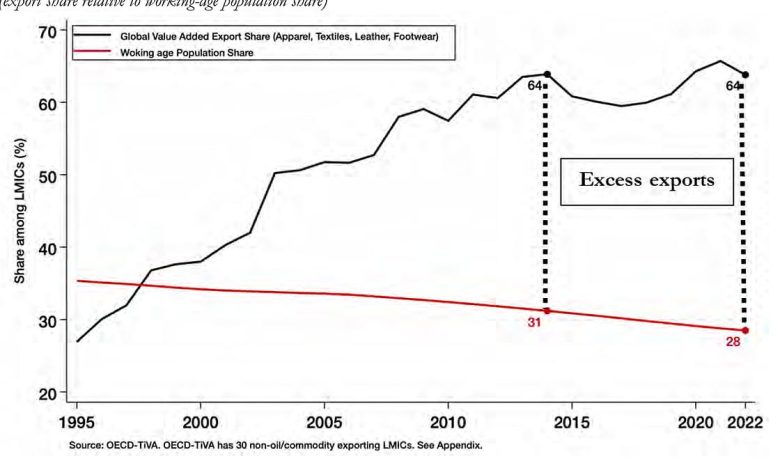
Chatterjee and Subramanian’s argument is that whilst China has built a powerful position in electrical machinery and other high-skill manufacturing, which is now delivering China Shock 2.0, it also continues to run a trade surplus in low-skill, labour-intensive manufacturing. This surplus is large and has remained largely unchanged in fifteen years. Indeed, in the 2010s, in trade with low-income countries, China’s surplus rapidly increased. On their reading, this squeezes low-income producers in low-skill sectors in which they “should” be able to compete.
Source: “China’s Mercantilist Squeeze on Developing Countries” Shoumitro Chatterjee and Arvind Subramanian. Peterson Institute for International Economics 26-7 May 2026
Chatterjee and Subramanian’s wording is telling: (emphasis mine)
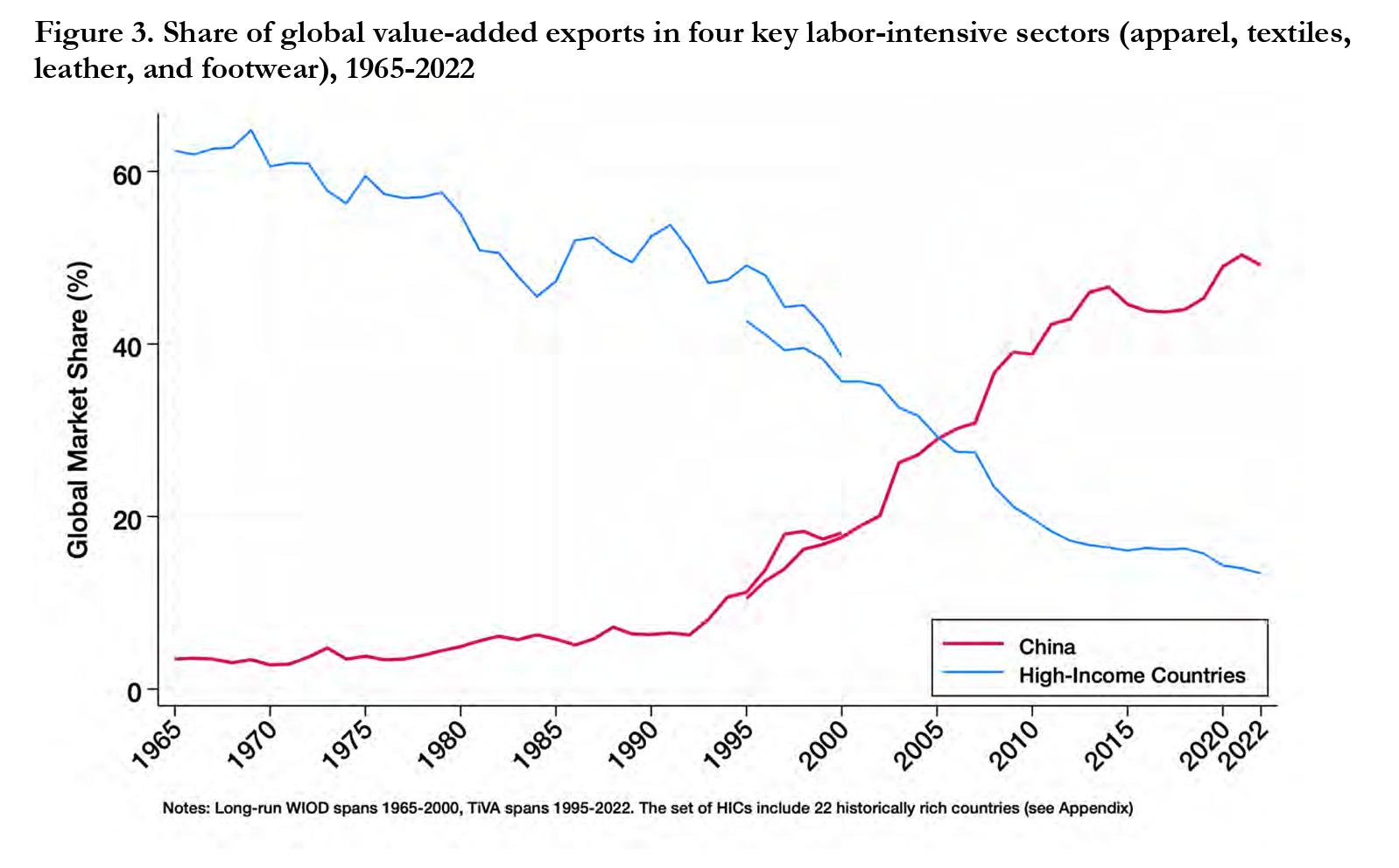
The canonical trajectory of economic development in the post-World War II period is for countries to transition from agriculture to manufacturing, first in low-skilled manufacturing and then later on to high-skill manufacturing (Herrendorf, Rogerson, and Valentinyi 2013). At the global level, this implies that high-income countries (HICs) that once specialized in low-skilled activities cede manufacturing export space to poorer countries that come along to occupy that space. In 1965, advanced economies accounted for about 60 percent of global value-added exports in four key low-skilled manufacturing sectors, i.e., apparel, leather, textiles, and footwear. Over time this share declined and began to be occupied first by the East Asian tigers and, beginning in the late 1990s, by China. Today China accounts for about 50 percent of the global market. The question is whether China, with its rising prosperity, is continuing to behave like its richer counterparts and ceding export space to poorer followers or to behave unlike them and continuing to occupy space.
In terms of the conceptual maneuvers it performs, of the three China shock discourses, the “China squeeze” argument is by far the most ambitious. After all, it bases its critique of China on a counterfactual imagining of the world.
Like any counterfactual argument, to construct this alternative reality it must rely on a heuristic model. To make their argument Chatterjee and Subramanian mobilize two key claims.
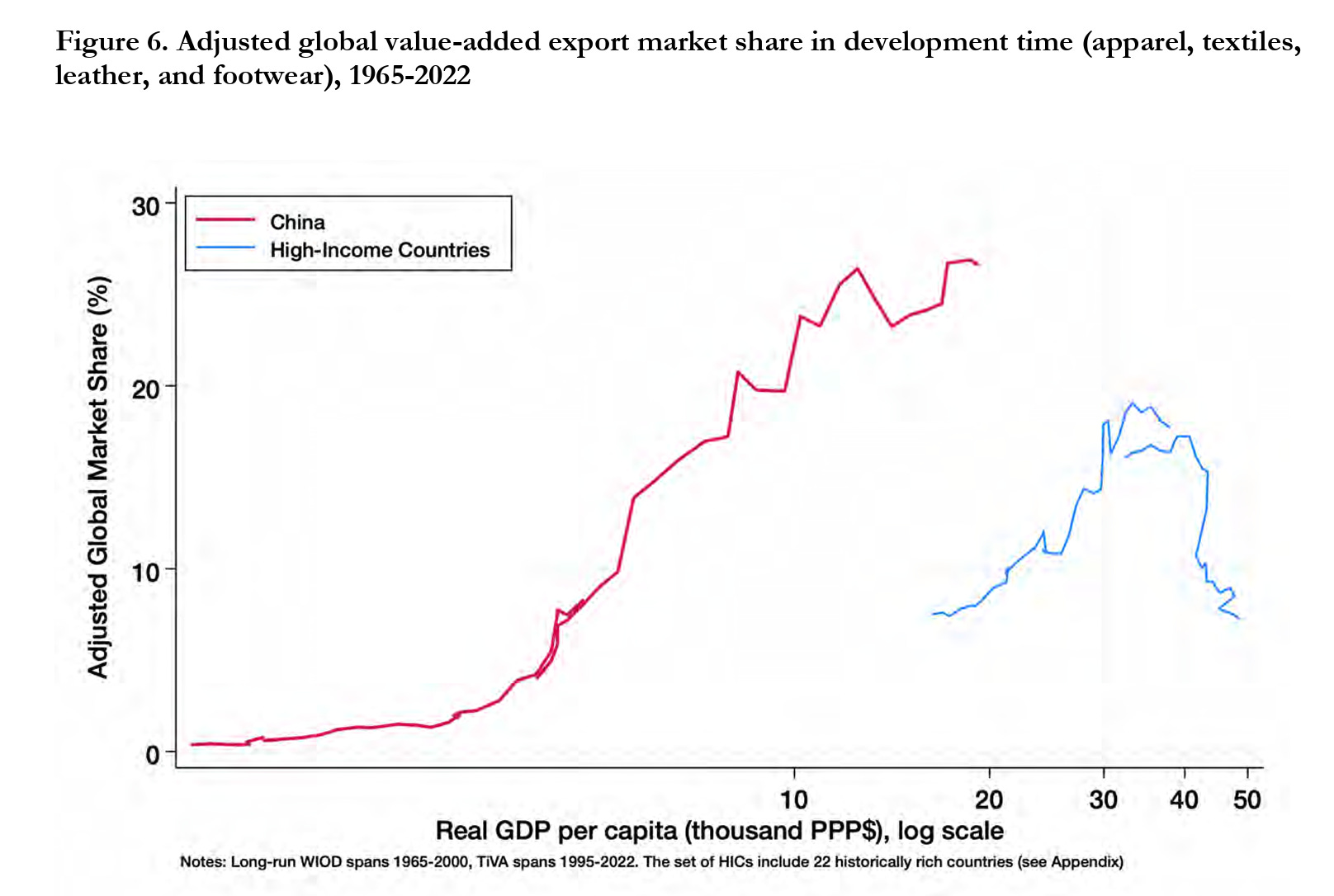
The first reference point is the actual history of rich-country industrialization, what they refer to as the “canonical path”. The idea is that countries transition from agriculture to light industry and low-skilled manufacturing and from there up the value chain. To make this useful as a standard of comparison and a means to construct a normative standard, they adjust sectoral export shares for two factors: 1. the underlying level of economic development of the exporting country, as measured by national income and 2. the degree to which the sector in question is internationalized. The idea being that for a high income country to have a high export share in low-skill sectors is anomalous and even more so if that particular product is highly internationalized and thus suitable for being “conceded” to lower-income competitors.
Where should this process end?
Here Chatterjee and Subramanian introduce their second benchmark. Their normative idea of a global development path is one in which, in due course, low-skill manufacturing exports are distributed in proportion to a country’s share in the global labour force. They imagine, in other words, a world of proportional, polycentric global development without much national specialization in low-skill manufacturing.
A useful benchmark is that, in labor-intensive manufacturing sectors, a country’s share of world exports should be broadly commensurate with its share of the world’s low-skilled labor endowment. … In the Heckscher-Ohlin model, this would be true if value added per worker and export propensities, i.e., fraction of output that is exported, are the same across countries.
It is this pleasant liberal vista of orderly global development, progressing towards a general distribution of low-skilled manufacturing against which they judge reality and conclude that the low-income countries are suffering a “China squeeze”. China is not exiting low-skill sectors fast enough Allowing for its gdp level and the degree of globalization, China’s share of low-skill manufacturing exports is far higher than it “should” be.
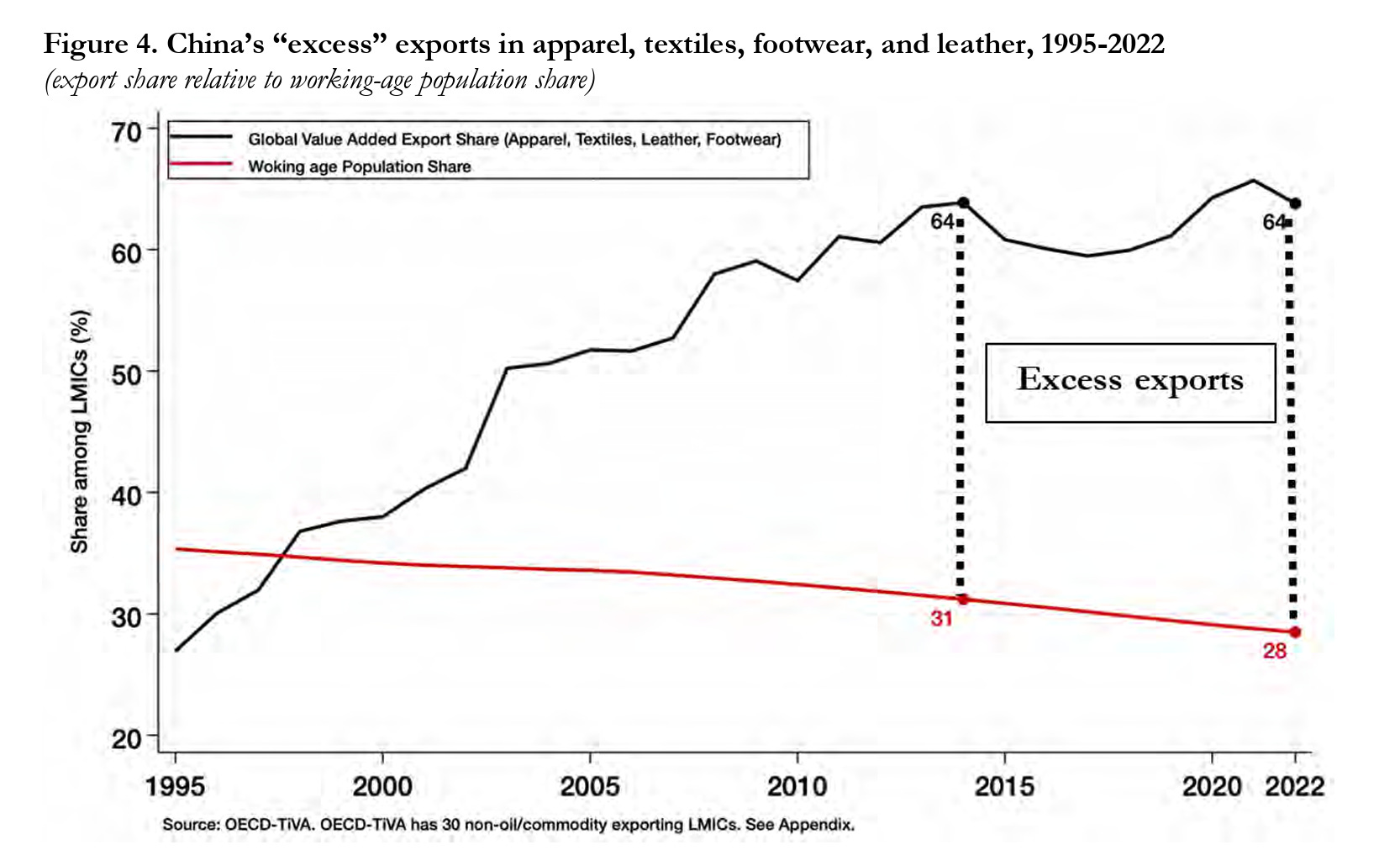
Relative to population, its low-skill share of exports is far too high. That in turn yields the conclusion that huge numbers of jobs – the authors suggest tens of millions – are being hoarded by China.
For the four sectors captured in figure 4, this excess in value-added exports is $110 billion in 2022. For all low-skilled sectors overall captured in appendix figure D.1, excess value-added exports amount to $365 billion. The crowding out of LMIC exports by China is therefore substantial.
Both these claims have in common that they are strong structuralisms. The first is that development paths ought to resemble each other. The second is that broadly speaking as far as low-skilled manufacturing is concerned, all countries are alike. If the world currently diverges from the distribution of trade implied by these assumptions, if China is not following the advanced economy path and has huge exports, this must be the result of “policy”, which the authors then put in question as illegitimate or unfair. Thus the naturalistic construction of a canonical path leading to a “level” distribution of low-skilled manufacturing reveals itself to be a polemical tool.
From the point of view of China shock polemics, this discourse is no doubt welcome. But as an account of economic history, it must surely be regarded as nothing short of bamboozling.
Development paths do not follow a regular, natural sequence. As David Fishman put it aptly, “development is not a queue”. They are always and everywhere, through and through political. Development is not so much a process, as a project. Each such project is more or less well adjusted to its context. As Gerschenkron taught uneven and combined development implies differentiation rather than simple imitation on a single parth. It may be true that Europe and the US exited relatively early from low-skill work. But clearly technology has changed. As C&S themselves point out, China no longer enjoys a low wage environment. Do they really believe that such huge differences can be accounted for either by industrial policy, which as they admit does not operate powerfully in low-skill sectors, or by exchange rate manipulation? What is overwhelmingly dominant in explaining the persistence of “low-skill” manufacturing in China are surely the network effects of complex supply chains. Indeed the label of “low-skill” may miss the point.
The degree of globalization which Chatterjee and Subramanian decide to conjure away in their model of the development path – to allow for the fact that Europe and American textiles exporters did not enjoy just-in-time logistics in the 1950s – obscures the point that the networks through which Chinese factories supply the world are themselves key parts of the low-skill industrialization project. China isn’t knocking out 1970s style “cheap”. It has redefined the entire product cycle. C&S’s casual reference to “T-shirts” is telling. In today’s “fast fashion”, there is weight on both terms. Fashion and fast. China’s success in delivering on both at unprecedentedly high speed and at unprecedentedly low cost, isn’t a low-skill operation at all.
If we see development trajectories not as the serial repetition of the same, but as distinctive, crafted projects that cumulate in complex agglomerations of skill, technology and labor, then this explains why the assumption that low-skilled manufacturing should follow the distribution of population flies in the face of all experience. As countless cases attest, low-wage, low-income developed economies are not by themselves the makings of a competitive production base. As Leon Liao puts it quite fairly: “International trade has never been allocated according to population. A country’s population gives it no natural claim to an equivalent share of global exports.”
And the remarkable fact is that Subramanian alone and with co-authors has long been making this point, not to pillory China, as is the case of the tendentious Foreign Affairs and Peterson pieces, but to highlight the great counterpart to China’s industrial success, namely India’s relative failure.
The much-quoted Foreign Affairs piece showed low-skill export shares only for China, not for India. If you put both countries in the picture as Chaterjee and Subramanian have done on other occasions, the picture looks like this.
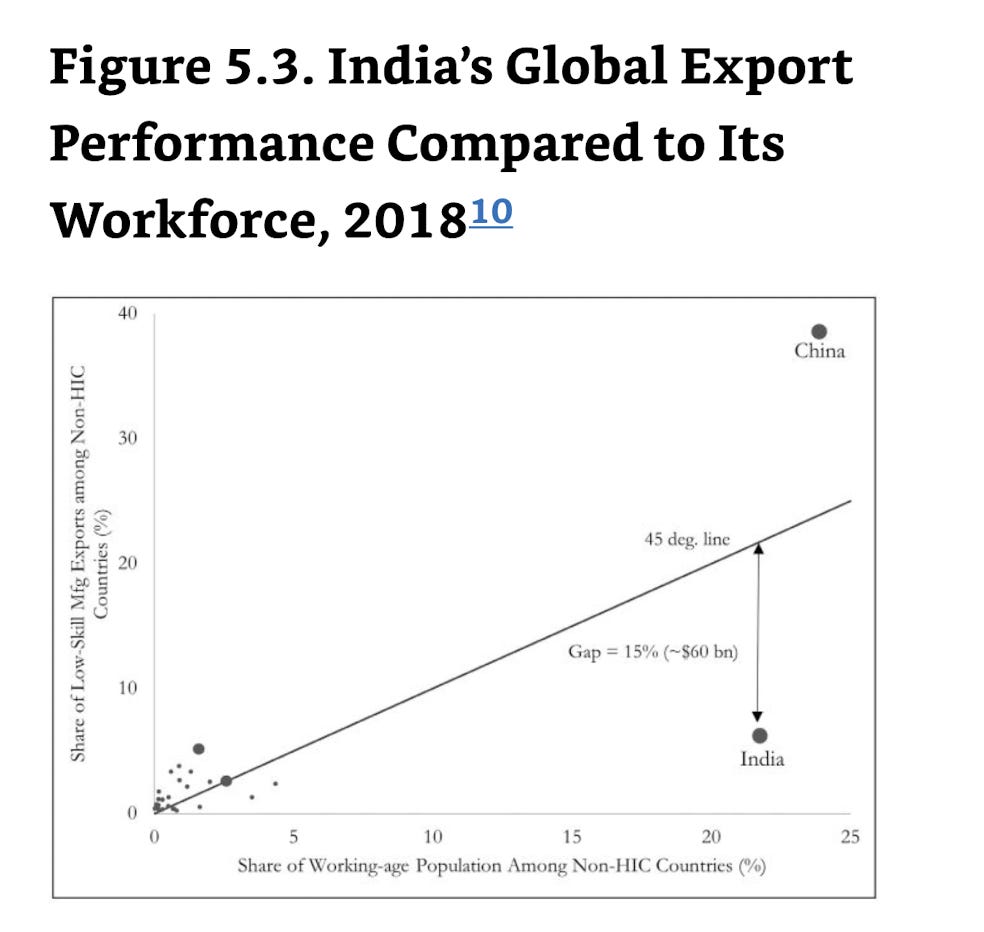
China is far above the line, but India, almost as large in terms of population, is no less anomalous, just in the opposite direction. As far as global populations are concerned, and the imagining of tens of millions of “squeezed” jobs, it is this Sino-Indian pair that account for a huge share of the action. What this graph reveals is not China’s cheating, but India’s “greatest development failure”, at least this is the argument made Arvind Subramanian, this time in co-authorship with Devesh Kapur, in their major book, A Sixth of Humanity. Independent India’s Development Odyssey which appeared with Oxford University Press earlier this year.
In this highly critical work on India’s development, China is repeatedly evoked, not to criticize but as a benchmark against which to illuminate what India’s political economy has not delivered i.e. large-scale formal employment for hundreds of millions of citizens.
Kapur and Subramanian leave no doubt, if you want to understand why China, not India was the main driver of manufacturing globalization from the 1980s, don’t look to slots opening up in the division of labour thanks to the liberal mindedness of advanced economies, look to the contrasting political economy of the Maoist PRC and India’s post-independence political economy. As Kapur and Subramian note:
The great divergence between China and India did not begin in 1978 with the Deng reforms—it was well underway by then.
In one of the great ironies of modern history, the conditions created by Maoism turned out to be a great launching pad for industrial globalization. As the comparison of India and China in 1980 makes clear, to imagine manufacturing would be equally distributed when populations are so differently endowed in terms of educational and nutritional is fanciful. Here is the data from Kapur and Subramanian, data which I explored back at the very beginning of Chartbook.
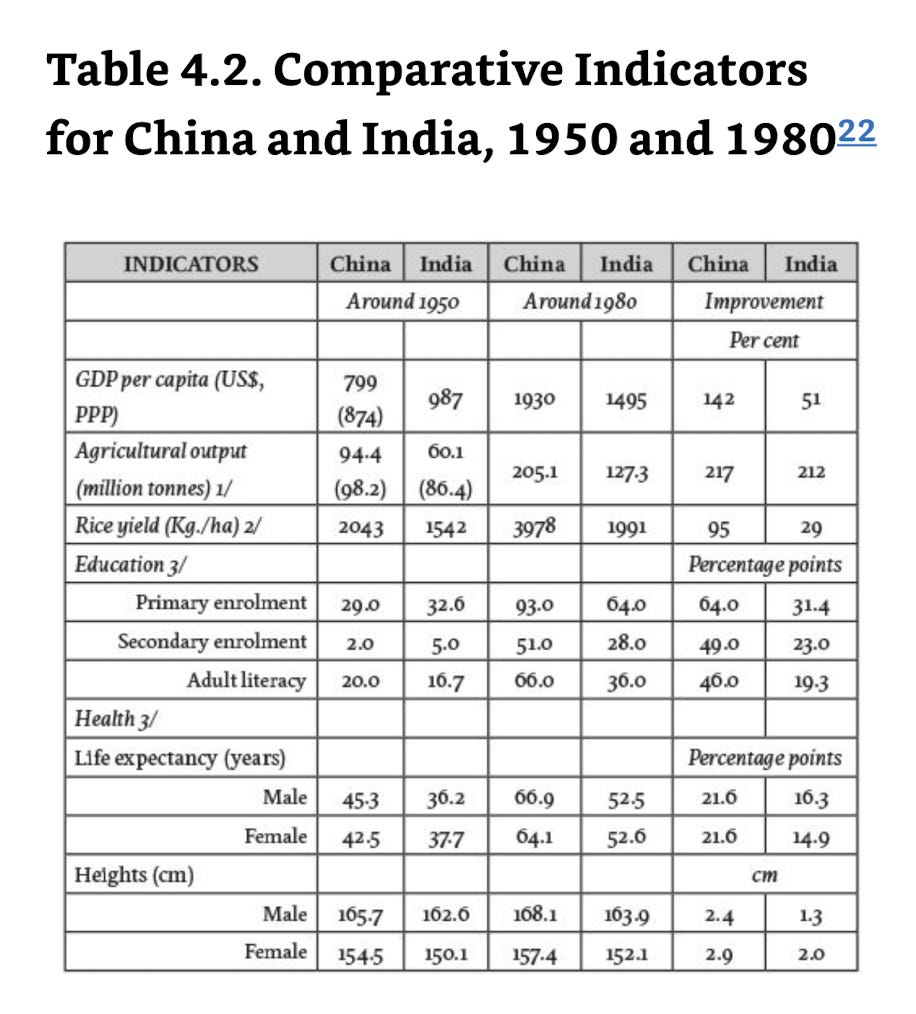
As Kapur and Subramanian insist, the striking fact is that even as India’s growth accelerated from the 1980s, structural change has not. Formal employment in India lags woefully behind. Why? As Kapur and Subramanian note, the path-dependent impact of India’s poor early start was devastating. The list of factors they mention is long and weighty:
We argue for a new five-fold explanation applicable at different stages of Indian history: in the initial stages, the legacy of two key pre-1980s policies, the neglect of agriculture and the strangling of the domestic private sector, were critical. The failure of broad-based agricultural growth militated against rural industrialization, which would have been devoted to satisfying local needs that would have necessarily been labour intensive. Then, when the boom came after 1980, the thicket of regulation and broader labour protections that were legislated prematurely in a nascent democracy, underpinned by a deep ideological aversion to private capital in general and big capital specifically, became a barrier to attaining the size that would be necessary to compete globally. Similarly, the reforms after 1991, while wide-ranging, did not quite encompass non-tradeable inputs critical to manufacturing, namely, land, logistics infrastructure and power. A combination of low investment (logistics infrastructure), regulation (land) and the continued monopoly supply by state governments (power), combined with residual socialism, kept costs at 75–100 per cent above efficient supply. These factors were compounded on the supply side by the government, which dominated the formal labour market and established exorbitantly high wages at the lower end of the skill spectrum. This made their employment in the labour-intensive sector by the private sector less attractive. Finally, when the services sector and its exports boomed, wages soared even further via a Dutch Disease effect: one successful tradeable sector killed and cannibalized another less-skilled tradable sector, namely, manufacturing. Thus, scarcity-inducing policies of the planning era, precocious democracy and a Gandhian aversion to size; inefficient, monopolistic supply of critical non-tradable inputs; the behemoth of government; and super-successful skill-intensive services successively undermined India’s unskilled labour employment opportunities. The employment failure seems to have been over-determined. … Less quantifiable but no less important are some of the sociological factors that have undermined manufacturing and factory jobs. Take the impact of the success of the IT sector—located in urban areas with better working conditions, such as air-conditioned offices, good schools for children and attractive entertainment options. It became a more attractive place for engineering and management graduates to flock to. … Consider manufacturing and female employment. Indian society makes it difficult for women to work, reflected in India’s unusually low female labour force participation (elaborated in Chapter XIII). Indian society, in particular the routine harassment of women in public spaces, makes it even more difficult for them to travel long distances to take up work.37 Combined with onerous regulations on creating hostels and dormitories for women—which, in turn, prevents multiple shifts of operation—factories need to be located in areas with a large female labour pool. While firms can take apparel plants to female labour or bring them to the plants by building large-scale dormitories, this raises costs. If there was a case for subsidies to encourage labour-intensive manufacturing, housing subsidies to build dormitories for women workers would be a good place to start.
All of this meant, that when opportunities did open up, in part thanks to adjustments in China, India was in no position to take advantage.
Here is the account of the 2020s from Kapur and Subramanian. It stands in dizzying contrast to the one-sided, “China squeeze” argument delivered in the Peterson and Foreign Affairs pieces:
In 2022, for example, India’s share of global exports in clothing (the canonical labour-intensive sector) was 3.1 per cent compared to 32 per cent for China. This is extremely disappointing because China started vacating export space in this sector after the Global Financial Crisis as its wages started rising; it then vacated further space in the aftermath of geopolitical developments that led investors to seek alternative investment locations. Between its peak and today, China lost about 7.5 percentage points of global export share (worth about $43 billion in 2022); over this period, India’s export share remained stagnant at 3 per cent, while that of Vietnam and Bangladesh rose by 3.5 to 4 percentage points. China’s loss did not translate into any gain for India in terms of low-skill exports and employment. Put differently, when the conditions for dynamism and prosperity were established after 1991, and even more tantalizingly when the global export opportunities opened up, it was as if India was a high-wage economy and only skilled labour could benefit from the dynamism. It had converted its physically abundant unskilled workforce into an economically expensive resource, penalizing its use.
It is not my mission here to argue for or against Kapur and Subramanian’s interpretation of India’s development trajectory. The point in this context is simply that the “China squeeze” such as it is can only be understood, in relation to the heavy burden of domestic constraints that Kapur and Subramanian so unsparingly enumerate. I am concentrating here on India because it is the great counterpart to China and the unspoken reference point of the “China squeeze” discourse. But the point is more general. Can anyone with a straight face suggest that the main problems afflicting the development of South Africa or Nigeria, the great centers of mass underemployment in sub-saharan Africa, are cheap competition from China driven by Beijing’s industrial policy and an undervalued RMB? Likewise, is the main problem of the American working-class the threat of Chinese competition or the manifest crisis of social reproduction in the United States itself?
The point here, as in the discourse around China shock 2.0 in Europe, is to insist that we should not normalize the world and pathologize China, without actually investigating what is going on in America’s industrial wastelands, the German car industry, or India’s lopsided labour market.
One-sided pathologization should be understood for what it is, a polemical gesture. Concepts like China shock and China squeeze are, what Reinhart Koselleck, following Carl Schmitt, would have described as “asymmetrische Kampfbegriffe”, or “asymmetrical counter-concepts” or “asymmetrical combat concepts”.
If the function of arguments like the “China squeeze” is to alert elites in the rest of the world of the need to rejuvenate and energize their development projects, so be it. But let us see the resulting discourses as the mobilizing interventions that they are.
Interestingly, a significant slice of China’s public sphere – the so-called industrial party – have been obsessed for the last twenty years with precisely these questions of counterfactual economic history. Since the mid 2000s, a massive online discourse developed around an alternative history in which Chinese techno-patriots were asked to imagine how they would proceed if they had the possibility of traveling back in time to transport modern technology into the Ming dynasty (1368-1644) thus averting the “great divergence” of the 18th and 19th centuries. It is a fantasy of course, but also a goad. The point was not directed at Westerners. The alternate history is dramatically nationalist, but few n the West had even heard of it until recently. The adherents of the industrial party are not liberal moralists. They don’t project natural ladders of international development and ask why others don’t cede space. They take the Realpolitik of global economic development for granted. Their pointe was directed against fellow Chinese. The rallying cry of the alternative narrative was this: Now that we are beginning to gain steam and push forward on our national development path, now that we are breaking out of the inferior position assigned to us even in the early years following WTO accession, do not lose yourself in humanistic imaginings about better futures. In the spirit of Deng, they called on China to embrace the hard truth of development.
Perhaps one might of the Industrial Party as a cultural trend born out of desire for symbolic revenge against those who had inflicted the century of humiliation. In terms of the various temporalities of the “China shock” – retrospective, prospective and counterfactual – one might think of the Industrial Policy discourse as truly speculative, conjuring up the China shock that never was. Or perhaps one might better think of it as imagining a world in which a powerful China was no shock at all, but simply a defining fact of modern history.
I love putting out Chartbook. I am particularly pleased that it goes out for free to thousands of subscribers around the world. But, writing this newsletter takes a lot of work. If you are enjoying it and would like to support the project, sign up for one of the subscription options here. It is the equivalent of a fancy cup of coffee per month!
Credit: Source link