Global crypto rally sends trading volumes soaring at Korean exchanges
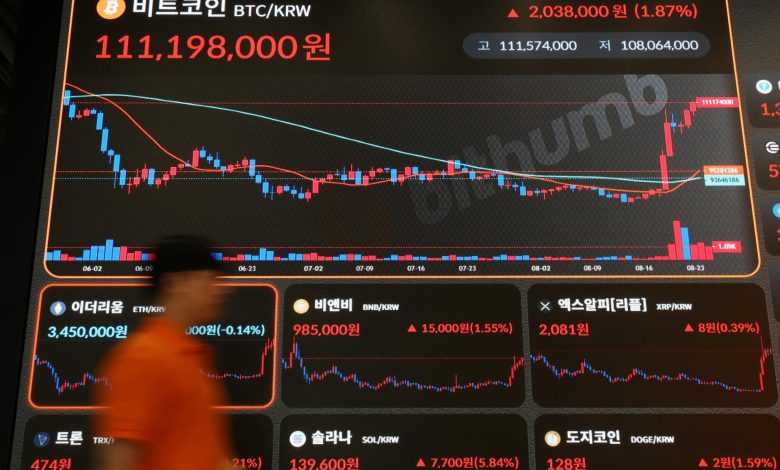
Bitcoin and other cryptocurrency prices are displayed at a Bithumb Lounge in Gangnam District, Seoul, Tuesday, as bitcoin tops the $80,00-mark for the first time since May. Yonhap
Trading volumes surged at Korean crypto exchanges in recent days after bitcoin and ethereum prices rebounded sharply, industry officials said Wednesday.
The rebound is raising expectations that the recovery in crypto prices will translate into improved fee revenue for local exchanges, which have suffered weak earnings amid a prolonged trading slump.
According to CoinMarketCap and other cryptocurrency data providers, daily trading volume on Upbit, the country’s largest crypto exchange, had hovered between 300 billion won ($217 million) and 600 billion won for a week before Aug. 20. It surpassed 1 trillion won on the afternoon of Aug. 20, when bitcoin approached $70,000, before reaching 4.61 trillion won as of 3 p.m. Saturday, nearly 10 times the level a week earlier.
Trading volume has since moderated but remained at around 2 trillion won a day.
Other won-denominated crypto exchanges also saw trading activity pick up over the weekend.
Bithumb’s 24-hour trading volume exceeded 2 trillion won as of 3 p.m. Saturday, while Coinone, Korbit and GOPAX also recorded higher-than-usual trading volumes of 157.7 billion won, 28.3 billion won and 800 million won, respectively.
Until early this month, the broader crypto market had been weighed down by weak trading activity, with major cryptocurrencies trading well below their previous highs.
In Korea, the prolonged downturn was exacerbated by funds shifting to the stock market, changes in the macroeconomic environment and delays in crypto-related legislation.
The prolonged slump also took a toll on earnings, with operating profits plunging 79.7 percent year-on-year at Dunamu, which operates Upbit, and 83.4 percent at Bithumb in the first half of the year.
However, the recent crypto rally has revived market activity.
Bitcoin surged about 22 percent last week, marking its biggest three-day gain since 2023. After hovering in the $60,000 range until mid-August, it climbed to an intraday high of $81,237.94 on Tuesday, briefly topping $80,000 for the first time since mid-May. On Wednesday, however, it edged lower on profit-taking, trading in the high-$70,000 range as of 11 a.m.
The rally has been driven by expectations of easing U.S. regulatory uncertainty and improving liquidity. The U.S. Securities and Exchange Commission’s clearer rules for token issuance and President Donald Trump’s push for the CLARITY Act, a bill aimed at establishing a regulatory framework for the crypto market, boosted regulatory optimism. Expanded Treasury buybacks also helped ease long-term yields and improve appetite for risk assets such as bitcoin.
“Crypto market sentiment has improved as regulatory uncertainty eases, the U.S. Treasury expands its buyback program and expectations grow that digital asset treasury firms will step up bitcoin purchases,” Kiwoom Securities analyst Shim Soo-bin said. “But bitcoin could face greater volatility this week as investors await key U.S. economic events, including the Jackson Hole symposium.”
The recent crypto rally has also sparked fiercer fee competition among domestic exchanges as they seek to attract more customers.
Coinone said Wednesday it would eliminate trading fees across all listed cryptocurrencies from 11 a.m. until further notice.
Digital X, which operates Korbit, had already launched a similar promotion Monday, offering zero-fee trading on all assets in its Korean won market through Aug. 24, 2027.
Major players Upbit and Bithumb are taking a more targeted approach, waiving fees for selected assets and trading products. Upbit has offered zero-fee trading on stablecoins such as Tether since July 26.
Industry officials expect the battle for market share among exchanges to intensify further as the sector moves toward greater regulatory recognition and broader use cases.
“A strong market position and ample liquidity are expected to give exchanges an edge in securing partnerships with companies in other industries,” an industry official said.