Stock market volatility: How investors are diversifying
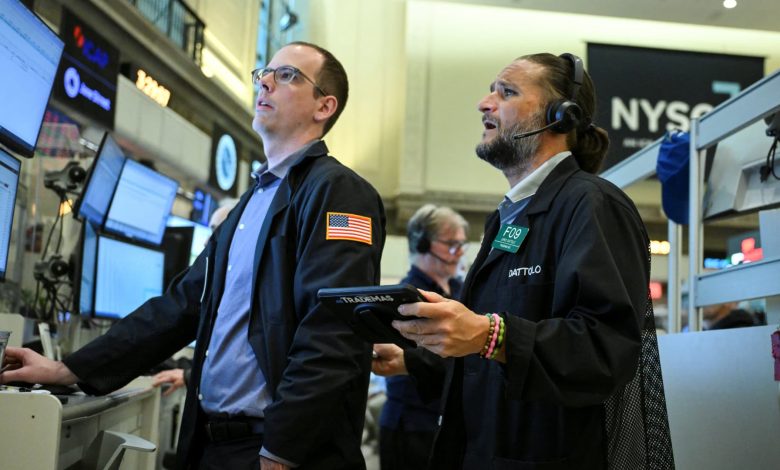
Traders work on the floor of the New York Stock Exchange (NYSE) in New York on July 23, 2026.
Angela Weiss | AFP | Getty Images
It has been a volatile year for global markets, rewarding some trades while punishing others.
CNBC asked six investors about the biggest risks they see and how they are positioning portfolios in response. Despite differing views on the biggest threat to markets, the investors repeatedly returned to the same response: diversify beyond this year’s biggest winners.
Fading U.S. exceptionalism
Chris Rush, investment manager at IBOSS, told CNBC the biggest risk investors were taking was being “too concentrated in the winners of the past and missing other opportunities around the world.”
“It is easy to focus on the short-term noise,” he said. “But with U.S. equities already making up such a large proportion of global portfolios, we think concentration is a bigger risk. U.S. exceptionalism has also started to fade from the levels seen before 2025, while rising debt levels among the Magnificent Seven add to the risks of continuing to chase the same companies.”
Real estate investment trusts, which Rush said “have been out of favor for years but now look increasingly attractive” from a valuation perspective, were one asset his team are using to broaden portfolios, alongside U.K. equities, and stocks listed in Asia and emerging markets.
“Investors have understandably been focused on the AI winners in Korea and Taiwan, but China has performed particularly well during the most recent pullback and we think it remains well positioned,” he said.
‘Don’t die trying to be a hero’
Ben Kumar, head of strategy for wealth, investment and public policy at British asset management firm 7IM, told CNBC the big challenge for investors this year “hasn’t been managing overall volatility, it’s been managing specific volatility.”
“The winners and losers have kept chopping and changing,” he explained. “Overall, the wins have been bigger than the losses … but being too exposed to any one theme, sector or style has been very tricky.”
Kumar noted that energy stocks have been the best and worst performers twice this year, as have IT stocks.
“Everything has worked at some points, nothing has worked at all points,” he said. “Diversification has helped hugely — across sectors and regions. And if, like us, you’re prepared not to go all in on winners (and risk being a loser), it’s been a pretty good year.”
“You don’t need to be a hero in this market — just let it work for you, and keep your exposures broad,” he added. “Don’t die trying to be a hero.”
Complacency warning
London-based Ben Seager-Scott, chief investment officer at Forvis Mazars, told CNBC “two powerful forces” — the Iran war and strong U.S. corporate earnings — were pulling markets in opposite directions, and that markets risked becoming complacent around events in the Middle East, inflationary pressure and shifts in the AI trade.
“In terms of our portfolios, it has been more about finessing — we have cut back some of our equity risk overweight (whilst remaining marginally overweight) and have rotated more out of the mega-cap technology names into ordinary U.S. stocks, mostly by shifting from market cap weighted exposures to equal weight exposures,” he said.

Equities and government bonds have swung sharply this year, rewarding some trades while punishing others.
‘Uncomfortable trade-off’
Charlie Ambler, co-chief investment officer and partner at Saltus, said the biggest risk to portfolios in his team’s view is a policy bind around interest rates.
“Central banks are struggling to bring long-term rates under control at precisely the moment the economy is absorbing a massive AI infrastructure buildout, which is capital-hungry and inflationary at the margin,” he said. “The problem is that the required tonic, raising short-term rates, has become harder to pull.”
Policymakers have been left with “an uncomfortable trade-off” between controlling inflation and maintaining financial stability, he said — and portfolios “need to be positioned for the possibility that they don’t get it cleanly right.”
Ambler also said his team’s response to the uncertainty was to “broaden out.”
“Rather than concentrating risk in the areas that have driven recent returns, we’re widening our exposures across equities, fixed income and alternatives,” he told CNBC. “Within alternatives in particular, the focus is on assets whose returns don’t simply move in line with equity and bond markets.”
Steve Brice, global chief investment officer at Standard Chartered, said the biggest cyclical risk is that something disrupts the global AI boom, while the biggest structural risk is the outlook for fiscal policy and inflation.
Brice cautioned against taking a “barbell approach” to the current market of investing heavily in growth areas while holding excessive cash.
“While the former has been very profitable, the latter is sub-optimal in our opinion as this area is likely to see purchasing power being eroded,” he told CNBC. “Therefore, we argue for investors to have a more diversified portfolio by increasing their allocation to other areas of equities — such as developed market financials and euro area industrials — and ensuring portfolios are buffered by allocations to both bonds, gold and other alternative asset classes where possible.”

Why AI spending could force the next rotation
Billy Leung, an investment strategist at Global X ETFs, said markets are currently running “two live risk debates in parallel.”
“On the acute side, the Strait of Hormuz situation remains unresolved … so the geopolitical premium in oil is not going away quickly,” he told CNBC. “But the more durable risk sits with AI capex. The scale of financing now being committed to AI infrastructure build-out, well into the hundreds of billions, is reviving a genuine debate about circular financing structures and weak free cash flow conversion across parts of the AI ecosystem. That is the risk with the longer tail, because unlike a geopolitical shock, it does not resolve on a single headline.”
Leung said positioning data showed equity investors were not taking a particularly defensive stance despite resurging bouts of volatility — and that “if anything it looks under-hedged.”
“Implied volatility across major indices and ETFs has been drifting down toward one-year lows, and skew is sitting near the bottom of its range, which points to broad-based bullishness rather than fear,” he said. “On sector rotation, the clearest beneficiaries have been data center-linked industrials, energy and travel, while healthcare, staples and real estate have lagged.”
According to Leung, the trigger most likely to force a real repositioning is AI capital spending durability rather than macroeconomic data signals.
“There is a growing and legitimate debate about whether the sheer scale of AI-related investment is starting to crowd out other forms of capital expenditure in the economy, and separately whether the financing structures underpinning that build-out can support the free cash flow gap over time,” he said. “If that debate starts showing up in guidance or financing costs rather than staying theoretical, that is what forces a rotation, not a broad AI selloff, but capital moving away from pure infrastructure plays toward names with nearer-term monetization.”